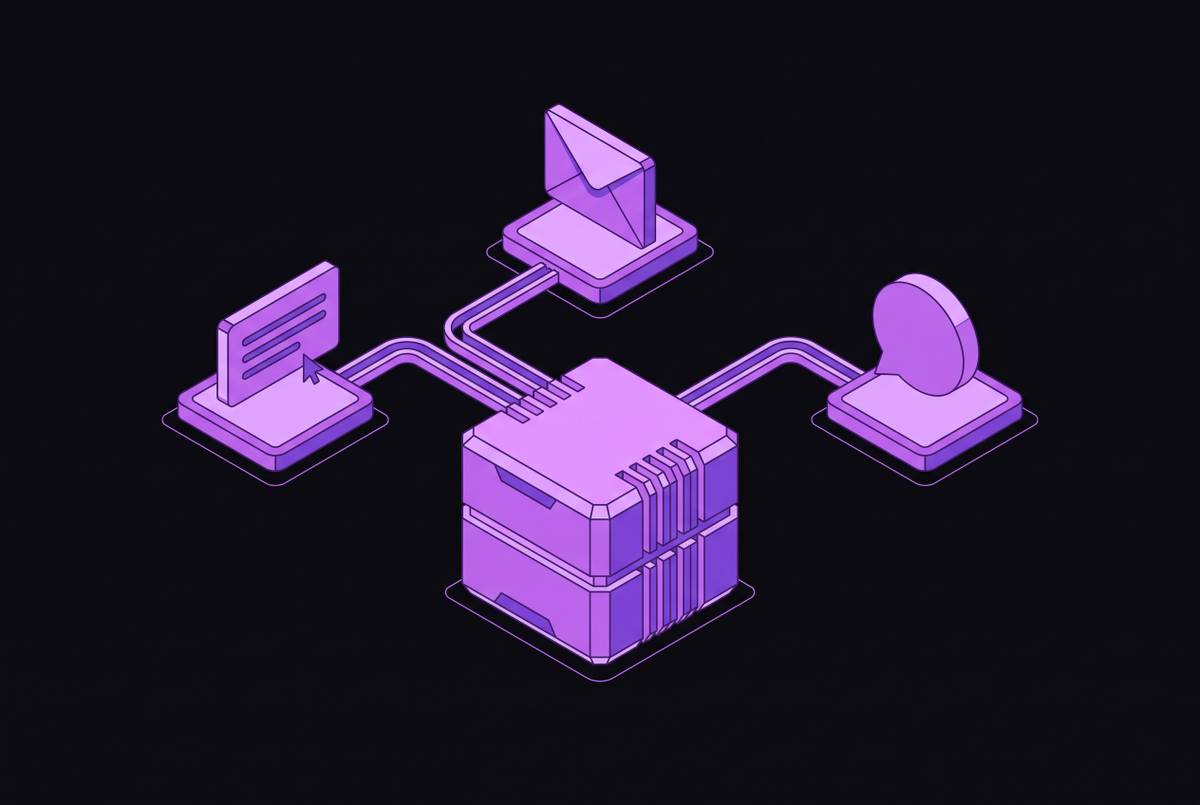
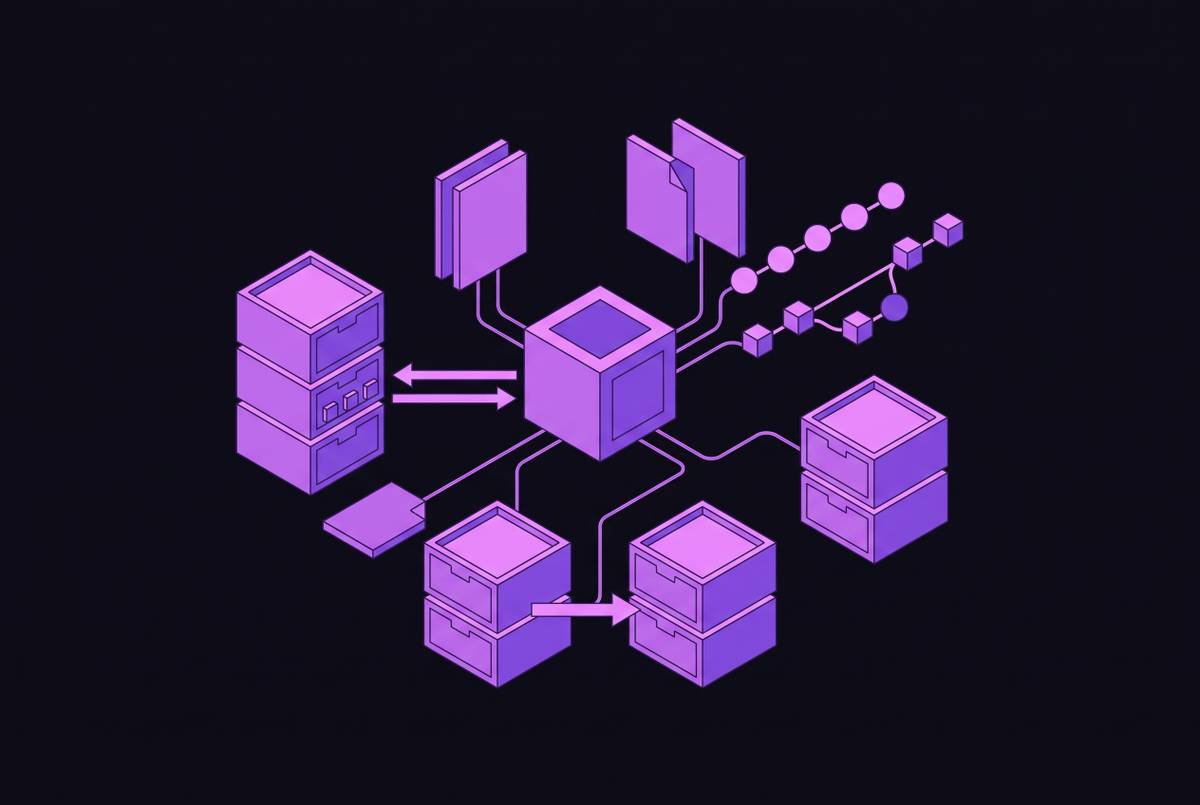
Webhook Ingestion Architecture for Event-Triggered Agents
Webhooks let agents react instantly instead of waiting for slow polling cycles.
Webhook ingestion decides whether an event-triggered agent fires when something happens, or sits there waiting on a poll cycle that's already too slow. The architecture looks trivial on paper: receive a POST, do something with it. Get the layering right and the agent is reactive in the true sense. Get it wrong and it's fragile in ways that appear only once production traffic hits it. Webhook Ingestion Architecture for Event-Triggered Agents.
Why webhooks exist: the polling problem agents outgrow
Polling means an agent asks the same question over and over: anything new yet? It repeats that check on a fixed interval, whether or not anything actually happened.
That interval sets a hard ceiling on how fast an agent can react. Worst-case lag in practice runs anywhere from 30 seconds to 5 minutes, depending on how the poll is scheduled. Webhooks skip that ceiling entirely. A source system fires the event and the agent hears about it in near-instant time, milliseconds up to a few seconds, a different latency class entirely.
There's a cost angle too, and it matters more as usage-based LLM pricing spreads. Empty polls aren't free. Confluent's research puts event-driven architectures at a 70 to 90 percent latency reduction compared to polling-based systems, and that figure should be read as a floor, not a ceiling, because it's measured against polling implementations that are already reasonably tuned.
The real problem appears at scale. One agent polling one data source is annoying but survivable. Ten agents polling ten sources each compounds fast, and polling traffic that was tolerable at small scale turns into a real infrastructure bottleneck once agent count and data-source count both grow. Webhooks flip the resource model entirely: the source pushes when something happens, the agent stays dormant otherwise, and compute tracks actual event volume instead of poll frequency.
That flip sounds almost too simple. Receive an HTTP POST, take action. Almost every production failure in webhook-driven agent systems starts exactly at that point, because "receive and act" hides a half dozen decisions that determine whether the system holds up under real load.
What a webhook is in an agent context, and what it is not
APIs and webhooks point in opposite directions, and confusing the two is the first mistake to rule out. An API is the agent's outbound arm: it pulls data or triggers an action whenever the agent decides to ask. A webhook is inbound. Some external system pushes an event into the agent's workflow on its own schedule.
A concrete pair makes the distinction stick. An agent calling the Stripe API to create a charge is outbound, the agent initiated it. Stripe sending a payment_intent.succeeded event to the agent's endpoint afterward is inbound, Stripe initiated that one. Same integration, two completely different traffic directions, and each needs its own handling.
Think of the webhook as a tap on the shoulder. Your fine-tuning job finished. A new lead just signed up. The file finished processing. The agent doesn't need to ask, because the world tells it.
Webhook payloads are usually thin. They're notifications, not full data snapshots, and that's by design, not a limitation to engineer around. A payment_intent.succeeded event tells the agent that something succeeded; it doesn't necessarily hand over the entire object state. That means the agent has to acknowledge the webhook fast, then go fetch the full object from the source API on its own time. That one design choice shapes the entire ingestion architecture downstream: fast ack, async hydration, always.
It's not an event streaming platform. Kafka and Pulsar are durable logs that support replay, SQS and RabbitMQ are durable queues with limited or no native replay, and a webhook is neither, it's a point-to-point HTTP POST that fires once and moves on. Different volumes, different guarantees, different problems solved. And a webhook ingestion layer is not an agent framework. LangGraph, CrewAI, and AutoGen decide how an agent reasons and orchestrates its steps once it's running; webhook ingestion decides whether it runs at all, and when. Confusing the two leads builders to look for retry logic and idempotency in the wrong layer of the stack.
The four ingestion patterns and when each one applies
Direct webhooks are the simplest pattern: a source sends an HTTP POST straight to the agent's URL. Lowest complexity, fewest moving parts, and the right choice for a single-agent trigger like classifying a document the moment it lands in a folder. Most builders start here, and for a lot of workloads, this is also where they should stay.
The advantage is replay: if an agent goes down or needs to catch up on history, the stream supports replay for debugging, training, or catching up after downtime. That makes it the right fit for high-throughput workloads or anything where history matters as much as the live signal.
Choreography is a multi-agent pattern with no central controller. Agent A finishes a task and emits a task.completed event; Agent B is listening for exactly that and picks up the next step. Nobody's directing traffic from above, coordination emerges from each agent reacting to what the last one emitted. It's elegant when it works and genuinely tricky to debug when it doesn't, because complexity emerges from a chain of simple interactions rather than living in one place.
The fourth pattern is newer and less common: pushing an event directly into an agent that's already mid-execution, rather than spawning a fresh run for every event. It's flagged in current research as an emerging approach rather than a settled one.
Picking between them isn't complicated once volume and coordination needs are clear. High throughput or a need for replay points toward streaming. Multiple agents that need to hand work to each other point toward choreography. A single source feeding a single agent should start with direct webhooks, full stop. That last pattern, direct webhooks landing on an agent's endpoint, is also where the majority of production failures actually happen, which is why it's worth walking through in detail.
The queue-first rule: why you must separate reception from processing
LLM calls are slow. Not slow like a database query, slow like seconds, sometimes tens of seconds, depending on the reasoning chain. Webhook providers were not built with that in mind. They expect a response in the range of seconds, and holding the HTTP connection open while an agent reasons through a response is a direct path to a timeout.
Timeouts don't just fail quietly. Providers treat a timeout, or any non-2xx response, as a delivery failure, and delivery failures trigger retries, often repeated ones. So the slow response doesn't just delay one event, it multiplies it. A system that was already struggling to keep up with the first delivery now faces cascading delivery failures and retry storms that amplify the original load.
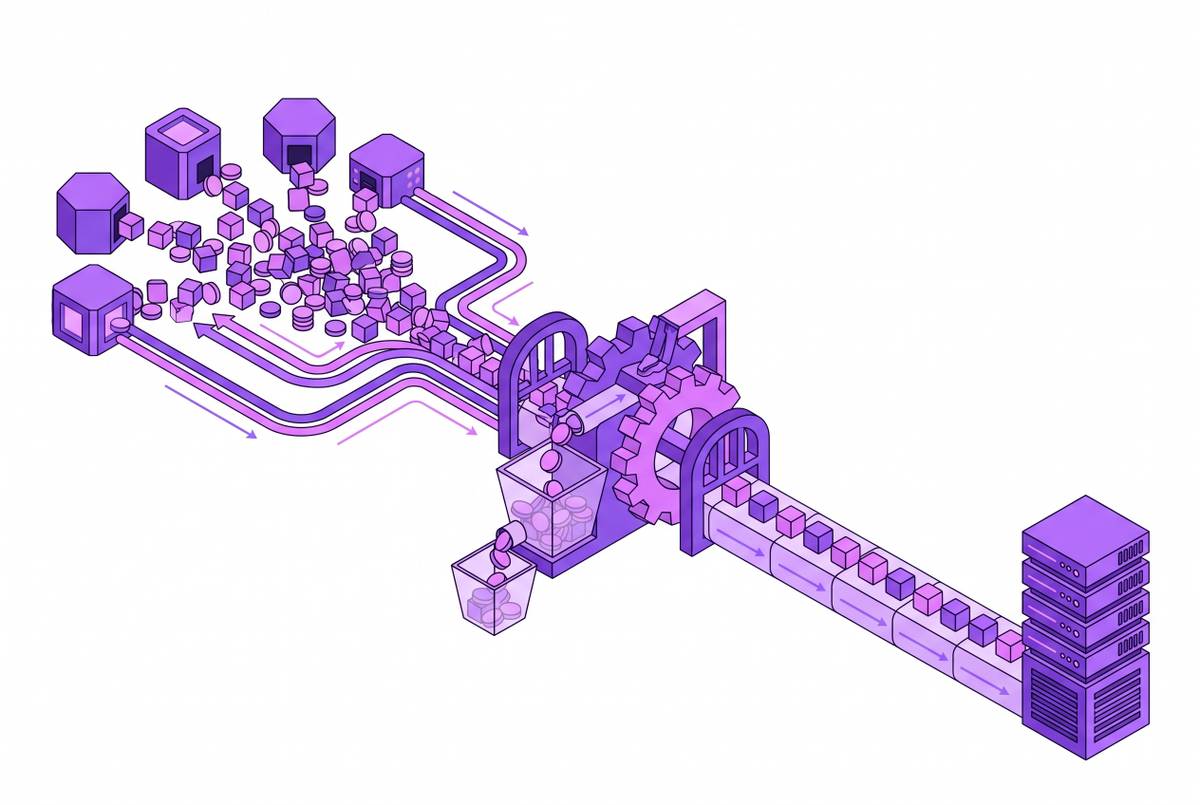
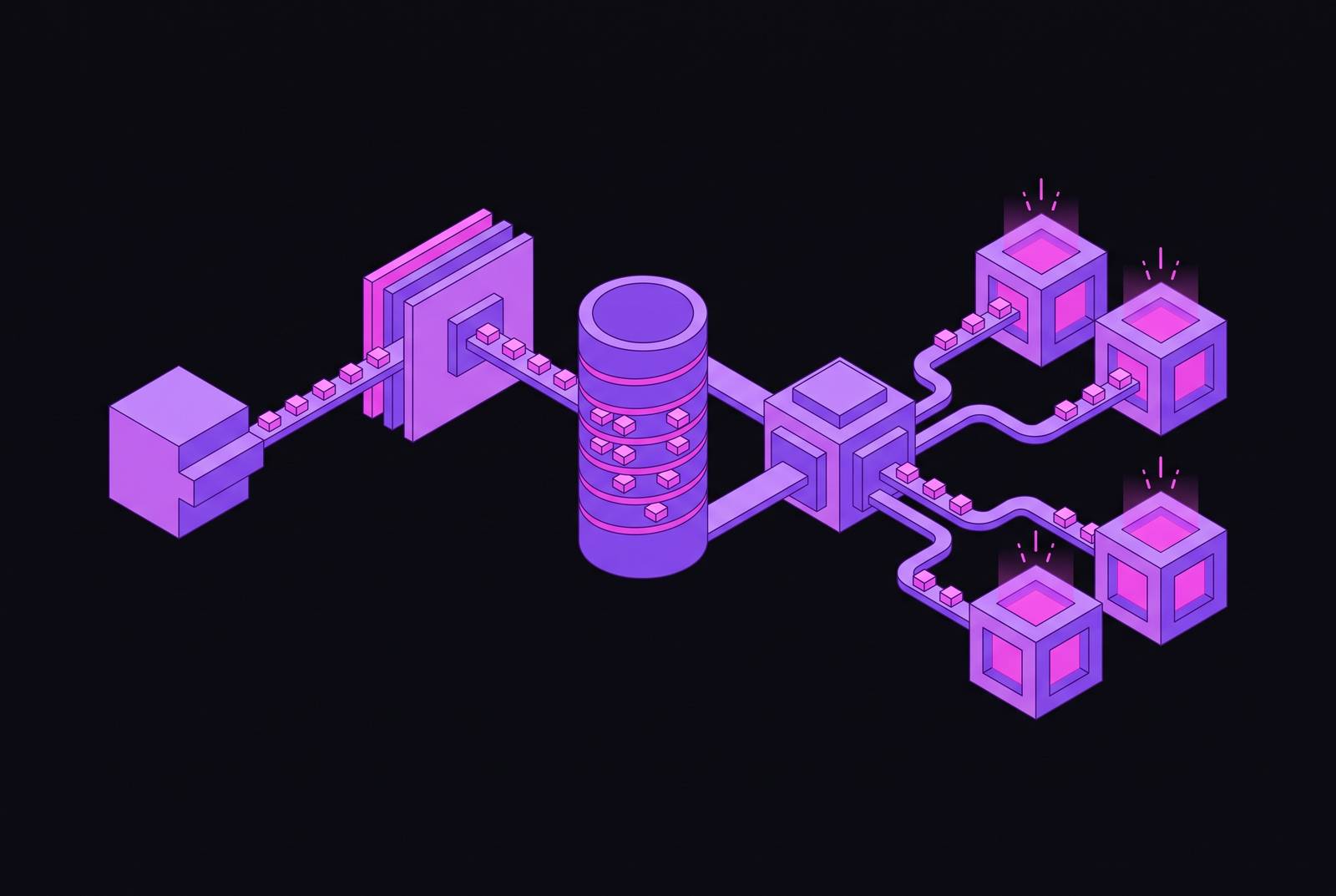
The fix is a queue-first pattern, and it becomes necessary once real traffic hits the system. Validate the incoming request immediately, write it to a queue, Kafka, SQS, RabbitMQ, or Pulsar all work, return a 200 within milliseconds, and let a separate worker pull from that queue and invoke the agent asynchronously. The webhook endpoint's only job becomes: confirm the signature, park it on the queue, say thanks. Nothing about agent reasoning happens on that request thread at all.
Decoupling ingestion from processing buys headroom against traffic spikes and slow agent runs. The ingestion layer never blocks on how long the agent takes to think. A traffic spike gets absorbed by the queue instead of by the provider's retry mechanism. The agent processes at whatever pace it processes, and that pace stops being anyone's emergency.
Skip this step and the failure mode is specific and ugly: a burst of events arrives, the LLM response is slow that day, or a model call times out, and the result is a cascading wave of retries that amplifies the original load rather than absorbing it. Everything covered in the next three sections, idempotency, signature checks, tenant routing, only works reliably once this queue boundary exists. Bolt them onto a synchronous endpoint and they'll fail under the exact same load conditions that break the endpoint itself.
Idempotency: the failure mode that costs real money before anyone notices
A specific scenario happens constantly and is entirely avoidable, so it's worth walking through here. An agent listens for Stripe's payment_intent.succeeded event and triggers a provisioning step when it arrives. In testing, one event comes in, provisioning runs once, everything looks fine. In production, an agent processes a Stripe payment_intent.succeeded event and triggers provisioning; it works in testing, but in production it fires twice or three times because Stripe's retry logic was never accounted for. Provisioning runs two or three times. By the time anyone notices on Monday morning, it's added up to hundreds of dollars in duplicate charges or duplicate resource spin-up.
The behavior sits within Stripe's retry design, working exactly as intended. Providers have no way to know an event was handled unless the receiving endpoint returns a fast 2xx; absent that confirmation, retrying is the responsible thing for them to do.
Processing the same event any number of times has to produce the exact same outcome as processing it once, which is the idempotency contract.
Implementing it isn't exotic. Deduplicate on the event's unique ID, either with a database lock or a Redis key set with a TTL⟧c22⟧. Write that event ID to a processed-events table before taking the action it triggers, not after, so a retry that arrives mid-processing sees the record and bails out instead of running twice. Check first, act second. That ordering is the entire trick.
The blast radius scales with what the agent is allowed to do. A duplicated log line is a shrug. A duplicated payment, a duplicated provisioning call, a duplicate customer email, those are the ones that appear as line items somebody has to explain. Anywhere money or irreversible external actions are involved, idempotency is the whole ballgame, not a nice-to-have. And to be clear about where responsibility sits: the queue delivers the event, but idempotency is the worker's job. Neither layer substitutes for the other, both have to be there.
Signature verification: keeping fake events out of your agent
A webhook endpoint is a public URL. Anyone who discovers the webhook endpoint's publicly accessible URL can POST to it, and without a verification step, the agent will process fabricated events as real ones.
That's not an abstract risk. A fabricated event triggers the exact same downstream actions a real one would, API calls, provisioning, emails, database writes, because the agent has no basis to treat it differently unless something checks first. The endpoint doesn't know it's being spoofed. It just sees a POST that looks like the shape it expects.
Every major provider solves this the same way: sign the payload with a shared secret and attach the signature as a header. Stripe uses Stripe-Signature, GitHub uses X-Hub-Signature-256, Slack uses X-Slack-Signature. The receiving side recomputes the signature from the raw body and the shared secret, and compares.
Verification has to happen on the raw request body, before anything parses it or hands it off anywhere else, because parsing first and verifying second leaves a window where a malformed or unverified payload could already be doing something. The correct sequence, spelled out: receive, verify signature, enqueue, return 200, process asynchronously. It is never an afterthought bolted on once something goes wrong.
That shared secret is a credential like any other, and it needs a rotation policy. A secret that's never rotated turns the endpoint into something that stays permanently exposed the day that secret ever leaks. And local development deserves the same rigor as production. The verification path that protects production should be exercised in dev too, through a tunnel tool or a provider's test mode, rather than bypassed for convenience during testing.
Per-user routing: why multi-tenant agent systems need more than a shared endpoint
A single shared webhook URL serving every customer sounds efficient until the second customer signs up. Without explicit routing logic, an event can land against the wrong agent, the wrong context, or worse, the wrong customer's data.
Paragon's 2026 guide on multi-tenant integration states that the requirement is storing and refreshing credentials per customer, mapping every event and every action back to the correct tenant, and never letting one customer's data bleed into another's context, and this layer usually gets ugly fastest. Routing isn't a detail to handle later, it's usually where multi-tenant systems either hold together or don't.
A few approaches handle this at different points on the complexity curve. Provisioning a unique webhook endpoint per customer at onboarding is the simplest to route correctly, though it gets harder to manage as customer count climbs into the hundreds. A shared endpoint that carries a tenant ID in the payload or a header keeps things to one ingestion URL, with the worker extracting the customer identifier and dispatching to the right agent sandbox. An event bus with per-tenant topics or per-customer partitioning, SQS or Kafka set up that way, gives the strongest isolation, at the cost of the highest operational complexity.
Getting the event to the correct agent isn't the finish line, either. Once it arrives, that agent's state, its files, its credentials, all need to be scoped to that one customer, because routing to the right destination means nothing if the destination is a shared pool where state can bleed across tenants. The cleanest setups provision the sandbox and register the webhook route in the same onboarding step: a customer signs up, their agent endpoint exists, and events start flowing immediately, with no gap where routing exists but isolation doesn't.
The proactive-reactive hybrid: combining webhooks with scheduled heartbeats
Webhooks only cover what a provider knows to tell you about. A delivery that silently fails, a state change the provider never emits an event for, that's just missing, and pure webhook reliance leaves an agent unaware it happened at all.
The fix is a heartbeat: a cron job that sends a scheduled POST to the agent's own webhook endpoint on a regular interval. The agent receives it and does an audit, unresolved tickets, pending reviews, records that look stale, then acts on anything that shows drift. It's a deliberate check-in layered on top of the event-driven flow.
What the heartbeat actually catches: events the provider tried to deliver and failed to, state that drifted without any event ever firing for it, and periodic reconciliation against the source API for anything the live stream simply missed. None of those occur if the system only ever reacts to what arrives.
This isn't backsliding into polling, even though a scheduled trigger might look like one at first glance. The heartbeat runs through the exact same async queue-to-worker-to-agent path a live event would take. Only the trigger source changes, the architecture underneath stays identical. How often it should fire depends on how much drift is tolerable: financial systems want tight intervals, a content pipeline can get away with looser ones. And because provider payloads are often thin to begin with, the heartbeat doubles as the natural moment to hydrate full object state for anything that only ever arrived as a notification.
Webhook infrastructure tooling that handles the plumbing layer
Standard HTTP servers were never built for this mismatch: a provider expects a response inside a couple of seconds, while a reasoning agent might take tens of seconds to produce one. That gap is structural, and it's why a small category of tooling has grown up specifically to sit in between.
Hookdeck operates as a dedicated event gateway between providers like Stripe, Shopify, and GitHub and the AI systems consuming their events. It handles automatic retries, rate limiting, and request buffering, and if the downstream AI service is down, it holds events and replays them once the service comes back. Its event log visibility is a real strength. It's built for ingestion, not for orchestrating what happens after.
Trigger.dev takes a different angle: a TypeScript-native background jobs framework with durable functions that run with no execution timeout at all. It turns a webhook receipt into a long-running job that's fully detached from the HTTP request lifecycle, so a slow agent run never risks a timeout in the first place. It's open-source, available self-hosted or on a managed cloud, and it assumes comfort with TypeScript.
Svix runs the other direction: webhooks-as-a-service for the sender side. It's the right fit for an AI platform that needs to notify its own customers, an agent task finished, say, rather than one consuming someone else's events. It comes with enterprise-grade signature verification and a customer-facing delivery portal.
Fastio leans into file and storage events specifically, with a WebSocket feed, activity polling, and outbound webhooks, which fits agents built around large assets like video, audio, or bulk datasets.
None of these compete head-to-head so much as split the problem by where the actual bottleneck sits. Reliable buffering of inbound events points toward Hookdeck. Long-running jobs that can't be timeout-constrained point toward Trigger.dev. Delivering webhooks out to your own customers points toward Svix. Whichever gets chosen, it handles the plumbing, buffering, retries, signatures, and none of it replaces the sandbox, the per-tenant routing, or the idempotency check. Those still have to be built.
Integration infrastructure: connecting agents to the apps that generate events
Wiring one agent to one API is a weekend's work. Making that same connection hold up reliably, securely, and per-customer, across every tool a growing customer base wants connected, and keeping it working when a provider quietly changes an endpoint, is an entirely different scope of problem.
Paragon's 2026 guide lists what the integration layer actually has to carry: multi-tenant credential storage, token refresh scoped per customer, per-tenant event mapping, retries with backoff, idempotency, dead-letter handling, and reconciliation whenever a sync drifts out of sync. None of those items is exotic on its own. Stack them across a few dozen integrations and the combination gets heavy fast.
Composio has built itself into a catalogue layer that sits at exactly this point. Per AutomationAtlas, it covers 1,089 toolkits, each mapped to one application, exposing more than 20,000 individual tools across them Automationatlas.io. Its supported app list runs past 1,500, spanning Gmail, Slack, GitHub, Google Drive, Notion, HubSpot, Salesforce, and Google Calendar among others Event-Driven AI Agent Architecture Guide (2026) | Fastio. The entire catalogue is reachable through a single MCP endpoint rather than requiring a separate server per application, which matters directly for the routing problem covered earlier: one governed connection point instead of a sprawl of one-off integrations to maintain.
Authentication sits at the center of what it actually does: managed OAuth flows, API key handling, token refresh, credential lifecycle management, and permissions scoped down to the individual connection. Most teams underestimate credential management until they're three months into supporting a few dozen customer integrations and realize it alone has become a full-time job. Getting it handled at the integration layer is what keeps the rest of the ingestion pipeline, the queue, the idempotency check, the routing logic, actually able to do its job without drowning in per-customer auth edge cases first.
Sources
- Event-Driven AI Agent Architecture Guide (2026) | Fastio
- AI Agent Integration Infrastructure: 2026 Guide - Paragon
- How Developers Connect Webhooks to AI Agents, MCP Servers, and LLM Tools
- Webhooks vs Polling: Why Real-Time Integrations Matter in 2026 - DEV Community
- Webhooks at Scale: Best Practices and Lessons Learned
- Webhook Infrastructure: What It Takes to Receive and Send Events Reliably at Scale
- Every AI Agent Failure I've Debugged in 2026 was an Idempotency Problem - DEV Community
- What is Webhook Security: Securing SaaS Integrations in 2026