API Rate Limit Management for High-Frequency Agentic Workloads
Token-aware limits replace request counts to match what agents actually consume.
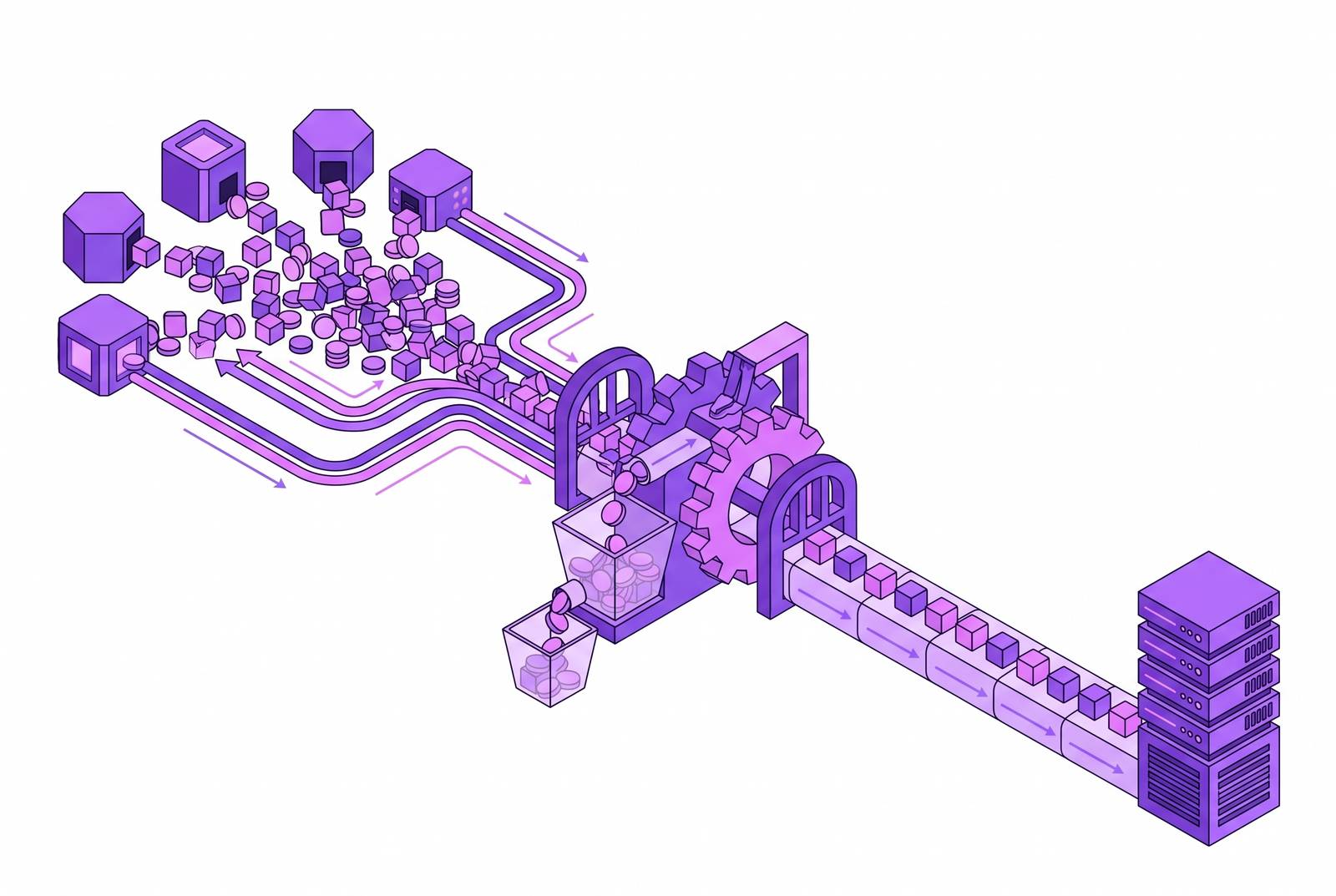
Rate limits built for web APIs count requests https://zuplo.com/learning-center/token-based-rate-limiting-ai-agents. AI agents don't spend requests, they spend tokens, and that mismatch is why fixed-window limiters keep breaking in production. Fixing it takes a layered setup: token-aware limits, backpressure signals, concurrency caps, and budget guards working together. Most teams get the fix backwards, they tune the limiter instead of changing what it counts, and that's why the errors keep coming back no matter how many retries they add. API Rate Limit Management for High-Frequency Agentic Workloads.
Why request-counting fails when a single agent task triggers 20–30 LLM calls
One HTTP request does not equal one unit of cost when you're talking about LLM inference. That assumption falls apart the moment an agent starts working, and no amount of retry tuning fixes it, because the counter itself is measuring the wrong thing.
A fixed-window limiter counts every call as a discrete, identical request. It has no way to know that a 50-token prompt and a 10,000-token prompt just tripped the same counter, even though the compute cost, latency, and provider bill for each differ by orders of magnitude. Counting requests instead of cost is the wrong unit entirely, and every symptom downstream, the false throttling, the surprise lockouts, traces back to that one bad assumption. It's the wrong unit entirely, and every symptom downstream, the false throttling, the surprise lockouts, traces back to that one bad assumption.
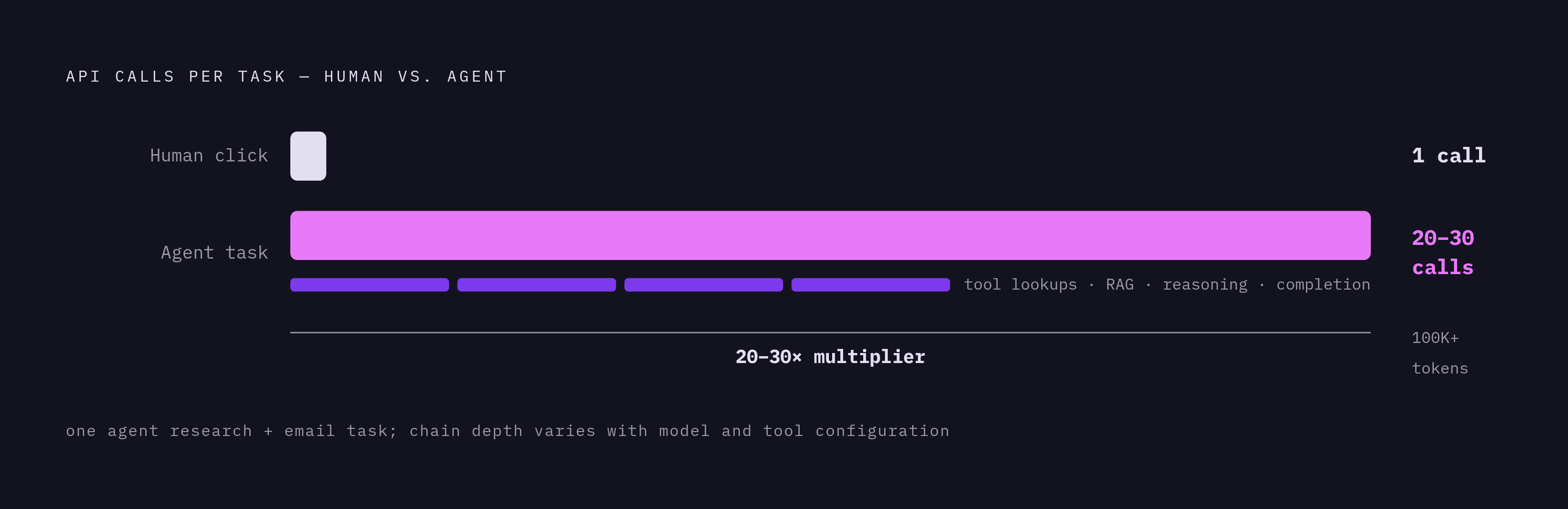
Then there's the shape of the traffic itself. Human users click, wait, read, click again. Agents don't pace themselves that way, they fire sequential chains as fast as the previous call returns, so the traffic lands bursty and largely unpredictable. A static threshold, built around steady human pacing, is wrong on arrival for this kind of load. A single agent task can chain 20–30 LLM requests (including tool lookups, RAG queries, multi-step reasoning, and a final completion), all counted as individual "requests" by a fixed-window limiter.
The multi-agent quota coordination problem that single-service retry logic cannot solve
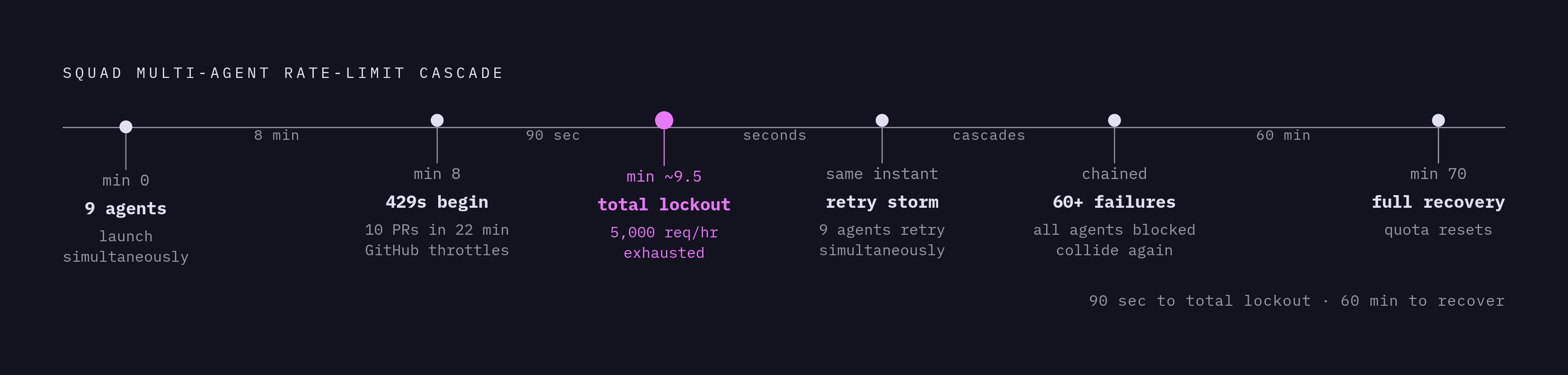
Tamir Dresher's Squad framework shows what happens when nobody plans for agent coordination. Nine agents shared one GitHub quota and one Copilot quota. All nine launched at once, and for eight minutes it worked, ten pull requests opened in 22 minutes, a solid pace, until GitHub started returning 429s https://www.tamirdresher.com/blog/2026/03/21/rate-limiting-multi-agent. Nine agents launched simultaneously, opened 10 pull requests in 22 minutes, triggered GitHub 429s at minute 8, and within 90 seconds the system had burned through GitHub's 5,000-requests-per-hour limit and was locked out entirely.
The lockout wasn't where it ended. All nine agents had received the same Retry-After header, so all nine retried at the same instant, collided again, and the wave grew instead of dying down. The incident log recorded more than 60 chained failures from that single thundering herd https://www.tamirdresher.com/blog/2026/03/21/rate-limiting-multi-agent.
Buried inside that failure is a subtler problem: priority inversion. One agent, doing background polling and low-priority issue triage, was eating quota that another agent needed for blocking architecture decisions. Both sat as equals in the retry queue, so the trivial work lined up ahead of the work that actually mattered. No amount of independent retry logic fixes this, because no single agent in the fleet can see what the others are doing or why. Retry logic answers "did my call fail." It has no way to answer "does my call matter more than the other nine".
Token-aware limits as the replacement unit of account for AI API traffic
The fix starts with changing what gets counted. Stop tallying HTTP calls and start counting resource consumption instead: tokens processed, compute time, actual cost incurred. That's the unit that actually maps to what a provider charges for and what a GPU spends its cycles doing.
What to track: prompt tokens (input, including system prompts and context), completion tokens (output), and total tokens, which most providers hand back in the response itself, OpenAI's usage.total_tokens field being one example.
Providers don't measure this the same way, and treating them as interchangeable is where teams get burned. Anthropic splits its limits into RPM plus separate input-token-per-minute and output-token-per-minute figures. Collapse that into one combined TPM number and the resulting picture misleads more than it clarifies. Cached reads generally don't count against the input-token limit on current Claude models either, which quietly raises effective throughput for any workload that reuses context heavily.
Budgets should scale with who's asking, not sit at one number for everyone. A free-tier developer running small experiments might get a ceiling of 10,000 tokens, while an enterprise running production agents at scale gets 10 million, and tying that ceiling to API key metadata means it enforces itself without a human checking anything. Count tokens, compute time, and cost. Stop counting calls.
Adaptive, algorithm-driven limiting: adjusting quotas dynamically rather than waiting for a 429
Fixed policy waits for a 429 to tell it something's wrong. That's backwards for agent traffic. Adaptive rate limiting adjusts quotas based on what the traffic is actually doing in the moment, which matters because multi-agent systems are irregular by nature and a static rule can't track that kind of movement.
Reinforcement-learning-based limiters push this further, watching traffic patterns and shifting limits as those patterns change. Early implementations report a 30% cut in false positives and a 25% cut in false negatives against static rules, and that gap matters in a concrete way: a false positive throttles legitimate work, a false negative lets a runaway loop burn through a budget before anyone notices.
Anomaly detection runs alongside this. ML models built for the job look at 27-plus behavioral features to tell a legitimate traffic spike apart from abuse or an agent stuck looping on itself, and that distinction matters most in multi-tenant setups where bursty traffic is the baseline, not the exception.
None of this is exotic once you see the shape of it. Off-peak hours, when a provider has spare capacity, are the right time to loosen token limits for agents that can tolerate a flexible schedule. Peak demand tightens the limits back down automatically, no human in the loop required.
Building a Rate Governor: the coordination layer that gives high-priority agents quota priority
The lesson from the Squad incident isn't about retry logic at all. Rate limiting in a multi-agent system is a coordination problem first, and coordination needs a shared authority that every agent checks before it spends quota, rather than nine agents each guessing independently that they have full quota available.
Call that shared authority a Rate Governor. It needs a few core pieces working together as one system. A shared quota tracker gives every agent the same view of what's left, replacing per-agent counters that can't see each other, the exact blind spot that let nine Squad agents each believe they had full quota available. A priority queue makes sure blocking, customer-facing work gets quota ahead of background polling, so the priority inversion that hit the Squad incident's low-priority and high-priority agents doesn't repeat. Backpressure signaling tells agents to slow down or pause when quota runs thin, instead of letting them queue up silently and flush all at once later. Dynamic reallocation lets idle agents hand quota back to the pool so agents under real load can draw on it when they need it most.
On a single machine, file-based quota coordination gets the job done. Once the system spans multiple nodes or serves multiple customer instances, that approach stops working outright, and Redis (Azure Managed Redis, specifically, for teams already on Azure) is the standard migration path, following multi-tenant rate limiting patterns already proven at scale. Redis-backed counters give every node the same shared state, and pub/sub handles telling agents when quota opens back up.
Exponential backoff, jitter, and the correct way to handle a 429 without making it worse
Retrying immediately after a 429 feels natural, and it's the wrong move. It burns API calls on requests almost certain to fail again, and it can trigger even stricter throttling or an outright ban.
Backoff alone isn't enough for a fleet of agents, though, and this is where most implementations quietly fail. If ten agents all compute the identical backoff schedule off the identical 429, they retry at the identical moment, and the herd reconvenes right on schedule https://www.tamirdresher.com/blog/2026/03/21/rate-limiting-multi-agent. Jitter, randomizing each wait interval slightly, breaks that synchronization so the retries spread out instead of colliding again.
Reading the right signal matters as much as getting the backoff math right. OpenAI returns remaining-requests, remaining-tokens, and reset-time headers on every response. Google Gemini returns a RESOURCE_EXHAUSTED error code instead, with limits that vary by request type. DeepSeek is its own case entirely: it uses dynamic concurrency caps, and a request can sit on an open HTTP connection or receive keep-alive lines before it finally gets a 429. Timeout handling has to sit alongside backoff here, not instead of it. The exponential backoff pattern waits 1s, then retries at 2s, 4s, and 8s, doubling each time up to a maximum typically of 32–64 seconds, and after a maximum number of retries typically of 5–7, it fails permanently and surfaces the error.
Budget guardrails and cost-based throttling: stopping runaway spend before it empties a wallet
Rate limits exist to protect the provider. Nothing about a rate limit protects the person paying the bill, and that gap is where the real damage happens: an agent stuck in a loop can rack up an enormous token bill before a rate limit ever kicks in, let alone before a human notices.
Cost-based throttling closes that gap by putting a dollar figure on every action and cutting execution off when the budget runs dry. It caps spend directly instead of hoping request counts happen to track it, which they don't, because request count and token cost aren't the same number.
A workable structure enforces per-task token caps tied to dollar ranges, backed by incremental cost tracking on every API response. Read the token counts off every response and add up the running cost in real time, rather than finding out what happened when the invoice lands.
Per-tool budgeting rounds this out, and the logic here is simple. An agent burning through unlimited file reads is cheap and usually harmless. An agent burning through unlimited web searches is not. Setting the ceiling low on the second while leaving the first mostly open reflects where the actual cost risk sits, not where it's easiest to measure. A per-day or per-org kill switch, recommended at 2–3× expected daily spend, halts non-critical traffic in under a minute.
Multi-provider load balancing and the real rate limits by provider in 2026
Splitting traffic across more than one provider is the most direct way to raise an effective ceiling, and treating any single provider's limit as a fixed constraint is the mistake to avoid. If one provider gives 10,000 requests per minute and another gives less, routing across both raises the fleet's effective ceiling instead of capping everything at the lower number https://zuplo.com/learning-center/token-based-rate-limiting-ai-agents.
Concurrency caps catch people off guard. Even when the requests-per-minute math looks fine on paper, a hard limit on simultaneous open requests creates a ceiling that no clever scheduling gets around within a single provider. DeepSeek's cap of 50 concurrent requests is exactly that kind of wall https://zuplo.com/learning-center/token-based-rate-limiting-ai-agents. Past that number, more API keys or another provider are the only way through, not smarter pacing.
Cost per token isn't the only number that matters when picking a provider, either. A provider charging more per token but offering meaningfully higher throughput can end up cheaper once queue management, infrastructure complexity, and the user-facing cost of latency all get counted. A cheap ceiling that gets hit constantly costs more in engineering time than a pricier one that never does.
Understanding the shape of the bucket determines how well an agent can exploit allowed bursts without tripping throttling. A bucket might permit 200 requests instantly, then throttle down to a sustained rate, something like 166 requests per second, for the rest of the minute https://zuplo.com/learning-center/token-based-rate-limiting-ai-agents. That structure rewards short, sharp bursts and punishes sustained hammering, which is exactly the traffic pattern an agent fleet needs to plan around rather than fight. Prompt caching cuts input costs by 40 to 90% on workloads that reuse context heavily, running at 10 to 50% of normal input token cost, and client-side deterministic response caching adds another 15 to 30% hit rate on top of that https://zuplo.com/learning-center/token-based-rate-limiting-ai-agents. OpenAI and Anthropic both discount asynchronous batch jobs 50% when they complete within 24 hours, which is the cheapest lever available for anything that doesn't need a live response https://zuplo.com/learning-center/token-based-rate-limiting-ai-agents. Watch the operational thresholds too: a 429 rate above 1% deserves an alert at 5%, quota utilization above 90% should trigger capacity planning before it becomes an outage, and average wait time above 2 seconds is already hurting the user on the other end https://zuplo.com/learning-center/token-based-rate-limiting-ai-agents. Groq's free tier caps at 30 requests per minute, GitHub's API is 5,000 requests per hour, and Copilot's quota runs 80 completions per hour, numbers worth knowing before a fleet of agents finds them the hard way https://zuplo.com/learning-center/token-based-rate-limiting-ai-agents https://www.tamirdresher.com/blog/2026/03/21/rate-limiting-multi-agent. Adaptive rate limiters report a 25% reduction in false negatives compared to static rules https://zuplo.com/learning-center/token-based-rate-limiting-ai-agents. ML models analyze 27+ behavioral features to distinguish legitimate AI agent traffic spikes from abuse patterns https://zuplo.com/learning-center/token-based-rate-limiting-ai-agents. It takes 90 seconds to burn through GitHub's 5,000 requests/hour limit and get locked out entirely after retry waves https://www.tamirdresher.com/blog/2026/03/21/rate-limiting-multi-agent. System-wide outage recovery after cascade amplification from a single GitHub secondary-rate-limit hit takes 60 minutes https://www.tamirdresher.com/blog/2026/03/21/rate-limiting-multi-agent. AI agents multiply request volume 10-50x compared to simple chat https://www.misar.blog/@synor/articles/ai-agent-rate-limiting. A research and email drafting task might generate 20-30 LLM requests and 100K+ tokens https://www.misar.blog/@synor/articles/ai-agent-rate-limiting.