Dead-Letter Handling for Failed Agent Task Queues
AI agents fail silently—traditional dead-letter queues won't catch them without redesign.
Traditional software fails loudly. An exception throws, a log fills up, a monitor fires an alert, someone gets paged. AI agents don't work that way: an agent can fail while its process stays alive, its heartbeat keeps ticking, and nothing in the system flags that work has actually stopped. Dead-letter queues have handled failed messages in distributed systems for years, but copying that old setup onto agent failures won't hold up, and treating it as a drop-in fix is the mistake most teams make first.
The scale of this is already documented. Trantorinc.com reported that 88% of organizations deploying AI agents hit at least one security incident in 2025, and that 84% of CIOs have no formal process for tracking AI accuracy; together, silent failure in agent systems is the common condition, not an edge case. An agent can "succeed" at a task while being completely wrong, and that failure surface stretches past infrastructure, timeouts, crashes, dropped connections, into something semantic. That changes what a dead-letter entry has to hold.
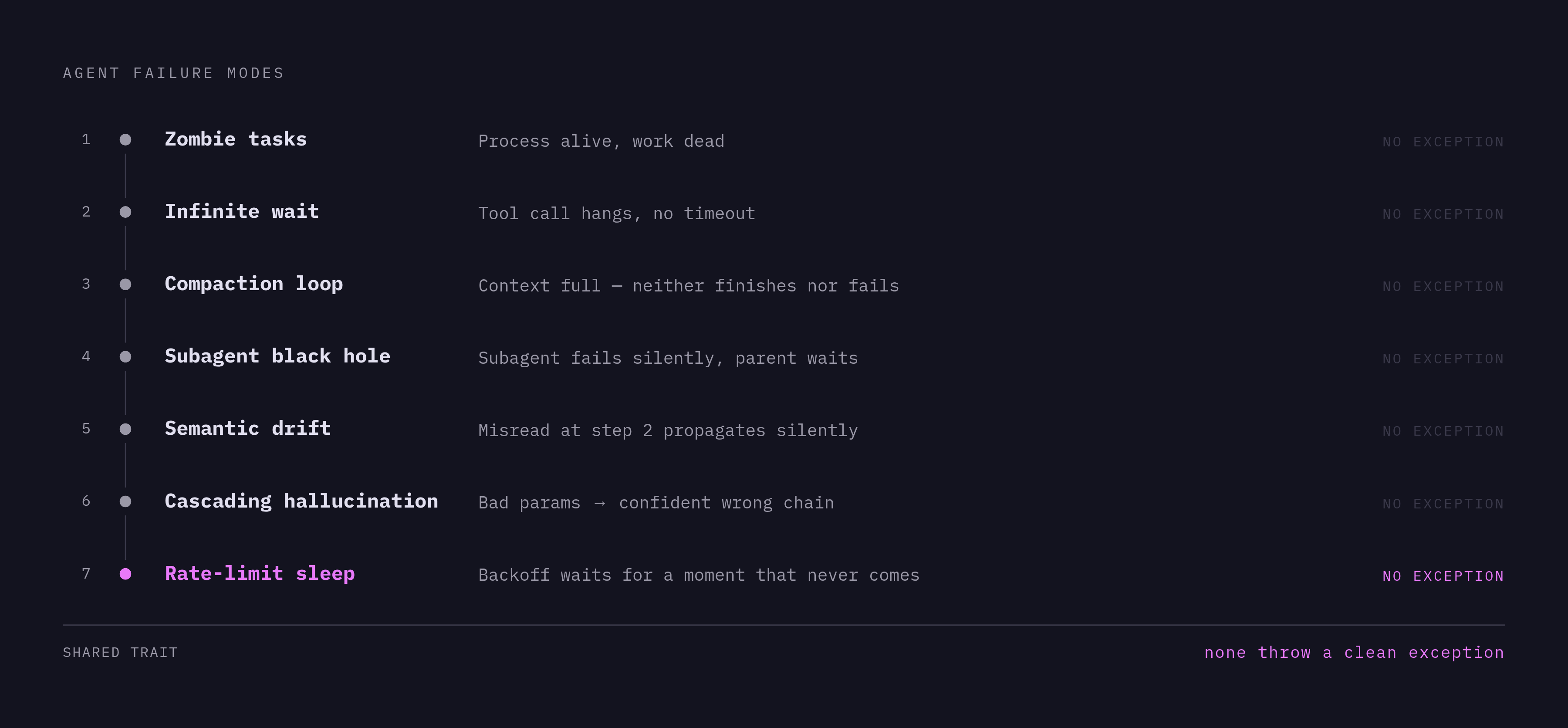
Before getting into design, the actual failure modes matter, because none of them map onto the "exception thrown" model DLQs were built for:
Zombie tasks occur when the process is alive, the work is dead, and no error appears in the system (a pattern described on dev.to).
- Infinite wait: a tool call hangs, and with no timeout configured, nothing triggers recovery.
- Compaction loop: the context window fills up, the compaction logic breaks, and the agent neither finishes nor fails, it just sits there.
- Subagent black hole: a spawned subagent fails without any signal, and the parent agent waits forever for a response that's never coming.
- Semantic drift: the agent misreads the task on step two, carries that error quietly through every step after it, and hands back a confident, well-formatted, wrong answer.
- Cascading hallucination: a tool gets called with slightly off parameters, returns a result anyway, and the agent treats that result as correct while every step downstream builds on the mistake.
- Rate-limit sleep: backoff logic waits for the right moment, except the task never wakes back up.
None of these throw a clean exception. That's the whole problem, and it's why dead-letter handling for agents needs its own design instead of a copy-paste from a message-queue tutorial.
What a dead-letter queue does, and why agents need it more than conventional automation
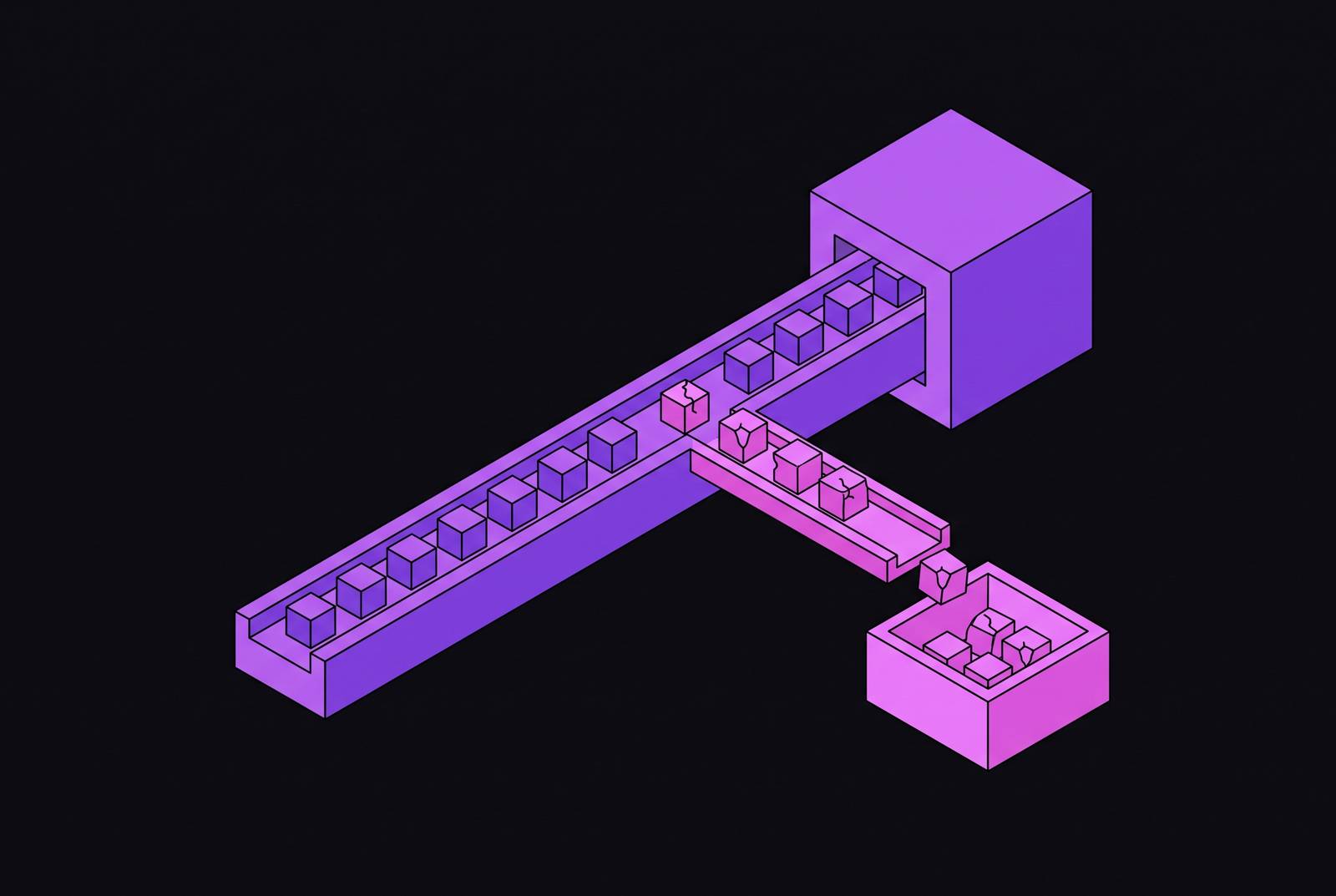
A DLQ is a separate holding area for work that couldn't get processed. A DLQ exists to get that work out of the way of everything still running normally, while keeping it around for someone to look at later. It's to get it out of the way of everything still running normally, while keeping it around for someone to look at later.
For plain automation, the failed item is usually just a message: a payload, an error code, maybe a timestamp. Agent systems need a lot more. Openclawai.io notes that a failed unit worth saving can include the incoming event, the session the agent was running under, a tool result, the channel account involved, a request ID, and whatever response the agent had drafted before things fell apart. That extra context means recovering a failure in minutes instead of rebuilding the whole incident from logs scattered across five different systems.
Iamstackwell.com identifies four failure patterns a working DLQ setup addresses, and every team falls into at least one without meaning to:
- Retrying endlessly, burning money on tasks that were never going to succeed
- Dropping failures silently, so nobody even knows the work died
- Digging through logs by hand to piece together what happened
- Treating every failure as a five-alarm page, until the team burns out on alerts that don't matter
Basic automation tooling trains people to expect a narrow failure shape: a missing field, a 500 error, something clean and diagnosable. Agent failures refuse to look like that. A planner picks the wrong tool. A small prompt change causes malformed output three steps later. A long reasoning chain piles up small errors until the final output reads as nonsense that happens to be formatted correctly. A workflow times out after it already fired off a side effect, and now there's a duplicate charge or a message sent twice with no clean rollback available.
That's why a DLQ is not a fancier retry mechanism, and treating it as one defeats the point. Retries are for transient problems with some known ceiling on attempts. A DLQ starts exactly where retries stop making sense: when the system needs to quit guessing and hand the decision to a human or a different process entirely.
Chat-based agents add one more wrinkle. A message can land right as the gateway restarts. A model provider can time out after the agent already started acting on a request. A destination channel can reject the reply. In every one of those cases, the user on the other end expects exactly one outcome, not two, not zero.
Where the DLQ actually lives says something about how seriously a team takes this. For finance or healthcare workloads, where losing track of even one failed request is unacceptable, a relational database table makes sense, since it lets operators query and filter failed items properly. For lighter, faster workloads, theneuralbase.com points to a Redis structure as a workable option for lighter, faster workloads. A review from theneuralbase.com, dated April 2026, flags real production gaps in naive Redis DLQ implementations though: connection-pooling issues, async code that blocks when it shouldn't, TTL settings applied wrong. Any Redis DLQ snippet found online is a sketch of the idea, not something to drop straight into production.
Failure classification: deciding which lane a failed task belongs in before it reaches the DLQ
Agent failures can be split into three tiers, and this split is what the rest of the recovery system gets built on: transient, permanent, and critical.
Transient failures include rate limits, a network blip, and a provider that's briefly down. The original request is still valid, nothing irreversible has happened yet, so these are retry candidates by default.
Permanent failures are a different animal, and this is where systems waste real retry budget on things that were never going to fix themselves. An agent can't retry its way past a rejected VAT number, an item that's out of stock, or a transaction over someone's approval limit. No amount of retrying changes those facts. What's needed instead is corrected data, a different decision, or a person with the authority to step in. Routing straight to the DLQ for a human to review isn't a failure of the system here, it's the system doing its job correctly.
Critical failures sit above both. These involve a tool call that changes state somewhere, a database write, a payment, with malformed arguments, where part of the side effect may have already gone through. These don't get queued for later. They get escalated immediately.
Classification itself is the hard part with agents, because it gets murky fast. An agent's output can pass every format check, valid JSON, correct field types, right structure, and still be wrong in a way that becomes visible only once it hits a downstream business rule. Format validation says everything's fine. Business logic disagrees. That gap shows semantic validation needs to happen before a run gets marked complete, not just structural validation.
The payoff is direct: separating transient from permanent failures cuts wasted resource use and stops the system from retrying something that was never going to succeed on attempt two, or attempt twenty. Skipping this step causes a permanent failure to loop through a retry mechanism for hours, burning API calls on a VAT number that's still getting rejected the fifth time.
The retry layer that sits between a failure and the DLQ
Not every failure should skip straight to the DLQ, and not every failure should retry blindly either. There's a layer in between that does most of the actual recovery work, and it needs to be built on purpose, not left to whatever the default library does.
Exponential backoff with jitter is the baseline. Hitting a rate limit and retrying immediately just makes the problem worse, so backoff doubles the wait time with each attempt and gives the downstream service room to breathe. Jitter, a small random offset added to that delay, stops a fleet of agents from all retrying at the exact same instant. This thundering-herd problem hits agent systems harder than typical software, since agents don't just retry the same call, they spin up follow-up searches, try alternate tools, or restart planning loops when an expected result doesn't come back in time. That turns one outage into a synchronized burst across the whole system.
For HTTP 429 responses specifically, honoring the Retry-After header when it's present is the right approach. When it isn't, fall back to exponential backoff and drop concurrency for that integration until things settle.
LLM output validation deserves its own retry path. Models produce malformed JSON or bad tool arguments often enough that it shouldn't count as an emergency. Instead of crashing the run, feed the error message straight back to the model as a correction prompt. Feeding the error back as a correction prompt is a cheap, bounded fix worth building before anything gets routed to the DLQ.
Retry budgets shouldn't be flat across the board either. The point is direct: a document search can absorb several failed attempts without consequence, a bank transfer can't, and a nightly batch sync can wait far longer than a customer staring at a checkout screen. Retry limits need to live per tool and per action type.
There's also a hard exit needed for when retries just aren't working. A well-designed system needs an ESCALATE path, a deterministic point where the system stops trying once a retry budget runs out. Without something like this, a model calling a state-changing tool with bad arguments can loop indefinitely, since nothing forces it to stop. ESCALATE puts a ceiling on how bad the worst case gets.
Once retries run out, or a failure gets classified as permanent or clearly non-deterministic, the run goes to the DLQ. Not back into another retry cycle.
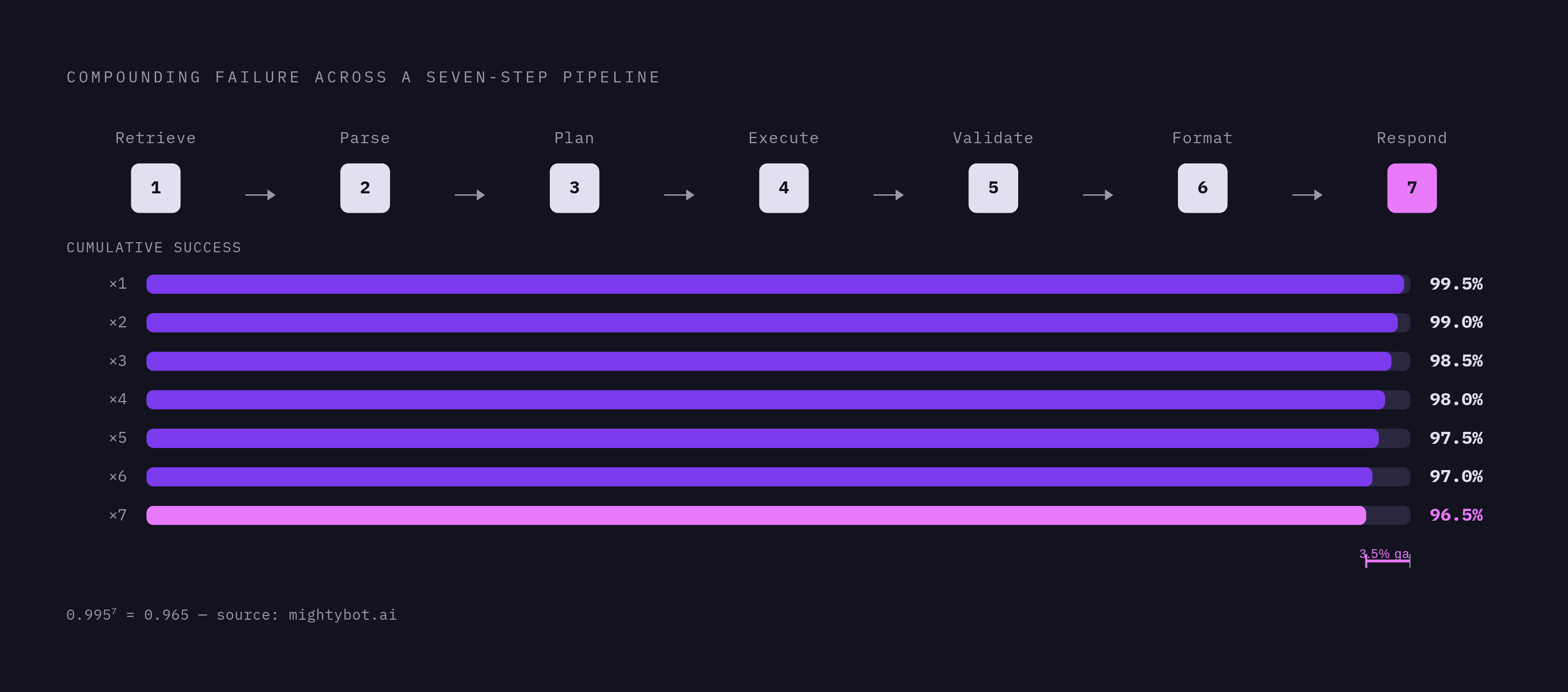
The stakes compound faster than most people expect. Mightybot.ai runs the math: a 99.5% success rate on each individual API call, which sounds close to perfect, only produces a 96.5% success rate across a seven-step pipeline. Every additional step multiplies the odds something along the way needs retry or DLQ handling, so the deeper the pipeline runs, the more this design work actually matters.
Circuit breakers: stopping runaway spend before failed tasks can multiply
Circuit breakers come straight out of distributed-systems design, and they map onto agent failures with only a little adaptation. A circuit breaker watches agent behavior and failure rates, then moves between states based on what it's actually seeing, cutting off calls down paths it already knows are failing.
The breaker does two distinct jobs for agent systems. First, it stops one dead dependency from taking every dependent task down with it. Second, and this one matters more for agents specifically, it caps runaway token spend. A retry loop hammering a model endpoint that's down doesn't just waste time, it burns real money on every attempt. The breaker's job is to refuse calls down a path it already knows is failing, before the bill gets out of hand.
That risk isn't hypothetical. Xcloud.host reported that community members running self-hosted OpenClaw setups have seen API bills top $3,600 in a single month, driven by agent activity nobody was watching closely enough. That's what a missing or misconfigured circuit breaker looks like in practice: the system keeps trying, and the meter keeps running.
Circuit breakers and DLQs do different jobs, and both are needed. They do different jobs, and both are needed. The breaker stops new work from walking into a path that's already failing. The DLQ holds the work that already walked in and couldn't get out. Skipping either one leaves the remaining control the only thing standing between a failure and an uncontrolled outcome.
Managed hosting setups tend to make this trade-off visible. Platforms that handle uptime, billing limits, and monitoring at the infrastructure layer can build circuit breakers and cost caps in as a feature. Self-hosted deployments have to build and maintain that same protection by hand, and it's easy to underestimate how much work that is until the bill arrives.
Required fields in a DLQ record for recoverable agent failures
A dead-letter record only earns its keep if it can answer two questions on its own, no extra digging required. Openclawai.io frames those questions as: what happened, and is it safe to replay this?
Pulling from iamstackwell.com and openclawai.io, a working agent DLQ entry needs at least the following:
- A run or request ID, stable and specific to that one execution
- The workflow or agent name
- The exact step that failed and the processing state at that moment (was the request just accepted? Had a model already been selected? had a tool already fired? had a draft response already been written? had delivery already been attempted?)
- A timestamp and retry count
Iamstackwell.com notes a few more fields that start as nice-to-haves and turn into requirements fast, including prompt version, an environment flag distinguishing staging from production, an idempotency key, a customer or account ID, links to related logs and traces, and some kind of severity or business-impact label.
Beyond structural fields, agent DLQ records benefit from context that captures not just what went wrong at the infrastructure level, but where the agent's reasoning diverged from the expected outcome. Skipping that context leaves anyone reviewing the entry working off infrastructure state alone, blind to the semantic drift that caused the failure in the first place.
Openclawai.io cites guidance from Microsoft's Service Bus documentation on this exact point: the queue itself doesn't heal anything. Someone, or something running a defined policy, still has to decide what happens next. The record's job is making that decision possible without sending anyone hunting through five unrelated log files.
Theneuralbase.com describes a standard in-memory store entry as containing a request ID, the payload, the error, a timestamp, and a status flag like pending_manual_review. That's a workable baseline for plenty of systems. For agent failures specifically, it's missing the side-effect evidence and the processing-state detail that make a replay decision actually safe to make.
Checkpointing and idempotency: the two design principles that make DLQ replay safe
None of the DLQ design above matters if replaying a failed task isn't actually safe. Two principles make replay safe: idempotency and checkpointing. Skipping either one turns a DLQ into a tool for creating duplicate side effects instead of fixing them.
Idempotency means running a task twice produces the same result as running it once. Bobrenze on dev.to explains that making everything idempotent is what lets a stalled task get killed outright without worrying about what happens next. But per mightybot.ai, most agent actions aren't idempotent by default: an agent that creates a record in an ERP system, then crashes before it can confirm the write succeeded, will happily create a second record on retry if nothing stops it.
The fix is an idempotency key, a deterministic ID derived from the task's inputs. Downstream systems check for that key and, if they've already seen it, hand back the existing result instead of duplicating the action. The same logic applies to LLM calls directly: cache the response keyed on the exact prompt and parameters used, so restarting a pipeline returns the cached answer instead of paying for the same call twice.
Checkpointing solves a related but separate problem, resuming work instead of restarting it from scratch. That means saving state at each step of a pipeline: the step ID, its output, and a status flag (pending, completed, or failed). When the pipeline restarts, the orchestrator reads that checkpoint store, finds the last completed step, and resumes from the one after it.
Mightybot.ai reports that skipping checkpointing means every failure forces a full pipeline re-run, every LLM call gets billed again, and rate limits get hit again for no reason. Those costs stack up fast at any real volume. Bobrenze's dev.to piece makes the same point from the recovery side: checkpoint state at key transitions, and a stall just resumes from the last known good point instead of starting over from zero.
One rule matters here and it's easy to get wrong: checkpoints need to be scoped to a single pipeline execution, never shared across separate runs. Mightybot.ai flags this directly, since a stale checkpoint left over from a previous version of the input produces results that don't match what's actually running now, and that mismatch is hard to catch after the fact.
Not every stalled task needs to land in the DLQ. Some have a real fallback mode. Bobrenze's dev.to post describes a research task that stalls partway through returning whatever it's gathered so far, tagged with an "incomplete" flag, instead of hanging indefinitely waiting for a result that may never arrive. A partial answer with an honest flag on it beats silence every time, because at least it gives the person on the other end something to act on.
There's a limit to how far self-healing should go, and taskade.com states it this way: an agent should recover from transient errors on its own and escalate loudly the ones it can't fix. The worst outcome is an agent that quietly "recovers" from a critical error in a way that looks like success but never really was. It's an agent that quietly "recovers" from a critical error in a way that looks like success but never really was.
Sources
- AI Agent Dead Letter Queue: How to Catch Failed Runs Before They Disappear
- AI agent dead-letter queues: recover messages after failure | OpenClawAI
- How AI Agents Handle Stalled Tasks and Timeouts: Lessons From My Production Failure
- Fault-Tolerant AI Agent Pipelines — MightyBot
- Dead letter queue for failures | Ai In Production Beginner Course | The Neural Base
- trantorinc.com
- theneuralbase.com