Event-Driven Agent Trigger Architecture for Production Systems
Proper schema and bus design prevent agents from duplicating work and burning tokens on nothing.
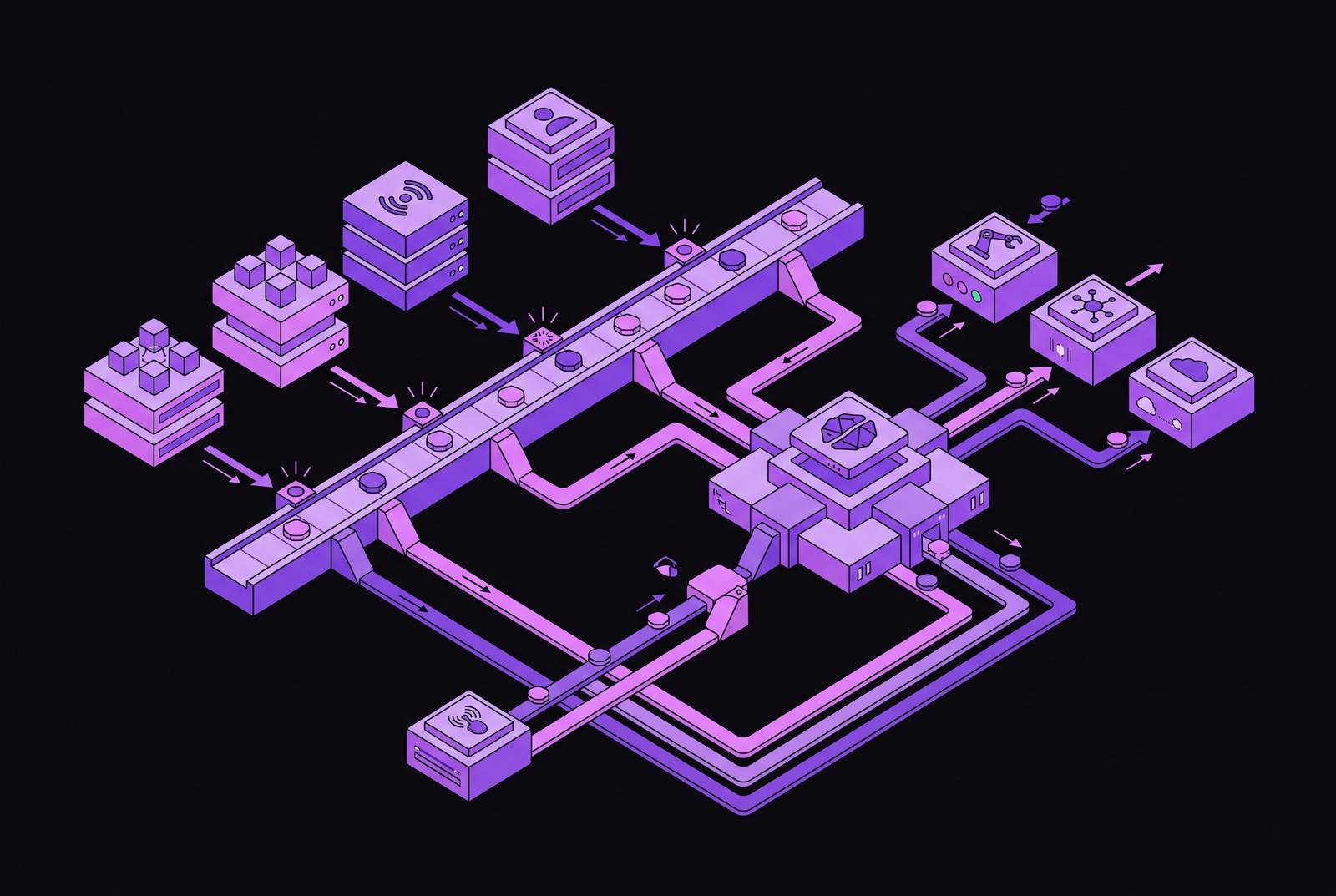
Event-driven agent architecture is a sequence of decisions, not a single tool pick. Schema design, bus configuration, idempotency, and failure handling all sit upstream of the agent logic itself, and getting the order wrong is what makes agents duplicate work, silently drop events, or burn through token budgets doing nothing useful.
Compare that to polling, which is still the default a lot of teams reach for. A polling agent hits an API on a fixed interval and asks "anything new?" It runs whether or not there's work to do. For usage-based LLM agents, that's a real cost problem: every empty check still burns tokens, and the bill climbs with nothing to show for it. Polling also sets a hard latency floor. A response can never arrive faster than the poll interval, which is a structural problem for anything time-sensitive: fraud detection, live customer support, anything where seconds matter.
Event-driven agents flip that. They sit idle at zero cost until something specific wakes them up, per fast.io's architecture guide. Per fast.io's architecture guide, the latency drop runs 70 to 90% compared to polling-based systems. That's not a marginal improvement, that's a different category of responsiveness.
None of this is theoretical to the people running these systems in production. In practice, production failures tend to cluster around three problems: tool definition quality, retry and fallback design, and event routing. This piece is about the third one, event routing, and everything that has to be true upstream of an agent for that routing to actually hold up under load.
How an event-driven agent system is structured before any code is written
Three layers make up the minimum viable structure. Skipping any one of them leaves a system that functions as a webhook with delusions of grandeur rather than a genuinely event-driven one.
Event producers are the sources: file systems, user interfaces, external APIs like Stripe, GitHub, or Slack. They emit events when something happens. They don't know or care who's listening.
The event bus is the routing layer. It takes events from producers and gets them to the right consumers. In high-throughput systems, this is Kafka or RabbitMQ. For simpler agent workflows, webhooks often do the job directly, no separate broker required.
Event consumers, the agents themselves, subscribe to specific topics or event types. An analyzer agent subscribes to PDF uploads. A transcriber only cares about audio. Each agent only processes what's actually relevant to its job, instead of every agent inspecting every event and deciding whether to bother.
A fourth layer that's easy to treat as optional and shouldn't be is governance and observability. This is the layer that tracks which agents consume which event types, records agent decisions as audit events, and monitors event lag and processing errors. Without it, an event-driven system becomes a black box where failures are hard to trace.
The webhook endpoint itself should do almost nothing. Accept the payload, verify the signature, return 200 OK, and push the event to a queue. That's the entire job of the endpoint, nothing more. All the real work, the LLM calls, the tool use, the database writes, happens asynchronously, somewhere else.
The canonical flow, per buildmvpfast.com, looks like this: an external service sends a webhook, the endpoint verifies the signature and returns 200 OK, the event lands in a queue (Redis, SQS, BullMQ), a router inspects the event type and sends it to the right agent, and if that agent fails enough times, the event lands in a dead-letter queue.
The queue step isn't a nice-to-have. Calling an LLM directly inside a webhook request risks a timeout. Some providers enforce hard delivery windows, and LLM responses can easily run longer than that window allows. The queue decouples the moment an event arrives from the moment it actually gets processed, and that separation is what keeps the whole system from falling over under a burst of traffic.
Once that structure exists, the next decision is what the events flowing through it actually look like. That's schema, and it's where most reliability problems get baked in or avoided before a single agent runs.
Event schema design: defining the contract that lets producers and consumers evolve independently
A schema is a formal spec for an event: its name, timestamp, source, payload fields, and version, agreed on between the producer and every agent that consumes it. It sounds like paperwork. It's the thing that decides whether two teams can change their code without breaking each other.
Get the schema right, and producers and consumers evolve independently, no coordination meetings required, per Atlan's EDA guide. Get it wrong, and a producer renames a field, doesn't tell anyone, and a downstream agent starts silently doing the wrong thing. No error thrown. No alert. Just wrong behavior that someone notices three days later when a customer complains.
Atlan gives a clean example: a data.quality.alert event that carries the asset ID, the quality score, and the affected columns. That's enough for any agent subscribed to it to act without making extra API calls just to figure out what happened. Good schema design front-loads the context an agent needs so it doesn't have to go fetch it.
Enforcement matters as much as design. A schema registry, Confluent Schema Registry and AWS Glue Schema Registry are two widely used options that enforce event contracts at the bus level and rejects incompatible changes before they ever reach an agent. Without one, schema drift builds up quietly. Nobody notices until a breaking change causes a production incident, and by then the fallout is in incident review rather than code review.
Versioning discipline closes the loop. Every event type should carry a version field, and agents should declare which versions they support. That way a producer can roll out a new event shape gradually, agent by agent, instead of forcing a coordinated cutover where every consumer has to update at once.
Events should describe what happened, not what to do about it. A payment.failed event should say a payment failed, not instruct the agent to send a specific email. The agent decides how to respond. The moment a schema starts encoding instructions, the producer becomes coupled to the consumer's logic, and that's the exact independence the schema was supposed to protect.
Choosing and configuring the event bus: delivery guarantees, broker trade-offs, and where webhooks fit
The bus answers one question that matters more than throughput or latency benchmarks: what happens to an event if the agent consuming it is slow, down, or throws an error? Everything else is detail.
Three broker categories cover most production setups, each trading off differently:
Apache Kafka handles high-throughput durability, low latency at scale, and millions of events per second. It's the right call when event volume is large and replay matters: the system needs to be able to go back and reprocess events after the fact.
Apache Pulsar is built for multi-tenancy and geo-replication. It's the right call when agents are spread across regions and need consistent event delivery regardless of where they're running.
AWS EventBridge is serverless and cloud-native with minimal operational overhead. It's the right call for teams that don't have the headcount to run Kafka infrastructure themselves.
Webhooks fit differently. For lower-volume or simpler workflows, the webhook itself can serve as the bus: the source system POSTs directly to the agent's HTTP endpoint, no broker to run or maintain. The trade-off is that delivery guarantees now depend entirely on the sending provider's retry policy, whether that's Stripe, GitHub, or Slack. There's no independent layer enforcing delivery if the provider's retry logic falls short.
The real value the bus provides, regardless of which one is chosen, is decoupling. Producers don't need to know which agents are listening. Consumers don't need to know which system produced the event. A new agent can subscribe to a topic without touching any existing component, per Atlan's guide, which is what makes it possible to add capability to a system without a redesign every time.
That decoupling also enables fan-out. A single asset.updated event can trigger a quality check agent, a lineage refresh agent, and a notification agent all at once, in parallel, instead of one after another. A lot of the latency savings actually come from that parallelism.
Latency-sensitive systems push this further. Financial trading systems and robotic fleets favor event triggers with guaranteed delivery semantics over polling or broadcast entirely. For requirements under 100ms, general-purpose orchestration layers add too much overhead. OpenClaw's TaskGraph, for instance, adds roughly 200ms per node for state passing, which rules it out for that tier of use case and means a custom event loop is the only option.
None of this solves the next problem, though. Reliable delivery, by design, tends to mean at-least-once delivery. That guarantee comes with a cost: the same event can, and will, arrive more than once.
Idempotency: why duplicate events are guaranteed and how to design agents that handle them safely
Start with the failure, because it's more instructive than the fix. An agent built to process Stripe's payment_intent.succeeded events works fine in testing. In production, it processes the same payment two or three times, because nobody accounted for Stripe's retry behavior. One missing idempotency check, and a team can rack up hundreds of dollars in duplicate API calls before anyone notices on Monday morning, per buildmvpfast.com's guide.
That's not a bug that gets fixed upstream. Most reliable event systems guarantee at-least-once delivery on purpose, because exactly-once delivery is either unavailable or expensive to guarantee at scale. The agent has to be the last line of defense, not the queue, not the bus.
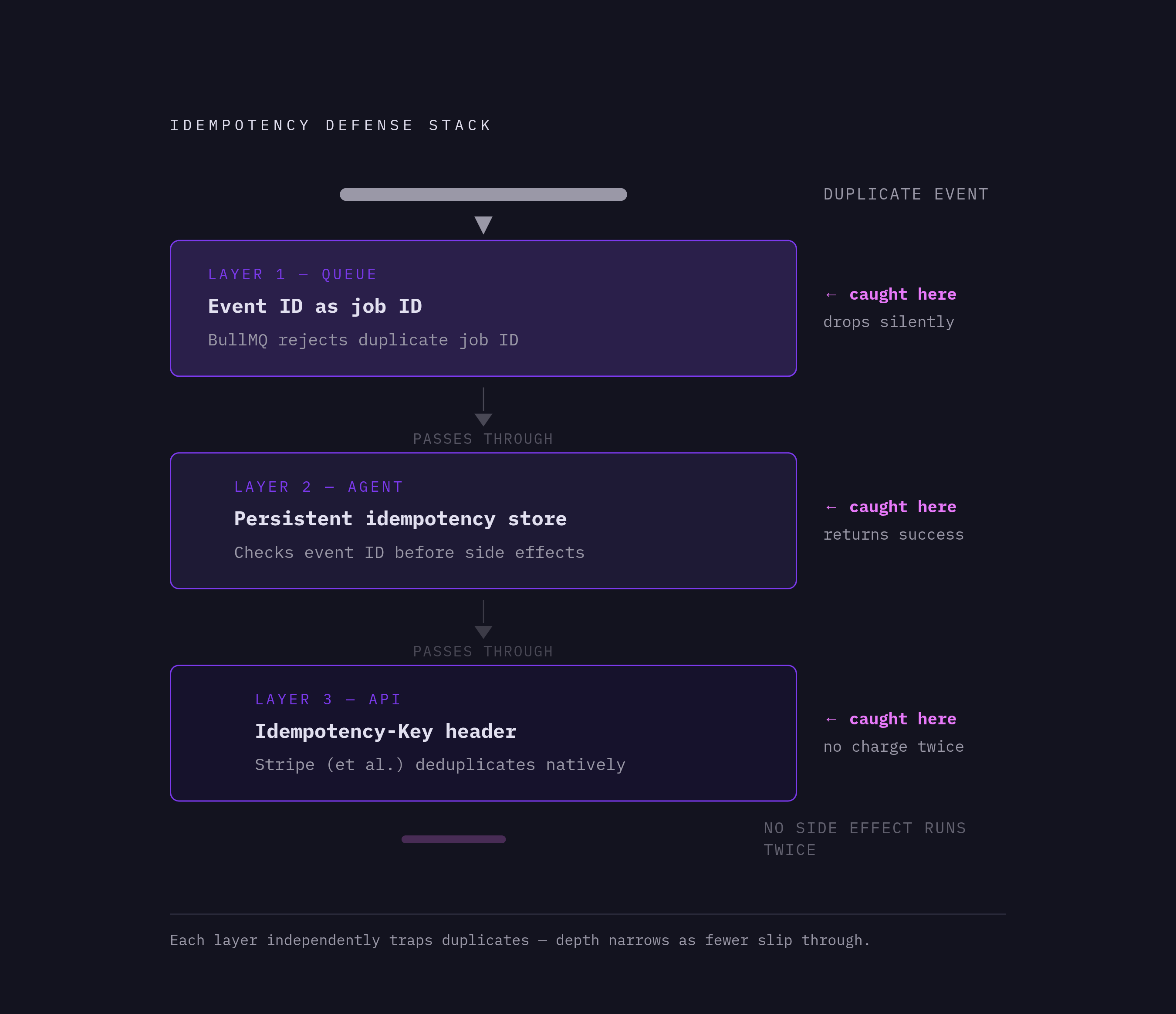
A three-layer strategy handles it:
Layer 1, deduplication at the queue. Use the event provider's own event ID as the job ID. BullMQ and similar queue systems will refuse to enqueue a job with an ID that's already there. That's a configuration line, not application code.
Layer 2, an idempotency key inside the agent. Before the agent does anything with side effects, provisioning a resource, sending a message, writing a record, it checks a persistent store for evidence that this event ID has already been handled. If it finds a match, it short-circuits and returns success without redoing the work.
Layer 3, idempotent external calls. When the agent itself calls a downstream API, it passes an idempotency key in the request header. Stripe supports this natively via request headers. Duplicate calls from the agent's own retries get caught on the receiving end too.
Scheduled and heartbeat triggers need a slightly different pattern. A cron job fires a heartbeat webhook to the agent on a set schedule. The agent doesn't act on the trigger itself, it checks the actual state of the world (unresolved tickets, pending reviews, stale records) and only acts if something needs attention. The state check is the idempotency guard here, not an event ID.
The payoff extends past correctness. An agent that's safe to retry is also safe to recover. When something breaks, the runbook becomes "reprocess from the queue," not "go manually figure out what the agent already did and undo the duplicates." That difference is the gap between a five-minute fix and an afternoon lost to forensic accounting.
Failure handling, dead-letter queues, and designing for partial failures in multi-agent chains
Idempotency handles duplicates. It doesn't handle what happens when an agent fails halfway through processing a legitimate, single-delivery event, and that needs its own architecture.
Three failure modes appear specifically in event-driven agent systems, distinct from generic software bugs:
Transient failures, where the LLM API times out or hits a rate limit. The fix is retrying with exponential backoff and jitter, not hammering the endpoint again immediately.
Poison-pill failures, where the event payload itself is malformed or triggers a bug in the agent's logic. Retrying this forever just blocks the queue and starves every other event behind it.
Cascading failures, which appear in chained pipelines. Agent A emits a task.complete event that triggers agent B, which triggers agent C. If agent B fails, agent A's work is orphaned and agent C never runs at all, with no obvious signal that anything went wrong downstream.
The dead-letter queue is the safety valve for all three. After a set number of retries with exponential backoff, the event moves to the DLQ, the agent stops retrying, and a human or a monitoring system reviews it. Without a DLQ, failed events either loop forever or vanish quietly, and neither is acceptable.
For workflows that run long and span multiple agents, saga orchestration is the right pattern, per Atlan's guide. A coordinator emits a sequence of command events, and if any step fails, compensating events roll back the partial work that already happened. A workflow that fails cleanly rolls back partial work through compensating events, while one without this pattern leaves half-finished state scattered across three different agents.
Event chaining, where each agent's output becomes the next agent's trigger, also has a debugging advantage baked in. Because every step emits its own discrete event, failures are isolated and auditable, per Atlan's guide. Nobody has to guess where in a black box a chain broke; the event log shows exactly which step didn't fire.
None of this works without observability tracking which agents consume which events, recording agent decisions as audit events, and monitoring lag and errors across the chain. Skipping it means a failure in a ten-agent chain just looks like a missing final output, with no trace of where things went sideways.
Grok Research's technical paper documented a real-world trading deployment that used OpenClaw's built-in state snapshots to let auditors reconstruct the exact sequence of events and decisions after the fact. That kind of deterministic replay turns an agent from a black box into something an auditor can actually walk through, and the same capability that helps with compliance is exactly what's needed for failure forensics.
There's a scaling wrinkle too. As the number of agents in a system grows, coordination overhead doesn't grow in a straight line, it grows exponentially. Production systems deal with this through clustering, where semantically or geographically related agents group under local coordinators, and through delegated control layers, where a higher-level agent issues strategic direction instead of micromanaging every agent underneath it.
Applying these patterns with production agent runtimes: OpenClaw, Hermes, and Claude Code
OpenClaw is probably the runtime most shaped by these exact production pressures. Install OpenClaw, configure it, and it runs as a runtime rather than a library. It handles messaging, memory, tool use, scheduling, browser automation, and multi-agent coordination across more than 20 messaging platforms out of the box.
That's a real distinction from LangChain, CrewAI, or AutoGen, all of which require writing Python to assemble an agent from parts. OpenClaw is something a team configures rather than builds. By mid-2026, it had passed 380,000 stars on GitHub, which is a reasonable proxy for how widely it's already running in production environments.
The TaskGraph overhead mentioned earlier (roughly 200ms per node for state passing) is a direct constraint on how tightly OpenClaw can sit inside an event bus. For sub-100ms response requirements, that overhead rules out TaskGraph, and teams building for that latency tier need a custom event loop instead.
Version v2026331 brought breaking changes that matter specifically for event-driven deployments: mandatory ClawHub plugin verification, WebSocket security patches, and breaking changes to node execution. Any team running event handlers through OpenClaw needs to audit those configurations before upgrading, not after something breaks.
There's also CVE-2026-25253, patched in v2026.1.29, an authentication token theft vulnerability that could lead to remote code execution. In an event-driven setup where the agent's endpoint is internet-facing (which a lot of webhook-triggered deployments are, by design), an unpatched instance is directly exposed. That's not a hypothetical, it's the exact attack surface a webhook-first architecture creates if the patch isn't applied.
Deployment patterns vary in ways that affect event ingestion and recovery: a Mac Mini cluster, a Kubernetes sidecar, and a bare-metal edge node each have different failure characteristics and different surfaces for receiving events in the first place.
One case study gives a sense of what reliable event triggering actually buys in practice, separate from the agent's own intelligence: an AWS ECS deployment running OpenClaw workers cut average PR review cycle time from 2.3 days down to 1.1 days. That's not the agent getting smarter, that's the event pipeline getting events to the right agent fast enough for the agent's work to matter.
Hermes Agent, from Nous Research, takes a different path: fully open source under MIT, with roughly 246,000 GitHub stars, about 51,000 forks, and contributions from close to 3,000 developers. It's built with integrations aimed at event-driven workflows from the ground up, giving teams that want to build rather than configure a well-supported open foundation to start from.
Whichever runtime a team lands on, none of it matters if the schema is loose, the bus can't guarantee delivery, the agent isn't idempotent, or there's no dead-letter queue catching what falls through. The runtime is the last decision in this chain, not the first.