Semantic Deduplication in Agent Long-Term Memory
Removing duplicate and outdated facts from agent memory improves retrieval accuracy.
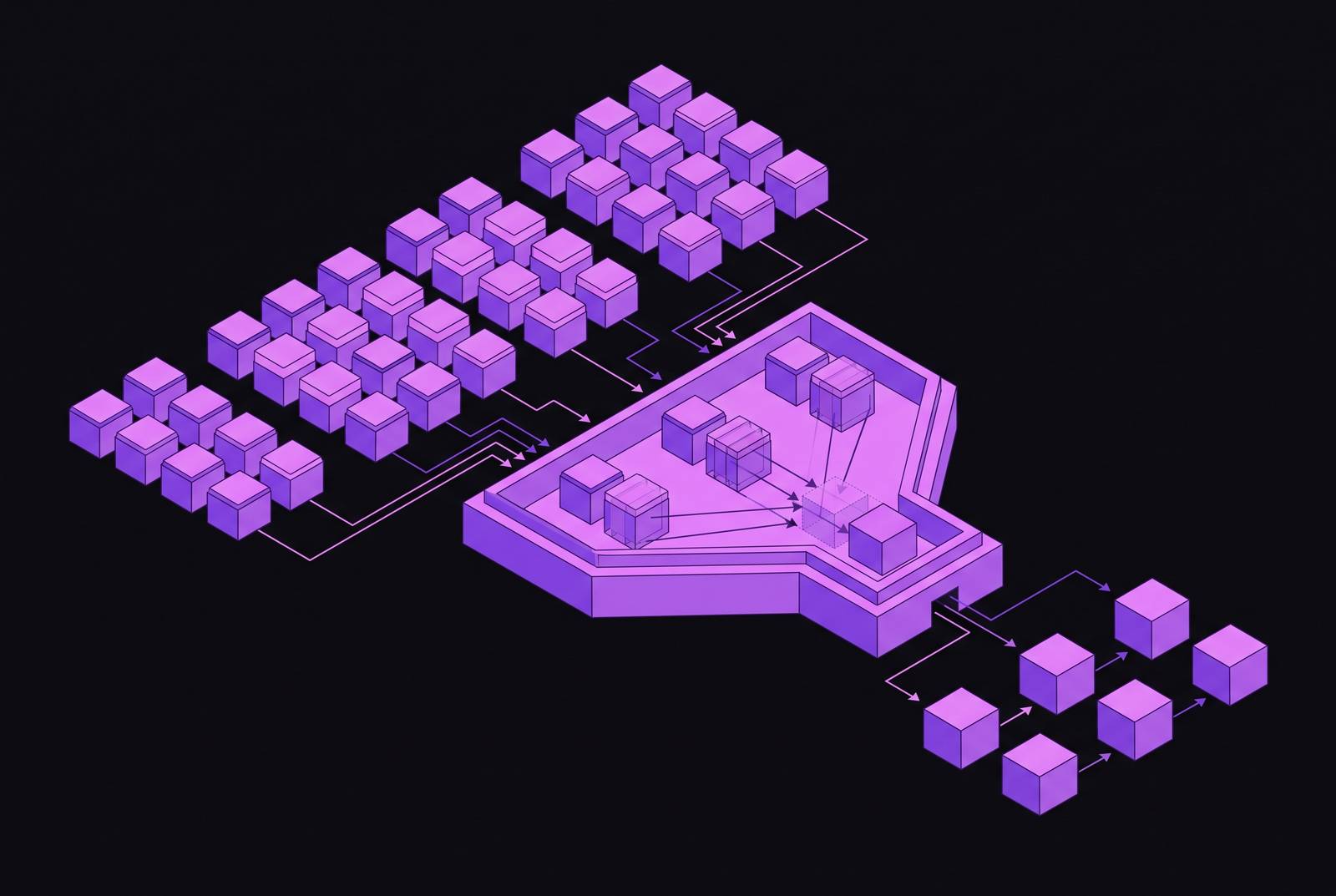
Every AI agent starts each conversation with a blank slate. Nothing carries over unless someone builds a system to store it, retrieve it, and eventually throw it away. That system decides whether an agent's memory gets sharper with use or piles up into noise, and the size of the model or the length of its context window has almost nothing to do with it. The survey "Memory in the Age of AI Agents" puts a number on the cost of getting this wrong: passive memory buffers lose 30 to 50% accuracy on tasks that involve tracking things over time.
Start with the naive version: append-only memory. An agent logs "User likes Python," then two months later logs "switched to Rust," and both statements sit in the same store with equal weight. No timestamp tells the agent which one is current. No process flags the contradiction. No scoring system decays the stale fact so the fresh one wins. When the agent retrieves memory later, it pulls either statement, or both, and answers as if it's certain of whichever one it grabbed. That failure has nothing to do with model quality. It comes from a storage design with no way to tell old from new, or true from superseded.
Vector databases don't fix this. They make it worse as they scale. A vector database is stateless: it stores an embedding and returns whatever's closest to the query, with no built-in sense that one of those embeddings represents a fact overturned three weeks ago. Adding more vectors doesn't sharpen retrieval, it adds noise. More candidates means more chances for a stale one to rank near the top, and that's not a flaw in the database. Vector search finds similarity, which is what it's built to do. Nobody told it that similarity and relevance aren't the same thing.
Why bigger context windows don't fix the problem
The logic sounds reasonable on its face. If a model can hold a million tokens, why not just hand it the entire conversation history and skip memory design? Let the model sort out what matters.
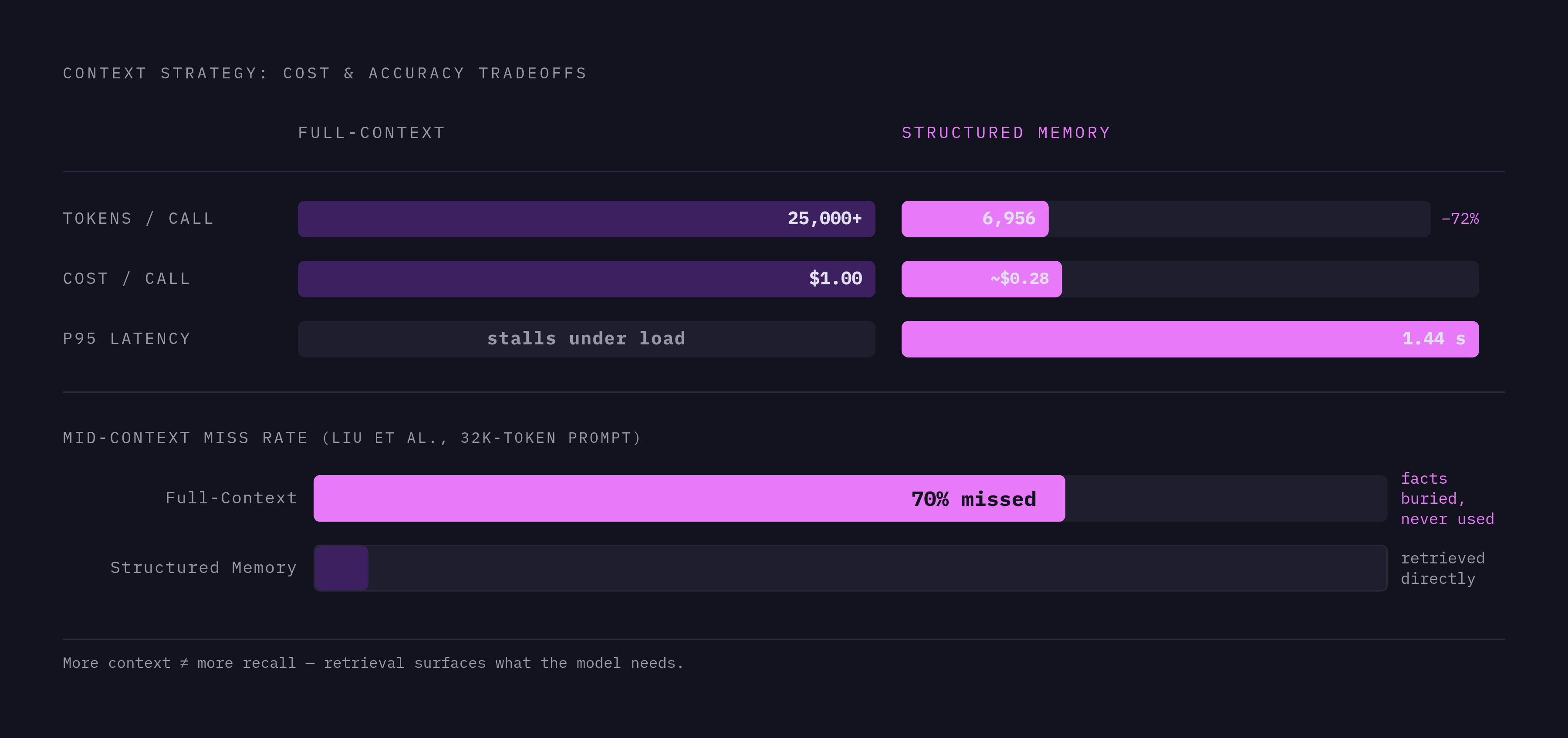
It doesn't work that way. Liu et al.'s "Lost in the Middle" study found accuracy drops sharply when the fact a model needs sits in the middle of a long prompt rather than near the start or end. Liu et al.'s Lost in the Middle study puts the miss rate at roughly 70% for facts buried in the middle of a 32,000-token prompt. Stuffing more history into the prompt doesn't help a model find the right fact. It buries that fact deeper.
Cost is the other problem, and the math adds up fast. A 200,000-token request priced at $5 per million tokens runs about $1 per call. That sounds small until 1,000 daily users running 10 sessions each push monthly spend past $30,000 on input tokens alone, before a single output token gets counted. Latency scales with context size too: full-context requests at real concurrency eat GPU memory, back up request queues, and eventually start timing out.
Structured memory retrieval sidesteps most of this by design. Mem0's own benchmarks put average retrieval at around 6,956 tokens per call against 25,000 or more for full-context approaches, a cut of roughly 72%. P95 latency for structured memory holds at 1.44 seconds even under heavy load, while full-context methods stall out at that same volume.
A bigger window just buys time. The failure still happens once the window fills, and no amount of context resolves a contradiction, removes a duplicate fact, or sharpens retrieval on its own. Fixing that takes an active layer that decides, on purpose, what gets kept, and that decision is the whole job.
The three memory types that structured systems manage
The CoALA framework (Cognitive Architectures for Language Agents, from Sumers, Yao, Narasimhan, and Griffiths) gives the field its working vocabulary, and LangChain's LangGraph documentation cites it directly. The split between episodic and semantic memory goes back further, to Tulving's 1972 work on human memory. Structured agent systems borrow that same three-way split, and treating it as optional is where a lot of memory systems quietly fail.
Semantic memory holds facts and preferences that stay true over time. A CRM agent might store "Budget cap $50K" and "Preferred channel: email," so a customer never has to repeat themselves on a follow-up call. Trouble starts the moment that budget changes to $75K. If the new number gets appended instead of replacing the old one, the agent now holds two contradictory beliefs about the same account and has no way to know which to trust at retrieval time.
Episodic memory logs specific past events, with enough detail to be useful later. "Last December, the team optimized Docker on ECS, try pruning images first" tells the agent what was already attempted, something well beyond what was said in passing. Left unmanaged, repeated conversations about the same topic pile up into redundant entries, and the system needs a real way to tell a genuinely new episode apart from a rehash of an old one.
Procedural memory covers learned behavior: formatting rules, tone, communication style, built up from feedback over time. A coding assistant that picks up "Team uses Black formatter, 120-character lines" and applies it without being told twice is running on procedural memory. Mem0's State of AI Agent Memory 2026 report doesn't dress this up: tooling built specifically for procedural memory is still early-stage, full stop.
Each of these three types goes stale on its own schedule, breaks in its own way, and needs its own retrieval logic. Treating all of it as one undifferentiated pile of vectors throws away the exact distinctions that make memory useful. Any team that skips this split is building a system that looks fine in a demo and falls apart three weeks into real use.
What semantic deduplication does inside an active memory system
Active memory systems run a loop: extract facts from the conversation, overwrite what's gone stale, adjust scores based on how the memory actually gets used. That loop, not raw storage, separates a working memory layer from a system that just appends and hopes for the best.
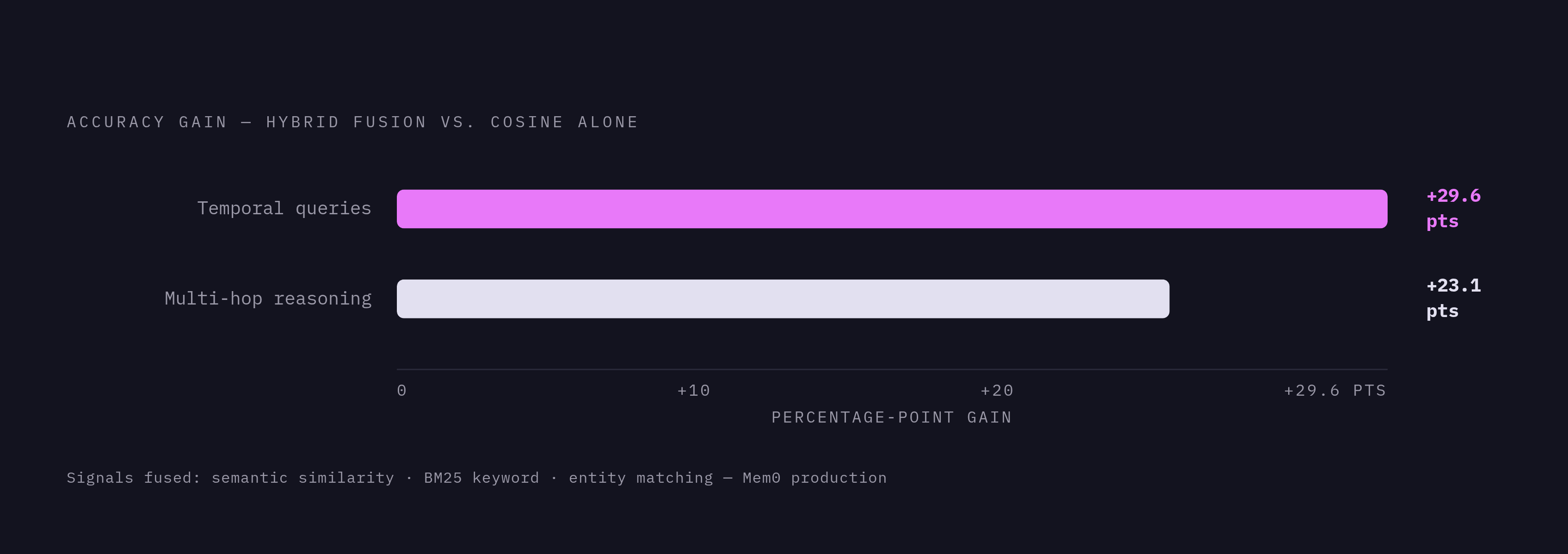
Cosine similarity alone can't carry that weight. A memory logged five minutes ago and a near-identical one from five weeks back look the same to a distance function, even though one of them matters far more right now. Zylos.ai's research found that Mem0's production system runs three scoring passes in parallel: semantic similarity, BM25 keyword matching, and entity matching, then fuses the three into one score. The biggest gains from that fusion land exactly where they matter most: +29.6 points on temporal queries and +23.1 points on multi-hop reasoning, the two categories that most closely mirror how real users actually talk to an agent over months of use.
Contradiction handling is turning into its own corner of the research. A paper titled TOKI (arXiv:2606.06240) lays out a formal algebra for resolving conflicting memory states over time. Two more recent benchmarks, MemConflict (arXiv:2605.20926) and BeliefShift (arXiv:2603.23848), test how consistently an agent holds beliefs and how well it adapts when new information should change its mind.
Forgetting belongs in this design too, and skipping it is a mistake dressed up as simplicity. The AI Agent Memory Design Guide treats TTLs (time-to-live settings), freshness metadata, and staleness detection as deliberate engineering choices, not defaults left to chance. An agent that keeps everything forever ends up just as unreliable as one that forgets too fast. It just takes longer to notice. The full pipeline runs extract, consolidate (dedupe, resolve conflicts, rescore), store, retrieve, and each step breaks in its own particular way if a team skips it.
How memory architecture choices shape retrieval quality in practice
Vector databases and graph databases get framed as rivals in a lot of the discourse, but that framing hasn't held up well since 2024, when graph memory was mostly experimental. The real shift isn't that everyone needs a graph database now. Production systems are moving past pure vector similarity as their only retrieval tool, and that's a narrower, more useful claim.
Vector retrieval finds facts that sit close to a query in embedding space. It's fast and well understood, but on its own it's blind to which entity a fact belongs to, how that entity connects to others, and how recent the fact even is. Graph-style retrieval follows entities and their relationships instead, which makes it noticeably better at multi-hop questions, the kind where the answer depends on chaining two or three separate facts together. The cost is visible in operations: graphs take more work to build, query, and keep in sync.
Memanto (arXiv:2604.22085, April 2026) pushes back on the idea that graphs are required for that kind of precision. It scores 89.8% on LongMemEval and 87.1% on LoCoMo using a typed semantic schema with 13 predefined categories and automatic conflict resolution, with no knowledge graph, and no LLM sitting in the ingestion path, all at sub-90-millisecond latency. The paper calls the overhead graphs add the "Memory Tax," and makes the case that plenty of systems shouldn't pay it. That argument holds up: if a system can hit 89.8% without a graph, the graph better be earning its keep somewhere specific, like deep multi-hop reasoning, not just sitting there as infrastructure.
Other architectures split the difference differently. MAGMA (Multi-Graph based Agentic Memory Architecture) separates episodic, semantic, and procedural memory into distinct sub-graphs routed through one retrieval layer, targeting improved performance on multi-step reasoning tasks. A separate paper on Hierarchical Memory Orchestration (arXiv:2604.01670, April 2026) organizes memory into tiers instead, using a tiered structure that keeps the active retrieval space small by organizing memories according to recency and priority, with a global archive for the rest. All three designs chase the same goal, keeping the active retrieval space small.
The pick between vector-only and graph-augmented comes down to what a team can actually run day to day. Vector-only wins when the latency budget is tight and the operational team is small. Graph-augmented earns its cost when multi-hop reasoning is the actual product requirement.
The benchmark landscape and where memory systems stand
Three benchmarks recur across 2026 papers and vendor claims: LongMemEval, LoCoMo, and BEAM. They test long-horizon memory recall and consistency, not single-turn question answering, and any number attached to them should be read with that in mind.
Mem0 reports 92.5% on LoCoMo and 94.4% on LongMemEval, driven by that fused retrieval approach combining semantic search, keyword matching, and entity matching. Memanto is at 89.8% on LongMemEval and 87.1% on LoCoMo, and doesn't chase the top score. It stakes its claim on hitting comparable accuracy with a simpler, vector-only architecture, betting that lower complexity is worth something real once a system is in production. That bet looks right: a few points of accuracy matter less than an architecture a small team can actually keep running.
A few points of difference between scores in the low 90s and the mid 90s is not a rounding error, either. Stretched across hundreds of sessions with a real user, that gap turns into an agent that surfaces an outdated preference or a resolved contradiction noticeably more often. Gartner, cited in the Memanto paper, projects that 40% of enterprise applications will include AI agents by the end of 2026, up from under 5% in 2025. On that kind of growth curve, mistakes in memory architecture get expensive fast, right around the time most teams are still treating memory as an afterthought.
The research pipeline behind these benchmarks points to where the field is headed next. MemRL (January 2026) explores memory that improves its own retrieval policy through reinforcement learning as it gets used. "Memory as Action" (November 2025) reframes memory writes as deliberate choices an agent makes, not passive logging that happens in the background. "Agentic Memory" (January 2026) works toward managing long-term and short-term memory in one unified system, instead of treating them as separate problems bolted together.
What production deployment of memory-enabled agents requires
A real gap separates an agent that remembers things in a demo from a product where every customer runs their own agent, with its own memory, at the same time. Writing the memory layer is the easy part. Provisioning it, securing it, watching it, updating it, and recovering it, for every customer, repeatably, is where the actual engineering effort goes.
Per-user isolation is the non-negotiable unit the whole system gets built around. Shared memory across users is a coherence failure and a privacy failure at once. One customer's semantic facts, episodic history, and procedural preferences leaking into another customer's session isn't a minor bug; it can turn up in a compliance audit and end a contract.
Scaling that isolation brings its own infrastructure demands. Mem0's stack picked up Apache Cassandra support (v1.0.1) and Valkey support (v0.1.118), both aimed at high-throughput, distributed storage. FastEmbed integration lets the embedding step run locally, on-device, which cuts cost and keeps data from leaving the deployment environment, a real advantage for anything privacy-sensitive. None of this works out of the box by default. Each piece takes deliberate setup and ongoing upkeep.
Persistent memory opens a security surface a stateless agent never has to worry about. An attacker who manages to inject something into an agent's memory doesn't just affect one conversation. They gain a foothold that persists across every future session with that user. A prompt injection that corrupts a single session is a bad afternoon. One that corrupts stored memory is a standing problem that outlives the conversation where it started.
Mem0 also offers a managed API, where the framework itself handles extraction, deduplication, conflict resolution, and retrieval on a team's behalf. The tradeoff is straightforward: less control over the internals of the memory pipeline, in exchange for not having to build and maintain all of it. Before picking an architecture, a team needs an honest answer to one question. Does it have the staff and time to build and maintain the consolidation, scoring, and decay logic that keeps memory from degrading, or is that work better handled by something built outside the core product? Most teams answer this wrong, by default, simply because nobody asked the question early enough.
Memory handling at the per-user level in managed agent hosting platforms
One agent per customer, isolated and persistent, provisioned automatically the moment that customer signs up, is the only architecture that keeps memory clean, bounded, and recoverable at scale. Hand-configuring that setup per customer stops working once the customer count climbs into the hundreds, and pretending otherwise just delays the reckoning.
Persistent, in this context, means the agent's memory (its semantic facts about the user, its episodic history of past interactions, its procedural sense of how that user likes things done) survives a session ending and stands ready the instant the next one starts. The customer never has to reintroduce themselves or repeat context handed over weeks earlier.
Managed hosting takes a specific set of jobs off a team's plate: provisioning a separate memory store for each new customer at signup, watching for memory degradation before it causes an agent to give wrong or contradictory answers, rolling out updates to the underlying memory framework (Mem0, Letta, or something else) without taking anyone's agent offline, and recovering memory state cleanly if an instance goes down. Each of those is a real operational job on its own, and each one has to run correctly for every customer, every time, not just most of the time. That last part is the whole difficulty. A memory system that works for the vast majority of customers still falls short of being a working memory system; it functions as a support queue waiting to happen.
Sources
- Long-Term Memory for AI Agents: The What, Why and How
- AI Agent Memory Design Guide - Working, Long-Term, and Procedural Memory with Forgetting and Staleness Management | hidekazu-konishi.com
- Memanto: Typed Semantic Memory with Information-Theoretic Retrieval for Long-Horizon Agents
- Hierarchical Memory Orchestration for Personalized Persistent Agents
- State of AI Agent Memory 2026: Benchmarks & Trends Report
- arxiv.org