Episodic vs Semantic Memory Structures for Autonomous Agents
Agents need episodic memory to learn from their own history with users.

The core problem in building a production AI agent has nothing to do with how smart the underlying model is. It comes down to persistent state. Large language models are stateless by nature: every time one runs, it starts from zero. Nothing carries over unless someone built a system to store it, load it back at the right moment, and eventually get rid of it. Anything an agent appears to "remember" is only there because of deliberate engineering, not because the model itself holds onto anything between calls. A March 2026 survey on memory for autonomous LLM agents describes this as a write-manage-read loop, the set of operations that turns a plain text generator into something that adapts over time. The write-manage-read loop that turns stateless inference into adaptive behavior is what production agent platforms must handle without exposing the plumbing to the people building on top of them: Agent37, for instance, abstracts the persistence layer so each customer's agent can load and update memory without the operator having to build state management from scratch.
Once you accept that an agent's memory is entirely a design choice, the next question is what kind of memory to build, and that question has an answer that goes back more than fifty years. Endel Tulving's 1972 paper, "Episodic and Semantic Memory," split human memory into two systems that do fundamentally different jobs. Semantic memory holds facts that don't depend on personal experience: the capital of France, the syntax of Python. These facts carry no timestamp and no context. You know the fact without remembering when or where you learned it. Episodic memory works the opposite way. It holds specific experiences tied to a time, a place, and a surrounding context: the bug from Tuesday's debugging session, the call made in last Friday's planning review. Every episodic entry carries metadata about when it happened, what came before it, and who was involved.
A language model shows up already loaded with enormous amounts of semantic memory from pretraining. It knows facts about frameworks, syntax, and entire domains before a single user ever talks to it. What it has none of is episodic memory about the specific person sitting in front of it right now. That gap doesn't close no matter how large or capable the model gets. Scaling up the model gives you a better reasoner, not a better rememberer. The distinction between episodic and semantic memory explains why most production agents feel smart in the moment and forgetful across sessions: they're carrying plenty of general knowledge and almost no record of their own history with the user.
What episodic memory gives an agent
Strip episodic memory out of an agent and three specific abilities vanish with it. The agent can't reference its own past decisions. It can't reconstruct cause and effect across sessions. And it can't track how a user's preferences have changed over time. All three look, from the outside, like the model being forgetful or dumb. They're actually failures of memory design, not failures of reasoning.
Take decision continuity first. A coding agent picks SQLAlchemy over Tortoise ORM during a session on Tuesday. The following Tuesday, a similar question comes up, and the agent asks again, as if the conversation never happened. The agent hasn't forgotten the fact that SQLAlchemy exists or what it does. It has no record that a decision was made, when it was made, or what reasoning led there. That's a missing episode, not a missing fact.
Causal reconstruction fails the same way. Say a user fixes a bug by adding a connection-pool configuration, and the same symptoms reappear a week later. Without episodic memory, the agent treats this as a brand-new problem and restarts the diagnostic process from the beginning. With episodic memory, it pulls up the earlier incident and starts from "this has happened before," which can cut a long debugging session down to a quick check of a known fix.
Preference drift is the subtlest of the three. A user liked long, detailed explanations in January and asked for shorter ones by March. If the agent stores this as a plain semantic fact, "user prefers terse," the new fact simply overwrites the old one. The system loses the information that the preference is recent and might shift again. An episodic record keeps both moments on the timeline, so the agent can tell that the preference changed and roughly when.
Across all three cases, the pattern is the same. What the agent needs isn't just the content of a fact. It needs when the fact became true, where it came from, and what context surrounded it, which is exactly the cargo semantic memory drops the moment it compresses an event into a plain statement. Logging every message is one crude way to approximate this: it preserves what was said, but retrieval then returns the right exchange buried in a pile of surrounding noise, and someone has to summarize it fresh every time. Vector search over chunks of conversation helps with relevance, but it tends to lose the temporal thread. A vector index can hand back the right sentence without telling you which session it came from, what led up to it, or what the user did after hearing it.
Semantic memory's advantages over episodic memory
Semantic memory is a different kind of object from episodic memory: a generalization that deliberately throws away the surrounding context to produce a durable, fast-to-query fact. That fact can then govern how the agent behaves without requiring it to reason back through raw history every single time.
The clearest example involves something as serious as an allergy. A user mentions in one conversation that they have a peanut allergy. Once that gets consolidated into a semantic record, something like "User Allergy: Peanuts," the agent no longer has to go digging through old conversations to check. The fact becomes a standing rule that applies automatically to every future interaction, with no retrieval cost attached. That's what lets an agent personalize behavior at scale. Instead of re-reading a user's entire history every turn, it checks a small, typed store of facts.
The customer-support case shows the same mechanism applied to policy. Each return request an agent handles is, on its own, an episodic record: this customer, this item, this date. But after an agent processes enough similar requests, a pattern can get consolidated into a semantic rule, something like "customers who received damaged items within seven days are eligible for express replacement." Once that rule exists, the agent applies it directly without replaying every prior case that led to it.
This also means semantic facts carry a kind of authority episodic entries don't. A fact in the semantic store gets treated as settled. An episodic entry is just something that happened once, open to interpretation depending on context. That authority is what makes semantic memory useful, giving fast and reliable recall without re-reasoning from scratch, but it comes with a cost. A fact that's treated as permanently true needs to actually stay true, and nothing about consolidating a fact guarantees that it will.
How consolidation turns episodic events into semantic knowledge
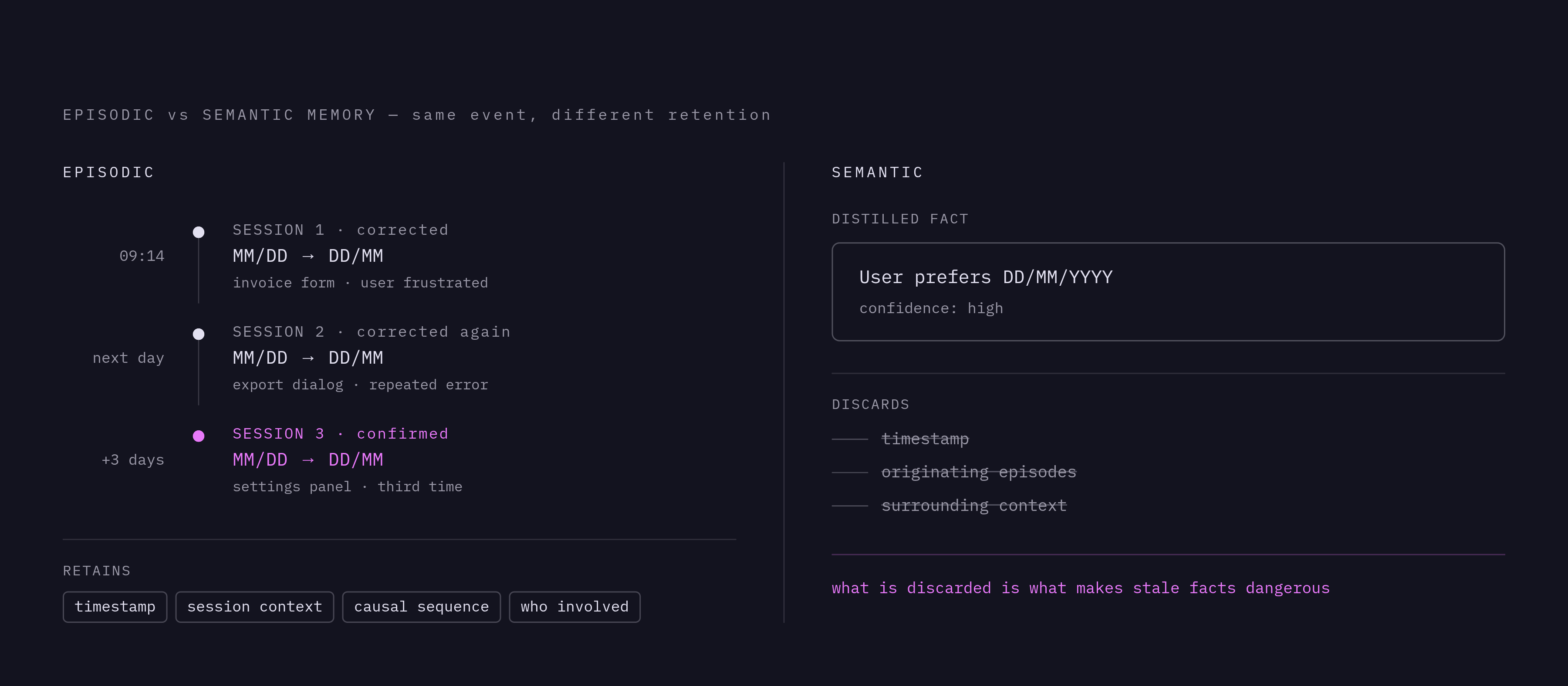
The process connecting these two memory types is called consolidation: repeated episodic events get abstracted into a standing semantic fact. It's also the most fragile step in the entire architecture, and most production systems handle it with heuristics nobody has really validated. The basic mechanism is simple enough. An episodic record showing that a user corrected a date format on three separate occasions can consolidate into a semantic entry: "user prefers DD/MM/YYYY." Once that generalization exists, the agent applies it going forward without needing to replay the three original corrections.
In practice, most systems build this consolidation step out of either hand-written developer rules or periodic summarization runs driven by another LLM call. Both approaches share the same weaknesses. Both are hard to audit after the fact. Both can break quietly, producing a wrong fact that looks exactly as confident as a correct one. The broader architectural vision calls for four integrated memory layers, working, episodic, semantic, and procedural, but most real deployments only build two of those layers well, and the handoffs between layers run on heuristics nobody formally specified.
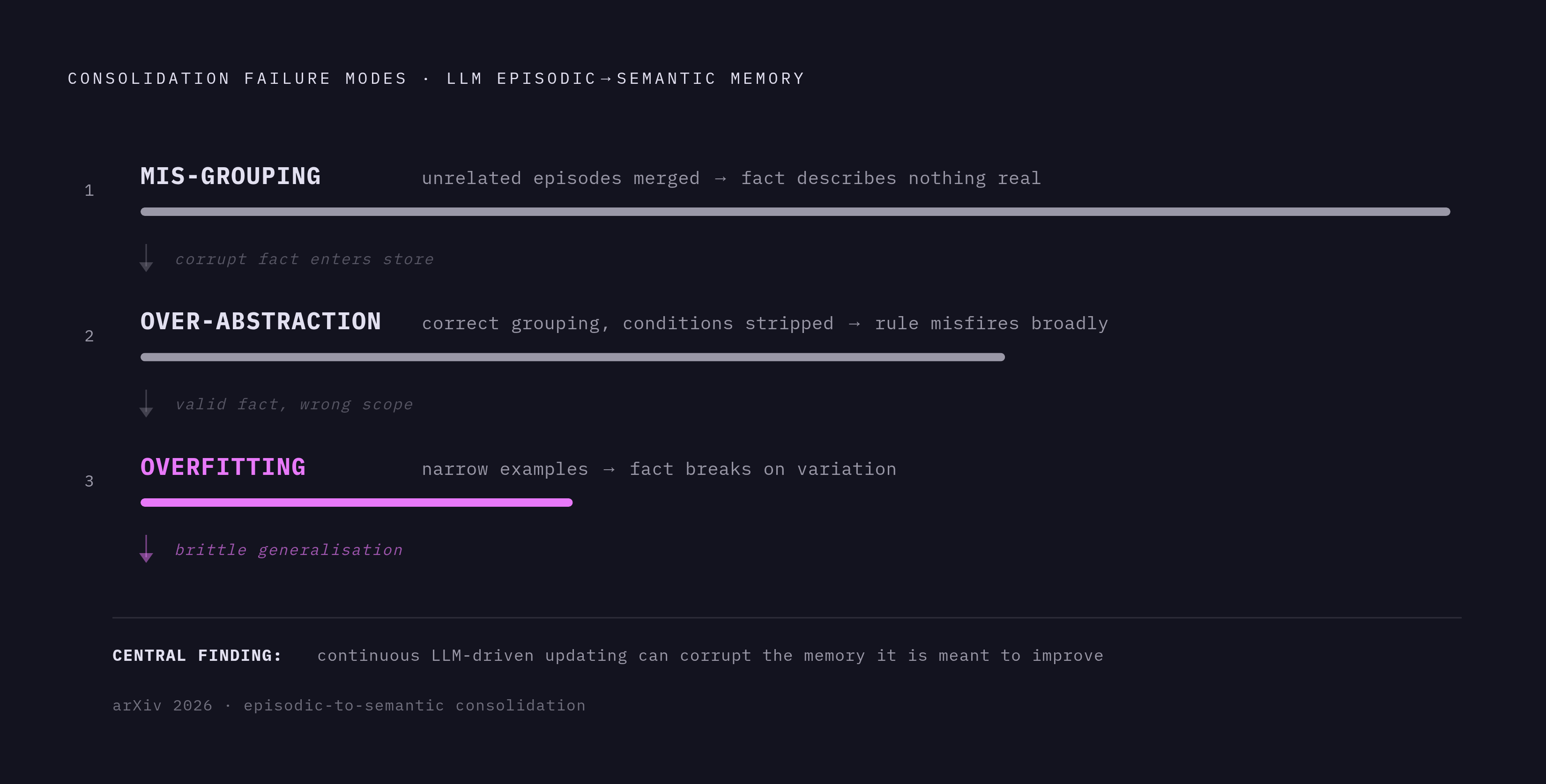
A 2026 arXiv paper lays out three specific ways this consolidation step fails. The first is mis-grouping: the agent pools together episodes that don't actually share any real underlying structure, then abstracts a fact out of that mismatched group, so the resulting semantic entry doesn't accurately describe any of the events it was supposedly drawn from. The second is over-abstraction. Even when the grouping is correct, the abstraction step can strip away the specific conditions under which a lesson applies, so an overly broad rule ends up interfering with tasks it was never meant to touch. The third is overfitting: when the agent has only seen a narrow slice of examples, the resulting fact fits that narrow slice perfectly and falls apart the moment a slightly different situation comes along. The paper's central finding is stark: continuous LLM-driven updating can corrupt the very memory it's supposed to be improving, turning good episodic records into faulty abstractions through the buildup of these three failure modes.
Two different architectural responses have shown up in research systems trying to deal with this. One approach runs consolidation as an explicit, separate step that the agent or developer triggers directly. The other, described in a paper on an episodic-semantic memory architecture for long-horizon scientific agents, decouples memory management from the main inference path. Every exchange between user and agent triggers a background consolidation process, run asynchronously by a separate LLM, so the user-facing model never has to reason about memory operations. It simply receives both the raw episodic buffer and the consolidated profile as input, already assembled. Even when consolidation works exactly as intended, though, it creates a new vulnerability: a fact that was true the day it got written down doesn't stay true forever, and nothing about the consolidation process checks on that later.
Why stale semantic facts are more dangerous
A semantic fact that was consolidated correctly and then never revisited turns into something worse than a gap. It becomes a confident lie. The agent treats it as settled truth and acts on it, while the user has no way of knowing why the agent keeps behaving incorrectly.
The clearest version of this problem: a user migrated their codebase from Python 3.10 to Python 3.12 two months ago, but the agent's semantic store still holds the old version preference. The agent keeps confidently writing version-specific code for a runtime the user stopped using months earlier, and it does this with the same tone of certainty it would use for a fact that's actually current. That's the real danger. Missing episodic memory produces uncertainty. The agent says, in effect, "I don't know," and a careful user can catch that and fill in the gap. Stale semantic memory produces false confidence. The agent says "I know," and it's wrong, which is a much harder failure to catch because nothing about the interaction signals that anything is off.
Most frameworks never answer a key question: when should an old semantic fact yield to new information? Without an explicit policy, systems default to whatever got retrieved first, which is not a decision anyone actually made on purpose. Fixing this requires three concrete design choices. The first is a freshness metadata scheme: every semantic entry needs a timestamp, a record of which episodes it came from, and some count of how many times it's been confirmed versus contradicted since. The second is a decay policy, a sense of how long a given type of fact should be trusted before it needs re-checking. Preferences and environmental details, like API endpoints, runtime versions, or who's currently on a team, have a much shorter natural shelf life than durable facts like an allergy or a person's core identity. A single blanket expiration time applied to everything is a blunt tool, but it beats having no expiration policy. The third is a conflict resolution rule: when new input contradicts a standing semantic fact, the agent needs a defined response, whether that's surfacing the contradiction and asking the user directly, updating silently, or updating while lowering its confidence in the fact. Leaving this undefined means accident determines the outcome.
One pattern makes the staleness problem actively worse instead of better: using retrieval-augmented generation as a stand-in for real episodic memory. RAG systems typically rank results by cosine similarity, which favors topical match over how recent something is. When several conversation segments touch on the same topic at different points in time, this setup can easily pull back an old, highly similar chunk instead of the current state of things, and nothing in the ranking itself flags that the result is outdated.
Retrieval strategy, latency, and memory type selection
Choosing which memory type to use for a given task is about what kind of information you're storing and about how fast that information needs to come back. Vector-only retrieval typically runs in the range of single-digit to tens of milliseconds, fast enough for real-time back-and-forth conversation. Graph traversal, the method used by knowledge-graph-backed semantic stores, runs slower, typically tens to low hundreds of milliseconds.
That gap has a direct effect on system design. Episodic memory, usually retrieved through vector search or full-text search over logs, fits comfortably inside a live conversational agent's response time. Semantic memory backed by a knowledge graph often doesn't fit that same window, unless the graph stays small or the queries running against it are tightly constrained. Episodic memory's value comes largely from preserving temporal and contextual detail: the session ID, the timestamp, what happened right before a given decision. The infrastructure hosting that memory has to keep all of that intact across sessions without losing track of it. Platforms built specifically for per-user agent isolation can bake that kind of memory handling directly into the persistence layer, rather than leaving founders to wire it manually into every single agent they deploy. Agent37 is one example of a platform taking that approach.
Research into alternative semantic memory designs suggests the latency tradeoff isn't fixed. Memanto claims high-fidelity semantic memory without a full knowledge graph: its typed semantic schema, combined with information-theoretic retrieval, reaches sub-ninety-millisecond latency using a single retrieval query, with no ingestion cost and no LLM-mediated extraction step. On the LongMemEval evaluation suite, it reaches 89.8% accuracy, matching or beating hybrid graph architectures on both the LongMemEval and LoCoMo benchmarks. That result matters because it breaks the assumption that semantic depth always costs retrieval speed. For a team deciding how to structure an agent's memory, the real question is which type of memory the task actually needs, how fresh that memory has to be, and how fast it needs to come back, and building the architecture around those three answers rather than around whichever approach seems more sophisticated on paper.