Working Memory vs Long-Term Store Partitioning in Agent Architecture
Agents need separate working and long-term memory layers to avoid costly failures.
A support agent forgets the account ID a customer gave it three turns ago, and a human has to step in to finish the job the agent was supposed to handle alone. That single failure cancels out the entire reason the agent was built: it was supposed to save a human's time, and instead it spent it. This failure recurs constantly across real deployments, baked into how large language models work, and it only becomes visible once an agent is running in front of real users doing real tasks over real stretches of time. An agent that can't remember a past failure repeats it because nothing about that failure was written down anywhere the next run could find it. Fixing that takes an architecture that gives the agent somewhere to put what it learns, not a smarter model.
The model itself worked fine.
The context window is the agent's working memory. It holds whatever the agent is dealing with right now, but its capacity is fixed, and fixed capacity means it cannot double as a permanent record. The context window produces three problems as it fills. First, "needle-in-a-haystack" retrieval gets worse as the window approaches its limit: the model can technically still reach distant tokens, but finding the right one among thousands gets harder and more expensive. Second, cost scales with every token sent, so a session that runs long gets expensive fast, not gradually. Third, feeding the model large volumes of tokens slows down Time to First Token, and the user sits there waiting longer before anything comes back, a delay felt directly at the interface.
Activepieces' 2026 agent memory guide states the business consequence: without a dedicated memory layer, a team is stuck choosing between high operational cost and low functional usefulness, and there's no middle option inside a single context window. The obvious objection here is that context windows keep growing, so maybe the problem solves itself once windows get big enough, but it doesn't. Even a very large context window gives an agent no persistence between sessions, no way to prioritize what matters, and no sense of which facts carry more weight than others. Those are architectural gaps, not capacity problems, and no amount of extra tokens fills them.
Mem0's architecture guide draws a line here worth holding onto. Context is what the model works with right now. Memory is what the agent keeps and can pull back later, across sessions, across tasks, across weeks. Chat history is a raw, unfiltered transcript, not memory, which is something distilled and structured, built from that transcript but not identical to it.
The two-layer architecture the field has converged on
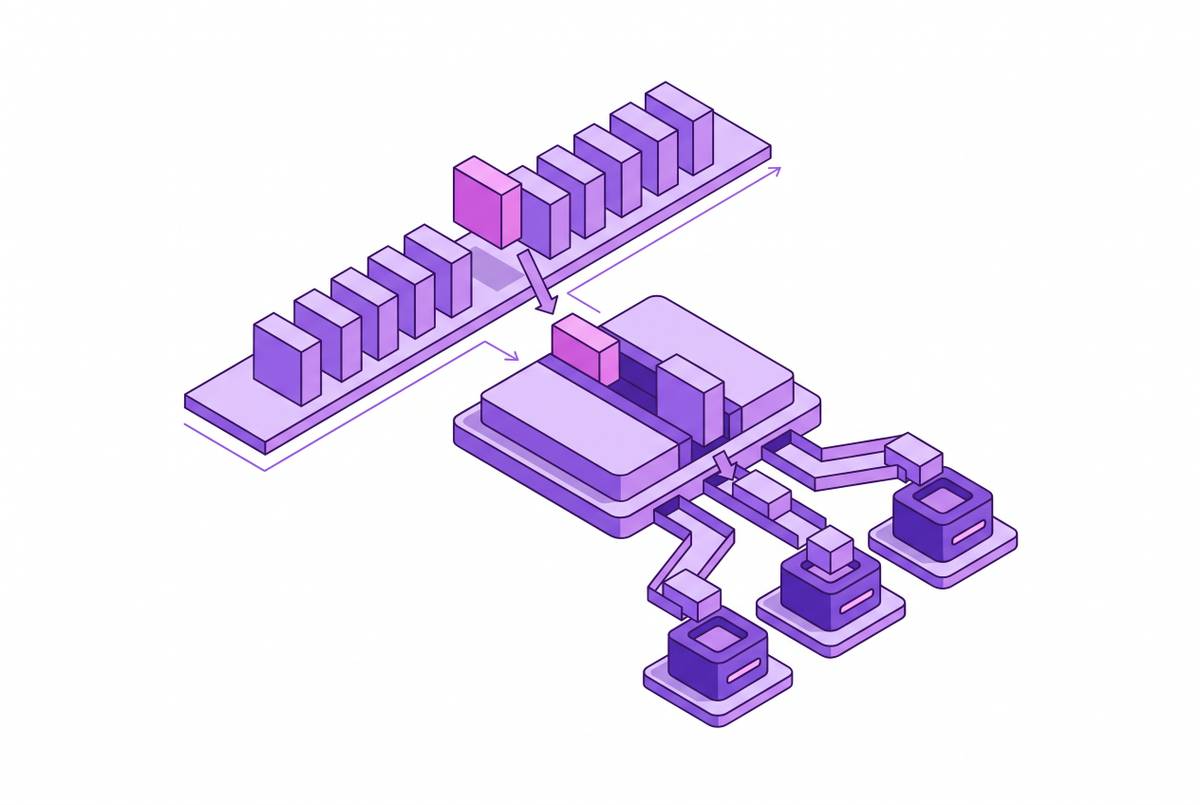
The field has settled on a two-layer split: a short-term working memory for the task directly in front of the agent, and a long-term store that holds knowledge across sessions, across users, and across time. What's on a desk right now is short-term memory; what's filed away in a cabinet down the hall is long-term memory.
Short-term memory, per Analytics Vidhya's piece "Architecture and Orchestration of Memory Systems in AI Agents," holds recent conversation history, system prompts, tool outputs, and the agent's own reasoning steps, all inside the active context window. It's built to disappear: once the session ends, that data is gone. Most systems clear it out using FIFO queues, pushing the oldest information out as new information comes in, and that's simple to build but genuinely risky, because what gets pushed out first is sometimes the thing that mattered most.
Long-term memory splits into three working categories. Episodic memory logs past actions and their outcomes, so the agent can repeat what worked and steer clear of what didn't. Semantic memory holds facts, like user preferences, policies, or domain knowledge that should carry forward regardless of which session they were learned in.
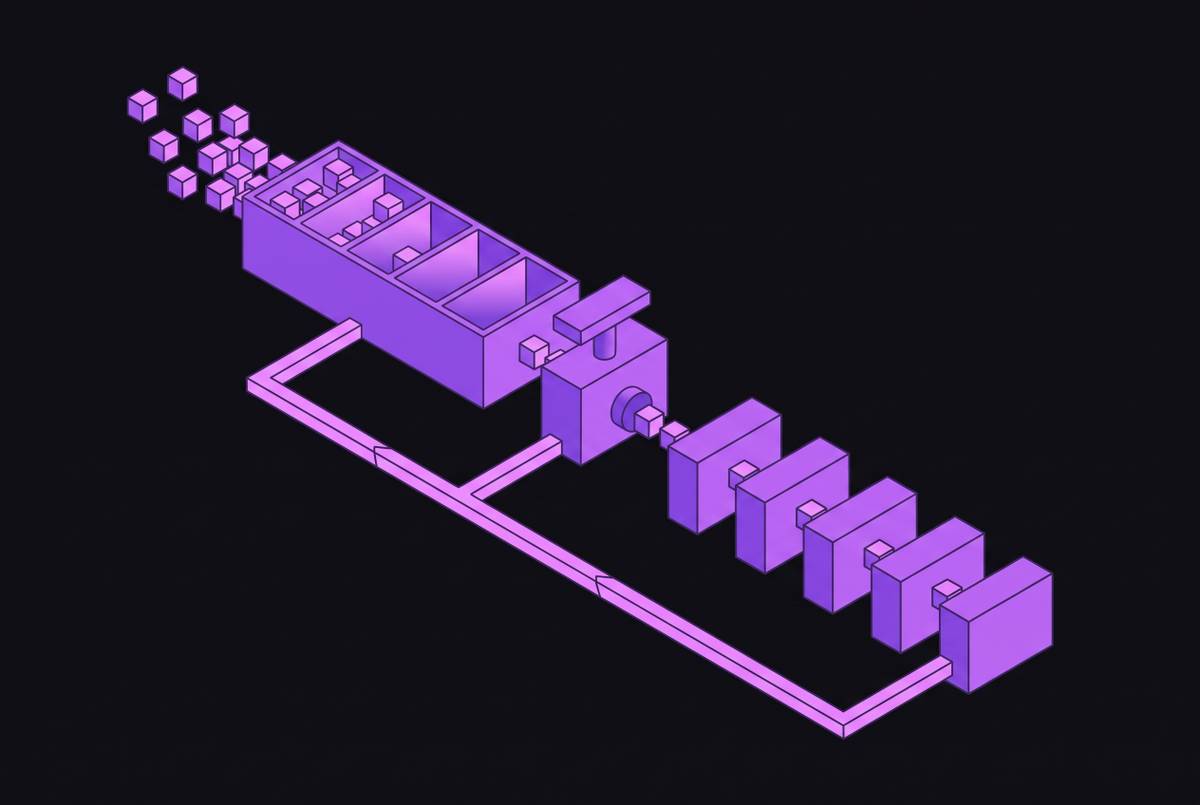
Analytics Vidhya frames this with an operating-system comparison that lands well: frameworks like MemGPT build a memory hierarchy the same way a computer does, keeping a small working memory active while pushing less urgent information out to external storage and pulling it back only when it's actually needed. That's what lets an agent handle a task that spans hours or days without blowing through its token limit.
Mem0's architecture guide names three pillars that separate real memory from the illusion of it: state, the agent knowing what's happening right now; persistence, retaining knowledge across sessions; and selection, judging what's actually worth keeping. If the agent misses any one of those three, it is still stateless, no matter how big its context window gets.
Retrieval mechanics for the long-term store
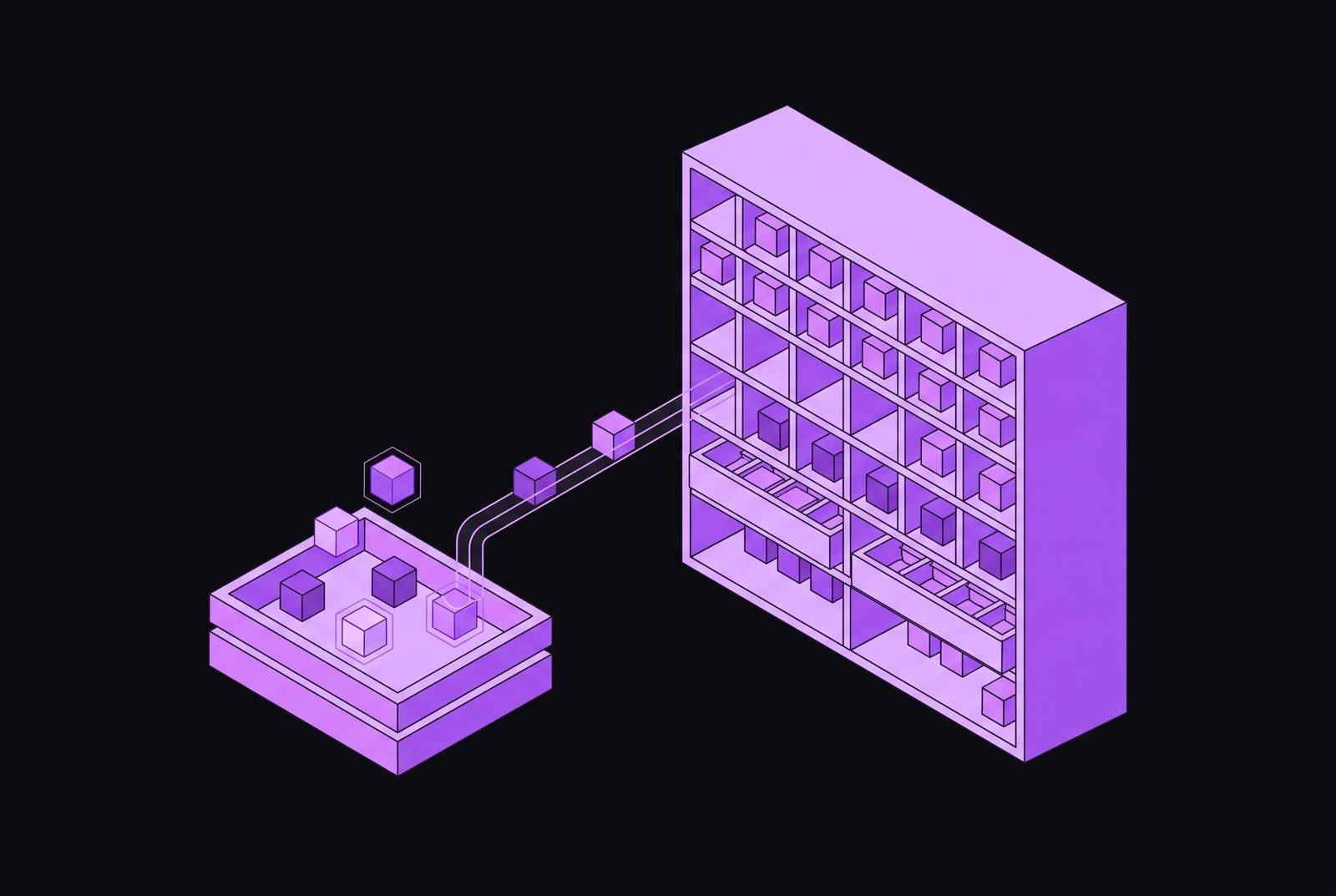
In production, the long-term store is almost always built on vector search. Past steps, tool outputs, and user feedback get embedded, and when the agent starts a new step, it pulls back the top handful of semantically relevant chunks. This works well for finding things that are similar in meaning, and far less well for finding things in exact sequence or at a precise point in time, which shapes what the store can and can't reliably answer. Pinecone and Weaviate hold embeddings permanently, so the agent can query its own history without a developer manually re-feeding it every turn. But that query has to leave the model and hit an external database, and that round trip adds latency that simply doesn't exist when the agent is just reading from its own context window.
Three branches of this architecture exist right now. One is the curated working view: MemGPT pages a small working context over a much larger store, and PEEK keeps a fixed-budget "context map" instead. A second is retrieval over stores with no fixed size, using vector retrieval with decay or graph-structured memory. The third is the commercial extraction pipeline: Mem0 pulls durable facts out of interactions and manages them directly, Zep runs a bi-temporal knowledge graph built for fast relational retrieval, and LangMem plugs natively into LangGraph with support for procedural learning.
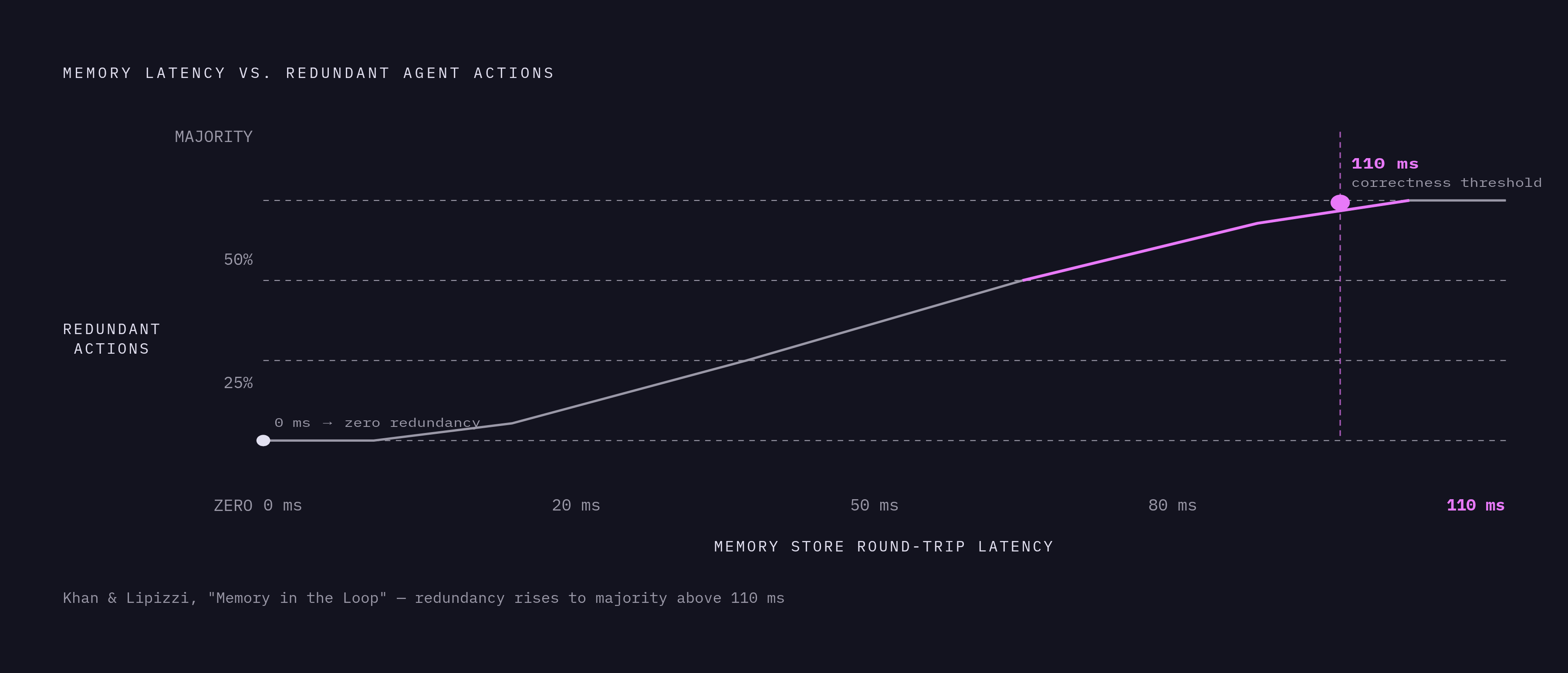
The strongest evidence that this isn't just an engineering preference but something with measurable consequences comes from Khan and Lipizzi's paper "Memory in the Loop," which found that the speed of the memory store, not only what's stored in it, directly affects how well the agent performs the task. Under a fixed memory budget per turn, redundant actions climbed steadily as the store got slower, going from zero redundant actions at in-process speed up to a majority of actions being redundant once round-trip latency hit 110 milliseconds. A networked vector store forces the agent to ration how often it checks memory, while an in-process store removes that rationing entirely, and that changes the actual outcome of the task, not just how fast it runs. Across the board, a bounded context window alone drove recall down to zero across GPT-5-class models, while adding in-loop, in-process memory recovered most of that recall, with whatever misses remained traced back to how the agent decided what to read, not to the store itself. Past a certain number of turns, a gated in-process store actually costs less than the token cost of restating everything every reply, at the same accuracy. Store speed is a design decision with a direct, measurable effect on whether the agent does its job correctly.
Cloudflare's April 2026 private beta of Agent Memory runs on this same logic: a managed service that pulls durable facts out of agent conversations, stores them, and serves them back through parallel retrieval instead of replaying the full raw conversation every time.
Memory management between the layers (what to summarize, what to discard, what to keep)
Nothing about the boundary between short-term and long-term memory runs itself. It takes active management logic, and the naive version, FIFO discard, reliably throws away important information at exactly the worst moment.
Analytics Vidhya lays out smarter strategies for handling that boundary. One is watching token usage in the working context and, as it nears its limit, prompting the model to summarize and push key details into long-term storage before anything gets dropped. Another is asynchronous semantic consolidation: compressing and reorganizing episodic memory into higher-level semantic knowledge in the background instead of just discarding it once it's no longer immediately useful. A third is intelligent forgetting: not everything should stay forever, and decay functions keep the long-term store from filling up with stale or contradictory facts that make retrieval worse over time. A fourth is conflict resolution, since a user changes a preference or a policy gets updated, and the system needs a way to settle which version wins, usually through temporal weighting or semantic merging.
The Mi-Memory lifecycle framework turns this into four formal roles, tied together by an audit contract. Structure, called MemStack, layers memory from raw facts up to reusable behaviors, covering facts, summaries, profiles, and skills. Expansion grounds memory in multimodal and cross-device evidence instead of relying on dialogue alone. Evolution governs how memory policies change over time without quietly breaking some hidden slice of what the system already knew about a user. Deployment, called LiteMem, is memory built to survive the real constraints of edge environments, including latency, cost, privacy, and the mix of cloud, edge, and local systems it has to run on.
Most organizations running agents today have built the memory layer but not the governance layer sitting on top of it. That gap is where stale context lingers, where access controls quietly fail, and where small regressions pile up unnoticed. It's also exactly the gap that turns a performance problem into a security problem.
The long-term store as an attack surface (memory poisoning in production)
Long-term memory is also the main attack surface in agentic systems. It's the main attack surface in agentic systems, precisely because it keeps shaping the agent's behavior long after the original interaction ends. An attacker who corrupts one entry in that store can skip the current session entirely and still compromise the agent. Every future session that retrieves that entry inherits the corruption. Mem0's architecture guide and supporting research both note that attack success rates jump once agents are built to check memory before responding, because the retrieval step itself becomes the thing an attacker targets. OWASP has formally named this: it's listed as ASI06, Memory & Context Poisoning, in its 2026 Top 10 for Agentic Applications.
The Microsoft Security Blog documented a real case in February 2026, describing "AI Recommendation Poisoning," in which attackers corrupted persistent memory to manipulate financial guidance and operational decisions inside an enterprise.
The Moltbook case is the clearest public example of what happens when memory architecture and security architecture are treated as separate concerns. Researchers at the cybersecurity firm Wiz found an exposed Supabase API key sitting in front-end JavaScript code, giving full read and write access to production data. The exposure reached 1.5 million API authentication tokens along with private messages between agents, and it revealed something else just as telling: a small number of human owners controlled a disproportionately large population of registered AI agents. The failure sat outside the model. It sat in the persistence layer connecting agents to each other and to user data.
The pattern behind nearly every one of these incidents is the same: strong sandbox isolation paired with wide-open credentials. Teams build a tight, well-contained environment for their code to run in, then hand that container a long-lived, broadly scoped API key with unrestricted egress. The container holds the code just fine. It does nothing to stop the damage a single poisoned memory entry can direct once it's inside.
Per-user memory isolation (why the partitioning question maps onto multi-tenant architecture)
Everything above scales differently once a single agent deployment serves more than one user. A memory store built for one user's facts, preferences, and history has to become a store that keeps thousands of users' facts, preferences, and histories cleanly separate, and that's no longer a memory design question alone. It's a multi-tenant architecture question, the same one that cloud infrastructure teams have been solving for databases and storage systems for years, now showing up inside the agent's own memory layer.
A long-term memory architecture that correctly separates episodic, semantic, and procedural memory but fails to separate tenant from tenant has solved the easier problem and left the harder one untouched. The partitioning boundary that matters most runs around each user's slice of the long-term store, not just between short-term and long-term memory. It's the boundary around each user's slice of that long-term store, enforced with the same rigor normally reserved for the database layer itself, because that's precisely what the memory layer has become.
Sources
- Short-Term vs Long-Term Memory for AI Agents: 2026 Guide
- AI Agent Memory: Complete Guide & Architecture
- Architecture and Orchestration of Memory Systems in AI Agents
- Memory in the Loop: In-Process Retrieval as Extended Working Memory for Language Agents
- Mi-Memory: A Lifecycle Memory Framework for Personal AI
- Eywa: Provenance-Grounded Long-Term Memory for AI Agents