Task Timeout Budgets and Cascading Deadline Propagation in Agent Pipelines
How four separate clocks in agent pipelines create mysterious timeouts and cascading failures.

A production agent pipeline doesn't run on one clock. It runs on a chain of clocks, each with its own owner, its own start signal, and its own idea of when time runs out. Missing that means you'll write timeout logic that fails in ways that look like model errors, tool bugs, or flaky infrastructure, when the actual problem is that nobody decided who owns the clock.
The four clocks running inside every agent step
Most people building on agent frameworks think of a single step as one bar on a timeline: prompt goes in, model thinks, tool runs, result comes back. Set a timeout, call it a day.
That picture is wrong, and it's wrong in a specific, mechanical way. A single agent step actually runs on four separate clocks:
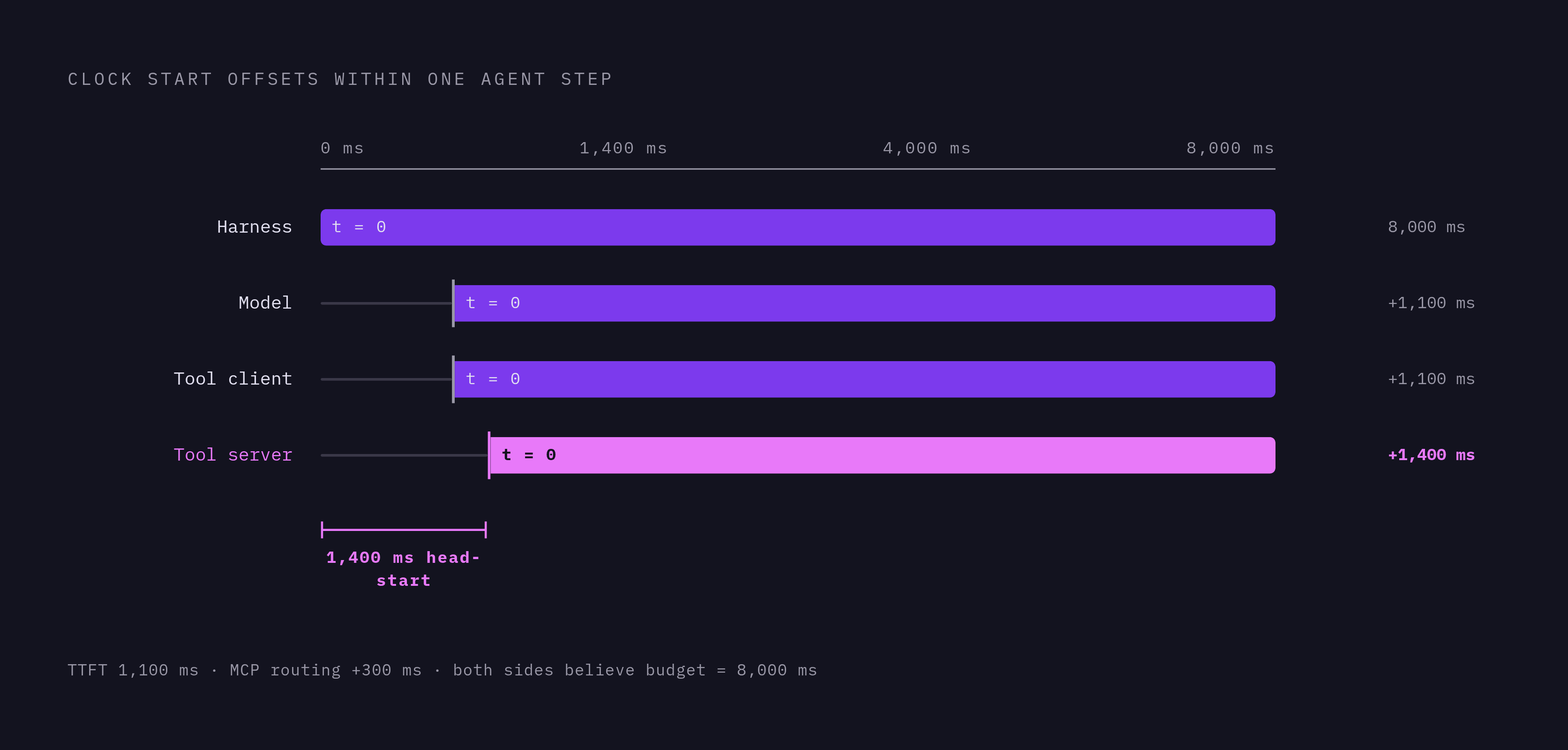
The agent harness clock starts the moment the request goes out to the model. The model's effective clock is different, and the harness usually only finds out it exists at the first streamed token, what's called time-to-first-token, or TTFT. As of 2026, TTFT runs anywhere from a few hundred milliseconds to a couple seconds depending on the model and load. Then there's the tool client clock, which starts when the harness fires off a tool call and stops when that tool returns, the thing most frameworks expose to you as a "per-tool timeout." And the tool server clock, which only starts once the tool process actually gets the request, underlies all of that. Anything sitting in front of it, a queue, an MCP router, a reverse proxy, adds latency the tool itself has no way to see.
This isn't clock skew in the NTP sense, where two machines disagree by a few milliseconds because their oscillators drift. This is disagreement about what counts as t-zero.
TianPan.co walks through a worked example that makes this concrete. Say the model's first token lands 1,100 milliseconds after the harness sends the request. MCP routing tacks on another 300 milliseconds. By the time the tool worker starts counting its own 8-second budget, 1.4 seconds have already burned off the harness's 8-second budget. Both sides think they've got 8 seconds. Both sides think they've got 8 seconds, but they don't. One of them is already 1.4 seconds behind before it even starts counting.
What clock drift produces in production: the race between a "failed" tool and a successful result
Here's where that 1.4-second gap turns into an actual production bug, not just a rounding error nobody cares about.
Say the agent gives up on a tool call at 7.9 seconds. The tool itself finishes at 8.0 seconds. Both sides write a clean, successful-looking entry to their own logs. Neither log is lying. They're just describing two different realities that no longer agree with each other.
That mismatch appears downstream as three distinct-looking failures, and each one tends to get diagnosed as its own separate bug:
A tool call finishes successfully, but nothing is listening for the result anymore, because the agent's coroutine already got cancelled. Some harnesses log this as "tool_use without matching tool_result," which reads like a protocol bug when it's actually a timing bug. Separately, the model turns around and confidently tells the user the tool failed, while the correct answer is sitting untouched in the tool's response queue. And then there's the ugliest version: the agent replans, picks the same tool with the same arguments, and now two calls are racing to write a result into a state machine that has no idea which one to trust.
That replanning move is where things really compound. Replan into a brand-new budget, and you've just built duplicate calls from scratch. Replan against a budget that's already near zero, and the harness gets stuck choosing between asking the user what to do or aborting.
There's also the question of what happens to a tool result that shows up late, after the agent's deadline has already passed. The safest move is to ensure late-arriving results are not silently discarded, because plenty of tools have side effects: a database write, an email sent, a payment initiated. The agent never acknowledged it happened. That doesn't mean it didn't.
How gRPC's deadline model solves the problem the agent stack has not borrowed yet
gRPC solved a version of this problem years ago, and most agent frameworks haven't gone and copied the fix yet.
The core idea is a distinction between a deadline and a timeout. A deadline is a fixed point in time. A timeout is a duration. That sounds like a technicality, but it isn't: if every hop in a call chain gets handed the same duration and restarts its own clock from zero, every hop thinks it has the full allowance, when really it's just inheriting whatever time is left over from the hop before it.
gRPC's actual propagation rule sidesteps the need for perfectly synchronized clocks across machines: pass along a timeout with the elapsed time already subtracted out. Whatever's downstream inherits the remaining budget, not a fresh copy of the original one.
gRPC does not set a deadline automatically. You have to ask for one. And when a deadline you did set runs out, the client stops waiting and the RPC gets cancelled server-side, but the server application is still on the hook for actually stopping whatever work it kicked off. Ending the wait and ending the work are two separate acts. Most agent harnesses treat them as the same thing, and that's exactly the assumption that produces orphaned tool results and phantom failures.
Decomposing a top-level budget: what each stage is allowed to spend
The fix is a single monotonic deadline set once, at the top of the run, with every downstream timeout and retry sleep leased from what's left of it, not handed a fresh allowance of its own.
Queueing, research, tool execution, verification: all of that spends down the same task budget. Not four separate pools that happen to run at the same time. One pool, four withdrawals.
Building that decomposition out for one workflow produces the following structure:
Start from the actual business deadline and work backward. Carve out time for owner review and delivery of the final result before you even start allocating time to research or drafting. Factor in queue delay when you compute what budget is actually left to hand off to the next stage, because time spent waiting in a queue is time spent, whether or not any work happened. And keep a cleanup allowance separate from the time budgeted for the actual task, so a slow shutdown doesn't eat into work that hasn't happened yet.
Retries follow the same logic. Retries spend down the same shared budget. Recompute what's actually left before every retry attempt, and never hand a retry the original full budget as if the first attempt never happened.
The ContextVar pattern: making remaining budget visible to every call in the chain
Once there's one budget instead of many, the next problem is plumbing: how does a tool three layers deep in the call stack know how much time is actually left?
The answer that shows up in practice is a ContextVar[Deadline], a value that is in the ambient context and is readable by any code running in that call chain, without anyone having to pass a deadline object down through every function signature by hand. A nested tool call can just ask the context how much time remains.
The Deadline object itself is simple: a start time and a budget. From those values you get elapsed, remaining, and exceeded, a boolean. Calling check() raises a DeadlineExceeded error if time's already up. And Deadline.intersect() combines two deadlines to yield the binding one, which is what you want when handing a sub-budget to a nested call, since it stops one slow nested operation from quietly eating the entire remaining budget for everything after it.
A harder architectural line runs through all of this and produces the divide between cooperative cancellation and forcible cancellation.
Cooperative cancellation means the agent checks the deadline on its own, at natural pause points, before each LLM call, before each tool execution. If nothing in the code path ever calls check(), the deadline does nothing. It just sits there. A tool that runs without returning control can't be interrupted cooperatively at all; it has to be wrapped in a thread with its own future-based timeout, sometimes called the tool-timeout-wrap pattern, so something outside the tool can pull the plug on it.
Adaptive prompting is another piece of this. When remaining time drops below some threshold, inject a prompt hint, something like "only 12 seconds left, keep this short." Plenty of models respond to that by actually shortening their output, and a shorter answer that lands beats a timeout that doesn't.
Cascading failures when budgets are absent: backpressure, rate-limit spirals, and runaway cost
Skipping budget propagation entirely makes the failure mode expensive. It's expensive.
A multi-agent research tool once slipped into a recursive loop and ran undetected for 11 days. The bill came to $47,000.
The structural cause: pipelines that spawn sub-agents and fan out tool calls build unbounded work queues. Work gets generated faster than it can finish, return, or even get logged. Without a budget forcing that queue to drain, it just keeps growing.
Context stacks up on top of the cost as it accumulates in the window. Five sub-agents each producing 2,000 tokens hands the orchestrator 10,000 tokens back per cycle. Ten cycles produce 100,000 tokens of accumulated context in the window. Eventually the window fills up and response quality starts to slip, well before anyone hits an explicit error.
Then there's the rate-limit spiral. Twenty concurrent tool calls from spawned sub-agents slam into the LLM provider's rate limit at once. Each sub-agent retries on failure, and those retries stack on top of each other, so a system that should be handling five requests at a time ends up fighting itself over capacity it never had.
What benchmarks reveal about timeout budget ranges in real agent tasks
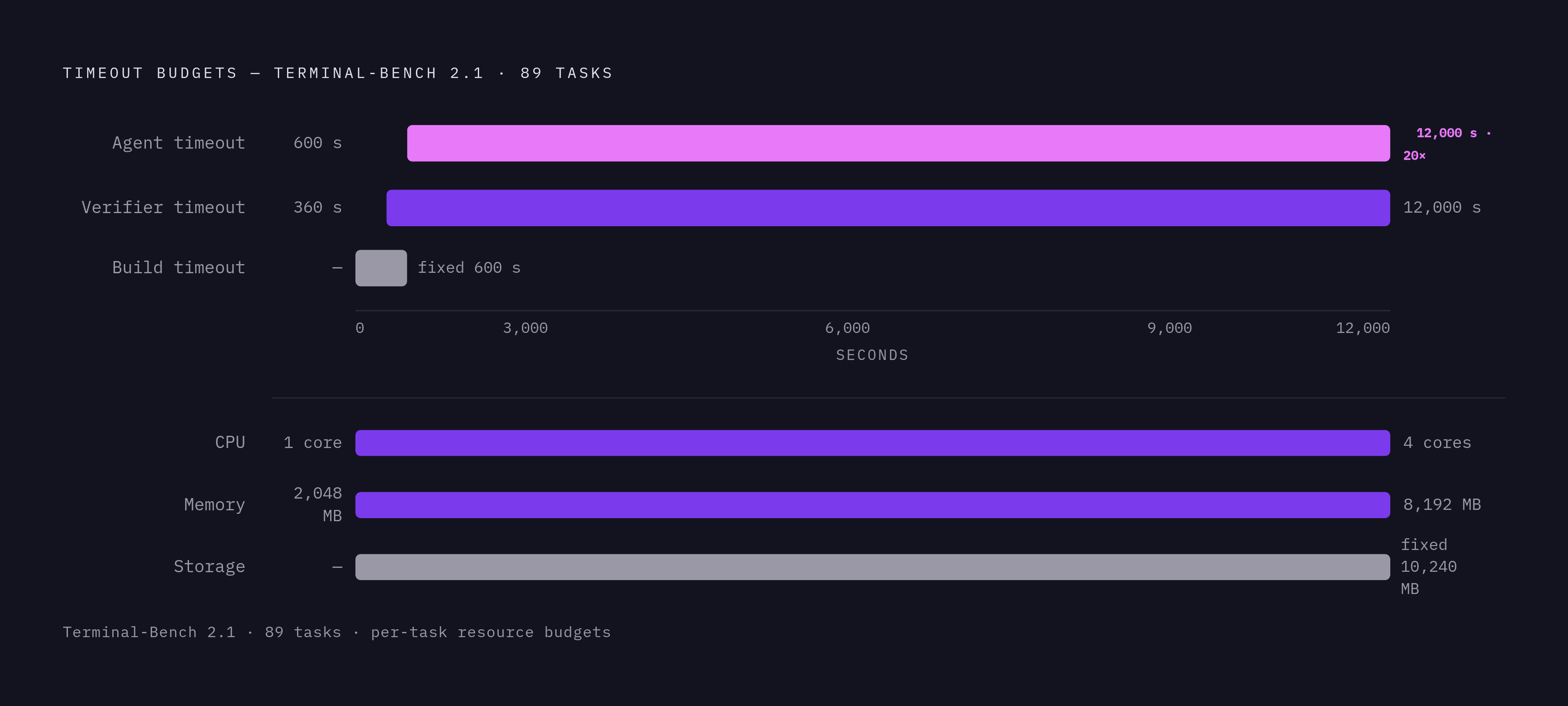
Terminal-Bench 2.1 is a useful reality check here, because it refuses to apply one global timeout across its tasks. Every task defines its own budget in a task.toml file: agent timeout, verifier timeout, container build timeout, CPU count, memory, storage, GPU count, network policy, all set independently, task by task.
Across the released 89-task suite, agent timeouts range from 600 to 12,000 seconds. Verifier timeouts run from 360 to 12,000 seconds. Every environment shares a 600-second build timeout, task allocations run from 1 to 4 CPUs, memory from 2,048 to 8,192 MB, and storage is fixed at 10,240 MB across the board.
A 20x spread in agent timeout within the same benchmark suite is the benchmark being honest about how much task complexity actually varies. It's the benchmark being honest about how much task complexity actually varies. Forcing every task through one uniform timeout would either starve the hard tasks of time they genuinely need, or burn budget on easy tasks that never needed it.
A²E adds a second axis: correctness across 23 benchmarks and 9 agent frameworks. Across 23 benchmarks and 9 agent frameworks, correctness is in a fairly tight band, 0.42 to 0.77. Planning, tool use, and efficiency, by contrast, swing far more widely between harnesses. Correctness alone doesn't tell you much about whether a given harness is managing time and cost well.
Applying budget propagation to OpenClaw, Hermes, Claude Code, and Codex pipelines
OpenClaw's Heartbeat system wakes the agent every 30 minutes by default (configurable), through the Gateway. Each heartbeat is a natural point to reset the stage budget for whatever that cycle needs to do, though the heartbeat itself is a scheduling mechanism, not a deadline propagation mechanism. It tells the agent when to check in. It doesn't tell downstream calls how much time they've got left.
OpenClaw also routes across multiple platforms, and tool client clocks can swing wildly depending on which channel a call is going through. A per-tool timeout floor stops a slow channel from quietly borrowing time that was supposed to go to a faster one.
Hermes Agent treats each skill invocation as a nested call. That nested call needs a sub-budget computed off whatever time is actually left, not a fresh full allowance handed out as if nothing came before it.
Coding agents like Claude Code, Codex, and OpenCode run into a related failure mode: agents grinding through thousands of turns before finally hitting a token limit. The fix that shows up in practice is a decision loop timeout paired with a hard ceiling on tool call cycles, so the loop gets stopped structurally instead of waiting for the token budget to run out on its own.
A clock record for one workflow: the five fields every stage boundary needs
Every clock in a pipeline needs the same five fields written down, whether it's a single-tool call or a full multi-agent workflow:
Owner: which system or process actually controls this clock. Start event: the exact action that starts it, not a vague "when the call begins," but the specific event, first byte sent, first token received, request received by the tool process. Budget: how much time this clock gets, expressed as a duration handed down from whatever's above it. Remaining: what's left once elapsed time gets subtracted, computed fresh at each hop rather than assumed. Exceeded: a clear yes-or-no signal for whether this clock has already run out, checked before any decision that assumes there's still time on the board.
Write those five fields down for every clock boundary in a workflow, and most of the failure modes covered above stop being mysterious. The tool that "failed" but actually succeeded, the duplicate call racing a stale result, the 11-day loop nobody caught: all of them trace back to a clock somebody forgot to name.