Deploying Agents Across Slack, Email, and WhatsApp From a Unified Backend
Unified backend architecture keeps agent behavior consistent across every communication channel.
The founder instinct is always the same: find the Slack API, find the WhatsApp API, wire them up, ship it. SandBase states that the integrations themselves are the easy 20% of the work. The hard 80% is everything that happens after a message lands: figuring out who's talking, tracking what session they're in, and keeping the agent's memory straight when the same person shows up on a different app tomorrow.
Skip that hard part and the failures appear fast. Each channel integration, built on its own, turns into its own codebase that someone has to maintain separately, forever. Agent behavior starts to drift: the WhatsApp bot answers a pricing question differently than the Slack bot, because they were never really the same agent to begin with. Worse, memory doesn't travel. A customer who messaged on email is a stranger when they switch to Slack.
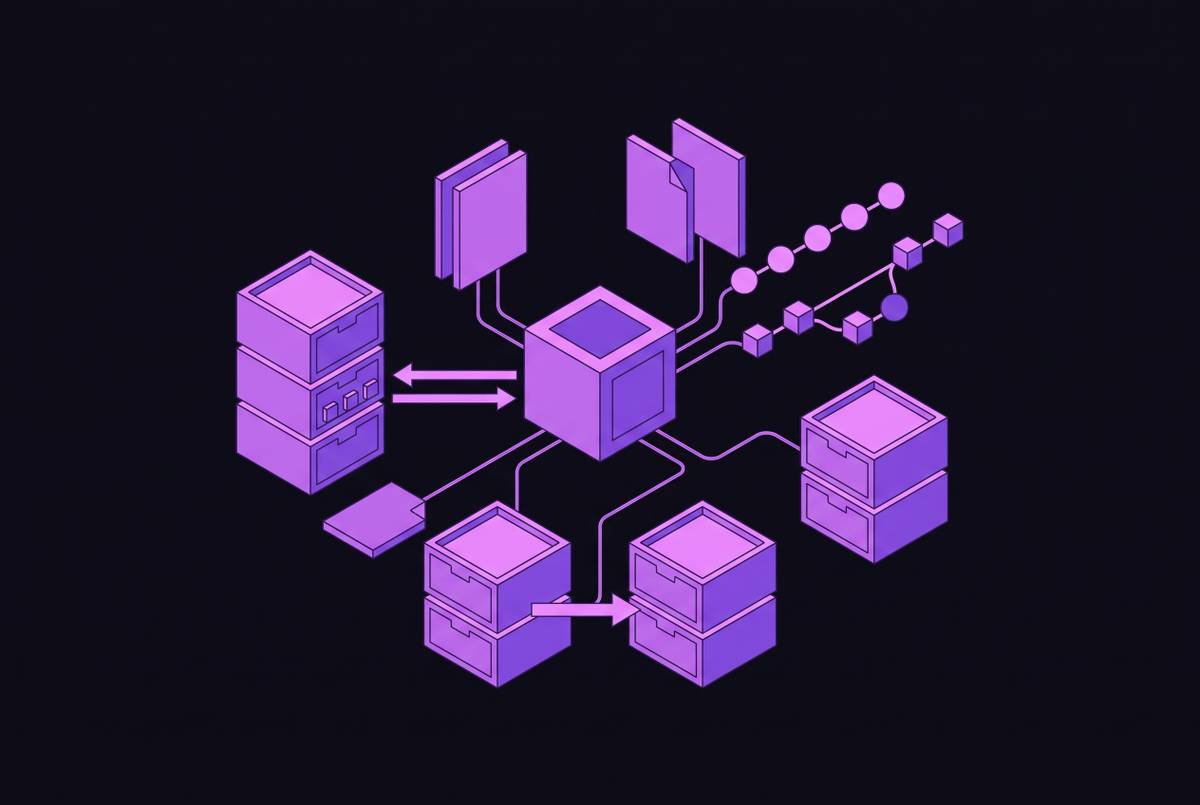
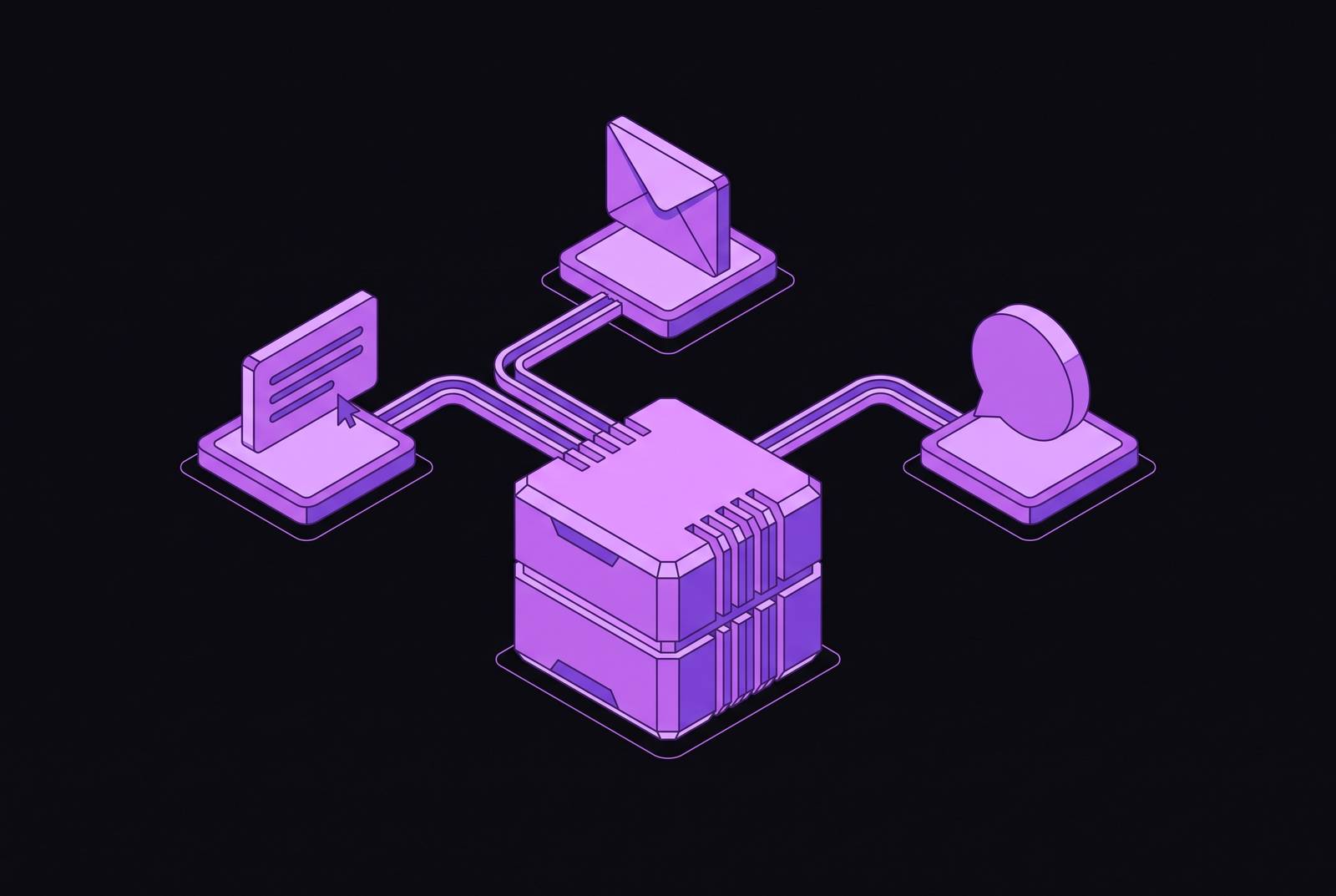
None of this is a wiring problem. It's an architecture problem, and the fix is to stop thinking about "the Slack bot" and "the WhatsApp bot" as separate things. The agent, its instructions, its knowledge, its guardrails, needs to live in one shared backend. Each channel is just a door into that backend, nothing more. Change the brain once, and every door reflects the change instantly. One brain, many doors is the model to carry through the rest of this piece.
The stakes for getting this right keep climbing. A Gartner survey found 91% of customer service leaders are under executive pressure to implement AI this year, and per Fin AI, that pressure now extends to every channel where a customer might reach out, not just the flagship one. Build the wrong architecture now, while channel count is still small, and the technical debt compounds at exactly the moment leadership expects channel count to keep growing.
What the unified backend looks like: the gateway pattern
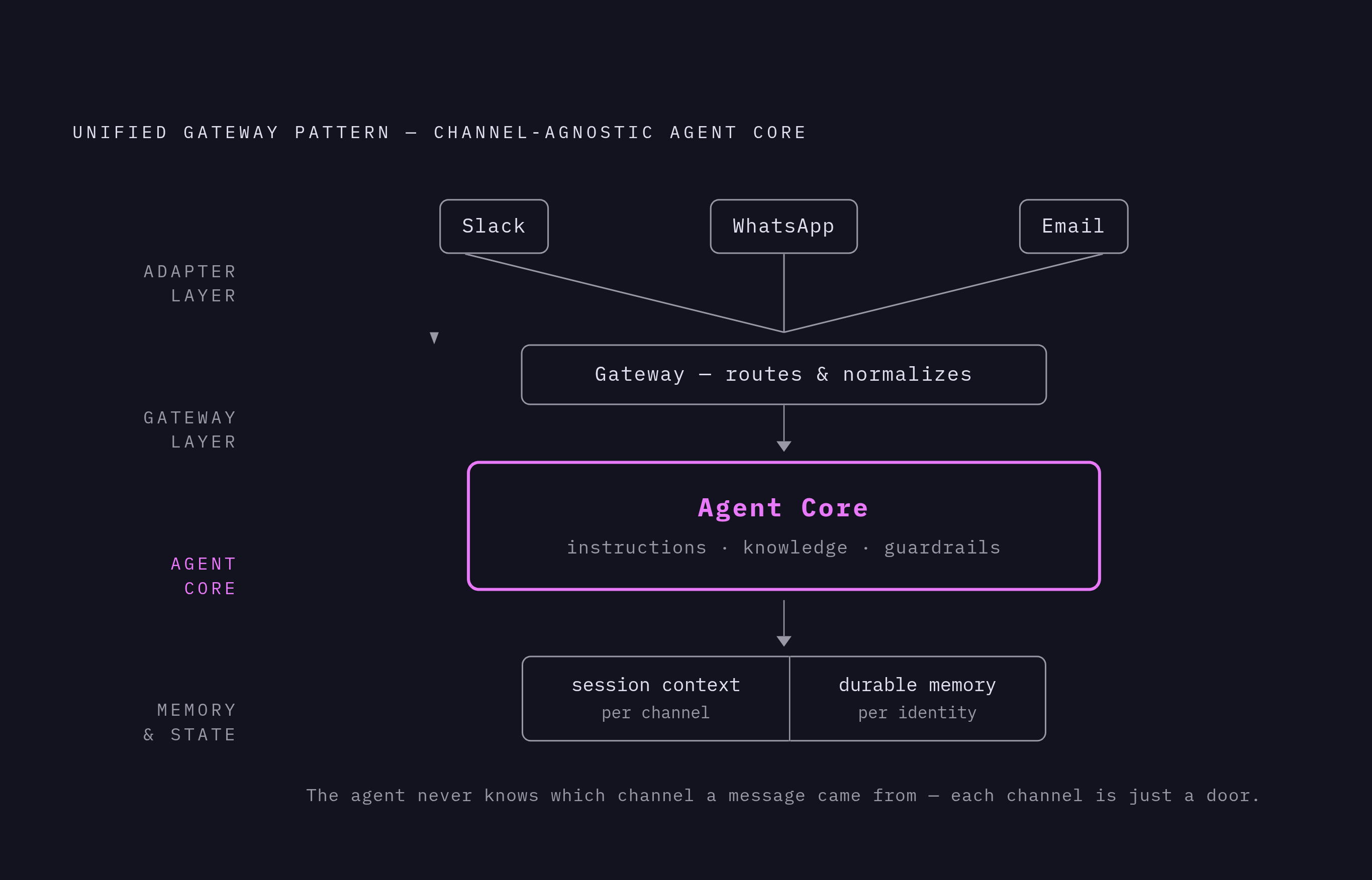
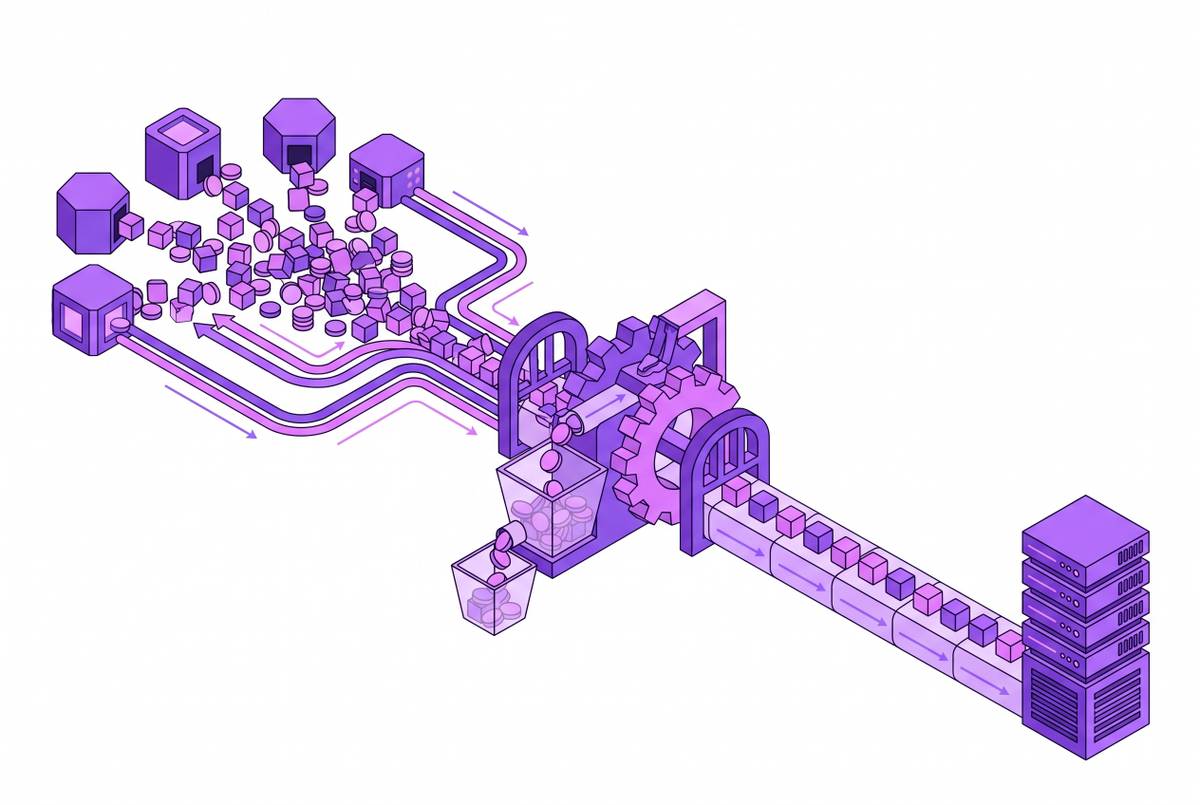
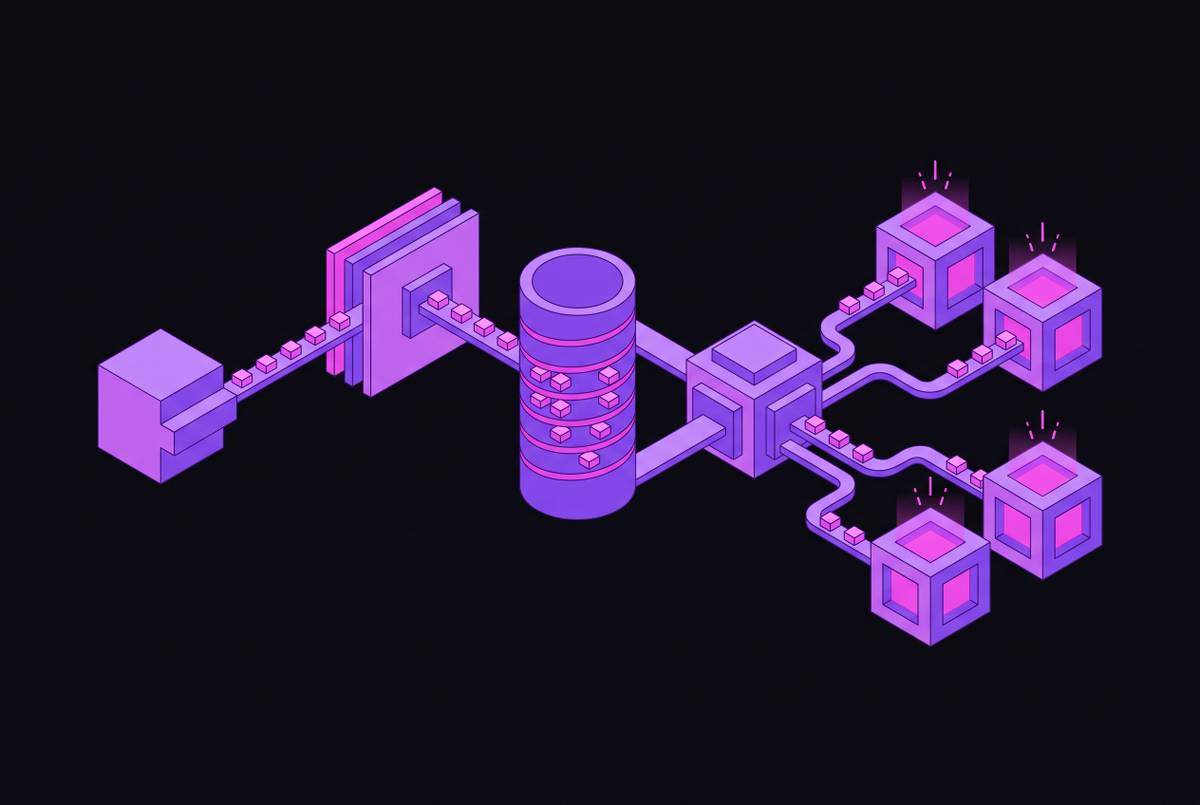
SandBase says the pattern that solves this is called the gateway, popularized by OpenClaw. The idea is straightforward even if the engineering underneath isn't: put a gateway between the channels and the agent, so nothing talks to the agent directly. Slack, WhatsApp, and email all feed into that one gateway. The gateway takes whatever format each platform hands it, whether that's a Slack event payload or a WhatsApp webhook, and normalizes it into one internal message shape the agent actually understands. From there, it maps the message to the right session and routes it in.
The reply travels the same road in reverse. The agent responds in a channel-agnostic format, plain content with no assumptions about where it's going, and the gateway handles turning that into Slack blocks, plain WhatsApp text, or a properly threaded email reply.
SandBase states the architectural rule that matters more than any other here: the agent must never know which channel a message came from. The instant agent logic contains an if channel == "slack" branch, the whole design starts working against itself. Every new platform added after that multiplies complexity instead of just adding a door.
Split the responsibilities cleanly and this gets much easier to reason about. The adapter layer, one per channel, handles authentication, webhook registration, and platform-specific formatting. The gateway layer handles normalization, session routing, and reply formatting. The agent core holds the instructions, knowledge, guardrails, and reasoning, and it stays entirely channel-agnostic. A memory and state layer holds session context per channel and durable memory per resolved identity. Add a fourth channel later, and the only new code is one adapter. Nothing about the agent core changes.
One more piece often gets treated as optional and shouldn't be: unified logging and tracing across every channel. Skip this and debugging an agent that's misbehaving across three surfaces at once becomes nearly impossible, since there's no single place to see what actually happened, AstraOps notes. This is also the real difference between "multi-channel" and "omnichannel," a distinction Pickaxe and SandBase both draw. Multi-channel usually means three bots, set up separately, quietly drifting apart from each other over time. One connected system produces omnichannel, keeping knowledge and behavior consistent no matter which door someone walks through, as Pickaxe and SandBase's distinction from multi-channel shows.
The identity problem: is the Slack user and the WhatsApp number the same person?
The gateway pattern runs into its hardest sub-problem at this point. Say @alice messages the agent on Slack, and later a phone number messages on WhatsApp. Is that the same person? The gateway can normalize the message format perfectly and still have no idea, and everything downstream, behavior, memory, context, depends on getting that answer right.
SandBase lays out three options, and they run in increasing order of both effort and risk. The simplest is per-channel identity: treat each channel account as its own separate user, with no attempt to connect them. There's no cross-channel memory, but there's also nothing to get wrong, and it covers plenty of real use cases just fine.
The middle option is manual linking, where the user does the connecting themselves, something like replying "LINK-1234" on WhatsApp to tie that number to their existing account. It's reliable because the person is vouching for the connection, but it adds a step of friction, which makes sense in higher-trust contexts where users are motivated to link accounts anyway.
The riskiest option is inferred linking: matching users automatically based on shared signals like an email address or a verified phone number. It's powerful when it works, no friction at all, but it's also error-prone. And the failure mode here isn't a bug in the usual sense. Wrongly merging two different people's memory and conversation history is a privacy incident, the kind of thing that ends up in an incident report, not a changelog.
SandBase's recommendation is to start with per-channel identity and only add linking when there's a real reason to. Most agents, honestly, don't need cross-channel identity at all. The ones that do should make the linking explicit rather than inferred, because explicit means the user knows it happened. This decision can't be bolted on after launch, either: it determines how the session store gets keyed from day one, and retrofitting identity resolution into a system that wasn't built for it is its own kind of expensive.
Email-to-Slack linking tends to be the easy case, since both often use the same work email address. WhatsApp-to-email linking is a different animal. Matching a phone number to an email address has no natural shared signal to lean on, which makes it the least reliable pairing to infer automatically.
Splitting session state and memory between channels and identities
Solve identity and there's still a second problem waiting: session management and keeping memory coherent across channels. Say identity is resolved and the system knows Alice on Slack is the same Alice on WhatsApp. If she asks something on Slack and then picks the conversation back up on WhatsApp an hour later, does WhatsApp actually know what happened on Slack?
Session context stays per channel. The back-and-forth happening in a specific Slack thread belongs to that thread, and a half-finished conversation there shouldn't leak into a WhatsApp session just because the same person is on both. Durable memory works the opposite way: it's tied to the resolved identity, not the channel, and it travels with the person no matter which door they use next.
What goes in durable memory is the stuff that should outlast any single conversation: user preferences, decisions made in past sessions, completed workflows, files the agent already generated for this person. What stays in session context is narrower and more temporary: the immediate thread, whatever task is mid-flight, formatting quirks specific to that channel.
Real persistence produces all of this, since without it nothing here works. An agent that's supposed to pick up where it left off, whether that's across channels or just across a weekend, needs a backing store that survives a restart. Keeping state in memory and hoping the process never goes down isn't a production strategy. It's a demo. This is also the practical argument for giving each customer's agent its own isolated, persistent memory store rather than a shared pool that needs careful namespacing to keep one user's data from leaking into another's session. Namespacing bugs in a shared pool are exactly the kind of privacy incident the identity section above was warning about, just arriving from a different direction. The clean architectural split (per SandBase) must be maintained between session state and memory across channels and identities.
Slack: native AI features and the role of a unified backend
Slack's own AI tooling covers more ground than people expect. On paid plans, with basic AI features on Pro and more advanced ones on Business+ and Enterprise+, Slack ships channel and thread summaries, huddle notes, AI-powered search, daily recaps, file summaries, message translation, and canvas content generation. Slackbot itself can summarize a conversation, draft an update, dig through an uploaded file, and adjust its responses based on someone's activity in the workspace. Salesforce's Agentforce goes further still, grounding agents in both Slack conversation data and Salesforce CRM data, extendable to third-party tools through Enterprise Search, though it requires its own Salesforce license and gets configured separately in Agentforce Builder.
All of that is real capability. It also has a hard ceiling: native Slack AI only sees Slack-native data. It doesn't reach into Notion, GitHub, Zendesk, or whatever proprietary system actually runs the business. Once a team needs the same agent logic, the same memory, and the same knowledge base working identically across Slack, email, and WhatsApp at once, Slack AI is no longer a substitute for that; it is one more surface the real agent needs to reach. Zentor and Dust report that plenty of teams end up running both side by side.
The production numbers on unified Slack agents back this up. Dust reports that Alan, a digital health insurer, cut project completion time by 10 to 20% using an @code-help agent inside Slack. Malt, a freelance marketplace, cut its ticket closing time in half using a Dust agent embedded directly in Slack. These are results from agents doing real work inside the channel, not just summarizing what already happened in it.
On the deployment side, the Slack piece of this stays refreshingly small. It's an installed Slack app, a registered bot user, and a listener on the Events API for message and app_mention events. That's the entire adapter. Every bit of routing, memory, and reasoning happens back in the shared backend, never inside the Slack app itself, which is exactly the separation the gateway pattern calls for.
WhatsApp: the two deployment paths under Meta's 2026 policy tightening
Pickaxe's rundown splits WhatsApp into two real paths. The official route is Meta's WhatsApp Business Platform, the Cloud API: connect a verified WhatsApp Business number, route messages through Meta's own infrastructure, and get support for templated notifications. It's the slower path to set up and the far more durable one once it's running.
The unofficial route, third-party libraries that piggyback on the regular WhatsApp client, gets a prototype running faster but comes with real fragility, including the risk of account bans. It's not something to build a customer-facing product on.
Pickaxe reports that Meta tightened its rules on general-purpose AI chatbots on WhatsApp in 2026, and anyone deploying an agent needs to check the current Business Platform policy before assuming a given use case is still fine. Policy, not engineering, is now the limiting factor for a lot of WhatsApp deployments, which is an unusual thing to have to say about a chat integration.
There's a concrete architectural consequence to this too. The WhatsApp Business API requires templated messages for anything business-initiated, and free-form replies only work inside a 24-hour window that opens once the user messages first. That means the gateway can't just fire off replies whenever the agent finishes reasoning. It has to track that 24-hour window per phone number and know whether a given response needs to be a pre-approved template or can go out as a free-form message.
The WhatsApp adapter, specifically, has to receive and verify Meta's webhook payloads, normalize text, image, audio, and document messages into the same shape everything else uses, and format outgoing replies as plain text, since WhatsApp has no equivalent of Slack's rich block formatting. On identity, WhatsApp actually hands over one of the better anchors available: a verified phone number, which makes it a solid candidate for manual linking to other channels.
Email: treating an inbox as a channel adapter, not a separate agent deployment
Email doesn't behave like Slack or WhatsApp at all. It's asynchronous, thread-based, and has no persistent connection sitting open the way a chat session does. None of that changes the architecture, though. The gateway pattern applies to email exactly the same way it applies anywhere else, which is the point teams most often miss, building a separate pipeline for the inbox instead of just another adapter.
The email adapter's job is fairly mechanical once it's laid out: parse the from address, subject line, thread ID, and plain-text body with the signature stripped out, normalize all of it into the same internal format every other channel uses, route it to the session keyed on thread ID plus sender address, and send the agent's reply back as a real email with the threading headers intact. That last part matters more than it sounds. Getting thread continuity wrong so the adapter fails to maintain the In-Reply-To and References headers means replies appear as brand-new messages instead of landing in the existing thread, which breaks the conversation from the recipient's side even if the agent's logic was flawless.
Email also turns out to be one of the strongest identity anchors in the whole stack. A sender's email address, if it matches an entry in the company's Slack directory, makes manual linking close to automatic.
Here is what separates the current generation of AI customer service agents from older chatbot builders. Fin AI's material states that the newer agents resolve complex queries end to end, take real actions in backend systems like processing a refund or checking an order, and hold onto context across channels, which is the actual difference between deflecting a ticket and resolving it. Fin AI also makes the case that social, messaging, and email conversations all need to land in one unified inbox. Siloed tools produce fragmented customer records and blind spots in reporting that become visible only once someone's trying to reconstruct what actually happened with a given customer.
Email carries sensitive customer data and is a common phishing/injection vector, so SOC 2 and GDPR compliance matter, and the gateway must sanitize inbound content before it reaches the agent. The gateway needs to sanitize inbound content before any of it reaches the agent, not after.
Choosing the agent framework that runs in the unified backend: OpenClaw vs. Hermes
Two open-source frameworks dominate this conversation in 2026: OpenClaw and Hermes.
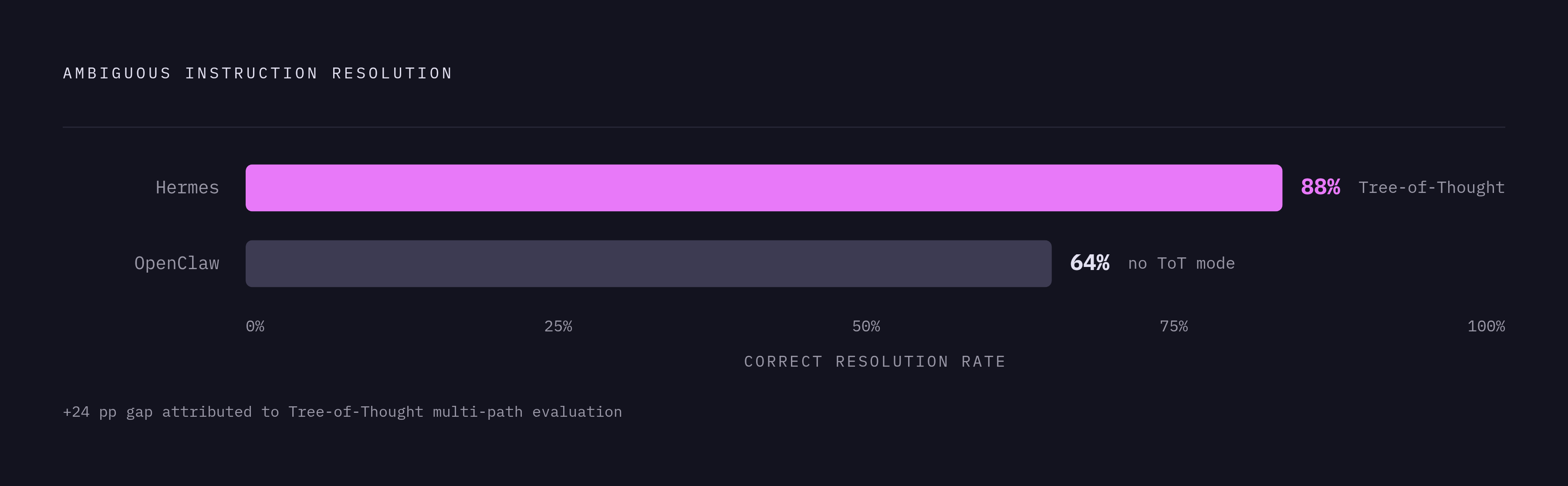
OpenClaw is open-source, MIT-licensed, and built on Node.js, now stewarded by a non-profit foundation after its creator, Peter Steinberger, joined OpenAI. It's a large project, with 345,000 GitHub stars and more than 13,700 skills as of mid-2026. It's built self-hosted first; cloud is a place to deploy it, not the default assumption, and there's no paid tier or token sitting behind it. HackerNoon reports that setup runs through Docker Compose and gets to a working state in under 30 minutes with a sizable default toolset already in place. Security-wise, it runs sandboxed execution with a command approval system that requires an actual human to sign off, and picked up patches in June 2026 for vCard and location-pin injection issues, along with tighter Docker sandbox boundaries and stricter Browser CDP endpoint validation. The gateway pattern this architecture rests on is the pattern OpenClaw popularized, giving native conceptual alignment with the unified backend architecture. It resolved ambiguous instructions correctly only 64% of the time in benchmark testing, which EasyClaw attributes to the absence of a Tree-of-Thought reasoning mode, marking its clearest weakness.
Hermes Agent, from Nous Research, is noted per multiple sources. Its repository dates to July 22, 2025, though it didn't publicly launch until February 25, 2026, and by September 21, 2026 it had climbed to 247,589 stars and 52,090 forks. Hermes also leans toward self-hosting by default, but it adds a real convenience for teams with no operations capacity: Hermes Cloud, an optional paid hosted endpoint that gets a team to its first prompt much faster. Pricing through the Nous Portal runs Free, Plus at $20 a month, Super at $100, and Ultra at $200, with Hermes Cloud compute starting at $0.29 a day while actively running. Hermes correctly resolved ambiguous instructions 88% of the time in benchmark testing, a result EasyClaw attributes to Hermes 4's Tree-of-Thought mode evaluating multiple interpretation paths before committing. Hermes also handles model flexibility more gracefully, working comfortably with open models and aggregators like OpenRouter, and letting teams route cheap models to simple skills like summarization while reserving expensive ones for heavier reasoning, all through a config file change. On security, four CVEs were disclosed in April 2026, including a path traversal issue in the WeCom platform adapter and an authentication flaw in the API server.
Both are legitimate choices for the agent core sitting inside a unified backend, and the decision mostly comes down to what a team already has running: heavier infrastructure discipline and a strong self-hosting posture point toward OpenClaw, while a need for faster reasoning on ambiguous instructions and flexible model routing points toward Hermes.
Sources
- Deploy an AI Agent to Web, WhatsApp & Slack
- Best AI Agents for Instagram, WhatsApp & Facebook - Fin AI
- How teams use Slack AI agents (2026) | Dust Blog
- Multi-Channel AI Agents: Slack, Discord & WhatsApp (2026) | SandBase Blog
- AI Slack Integration in 2026: What Actually Works | Zentor Blog
- How to Deploy AI Agents Across Slack, WhatsApp, and Email - AstraOps | The Agentic AI Platform for Scalable Enterprise Automation
- What is an Agent Gateway? A Complete Guide (2026)