Cron-Style Scheduling Reliability for Persistent AI Agents
Five scheduling patterns solve most AI agent deployment challenges in production.
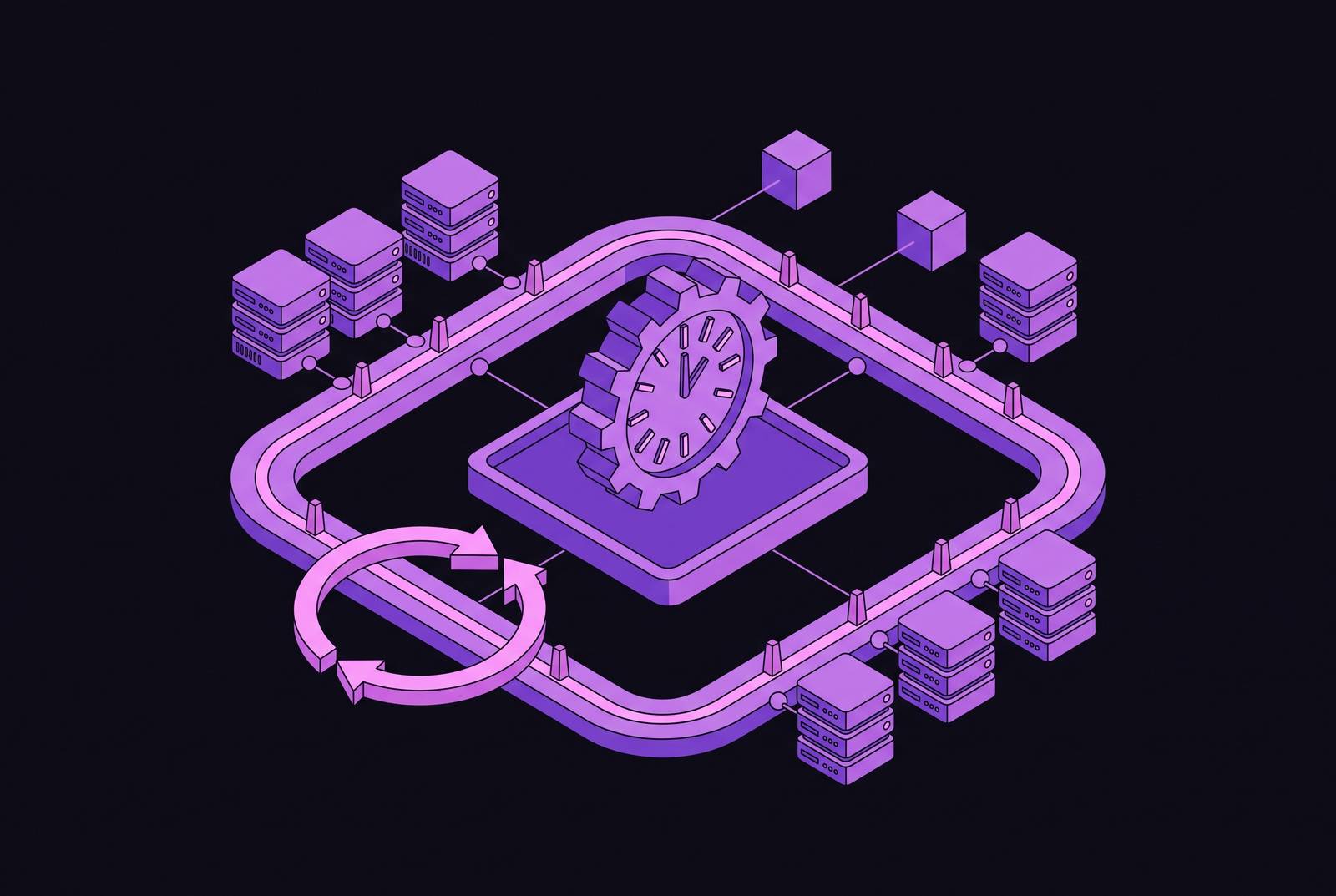
Scheduled AI agents borrow the cron mental model, run a job on a timer, but they break it in a way most teams don't catch until something goes wrong in production. A script that runs on a schedule and finishes with no memory of itself is fine for a script. It's broken for an agent, because an agent's job depends on knowing what it did last time.
The five scheduling patterns and when each applies
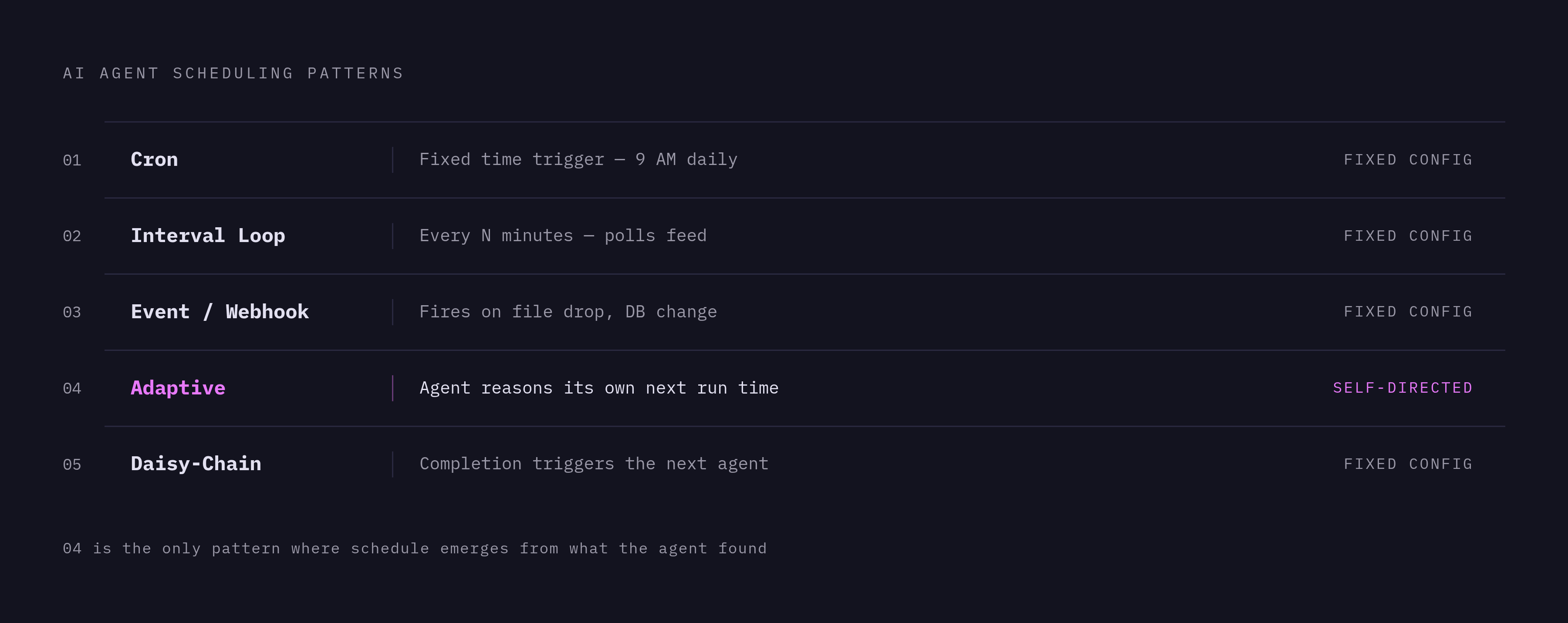
Not every scheduled agent should fire the same way. The right trigger depends on how much autonomy the agent has and how tight the resource budget is. Five patterns cover almost every real deployment.
Cron pattern: a time-based trigger, say, 9 AM every day. Good for daily reports, cleanup jobs, anything with a fixed rhythm. The timing isn't the catch; making sure the agent picks up context from its last run instead of starting cold is.
Interval loop: run every N minutes or hours. Common for monitoring agents watching a feed or a queue. Intervals drift if the previous job runs long, and that drift can go either way: sometimes it saves you from overlapping runs, sometimes it means you miss a deadline you needed to hit.
Event or webhook trigger. The agent fires off an external event, a file lands in a bucket, a database row changes, an API call comes in. This needs a scheduler built to handle dynamic triggering, not just a clock, and it needs a real integration with whatever system is producing the event.
Adaptive scheduling: the agent sets its own next run time. A monitoring agent that finds nothing interesting can sleep longer; one that spots a spike wakes up sooner. A monitoring agent that finds nothing interesting can sleep longer; one that spots a spike wakes up sooner, so the agent reasons about its own schedule rather than treating it as a fixed config value.
Daisy-chain orchestration: one agent's completion triggers the next. A research agent finishes pulling data and schedules a writer agent to pick it up. This matters most in multi-step workflows where the output of step one is the input of step two, and step two shouldn't start early.
Cron-style triggers are the wrong tool in two situations. Anything truly real-time, fraud detection, ad bidding, live pricing, needs streaming with inference running inline. And bursty workloads, like a job that has to churn through a huge record set once a day, will slam into rate limits if you run it all at once. Chunk the schedule to spread the load, or move to a streaming pipeline instead.
This has stopped being a niche feature. OpenAI shipped scheduled tasks on paid ChatGPT plans, Anthropic added scheduled and recurring tasks to Claude, and xAI shipped Automations in Grok on July 16, 2026. Three model vendors landing on the same capability within roughly two months means it's no longer a differentiator. It's table stakes.
The three reliability problems that make production scheduling difficult: state, idempotency, and silent failure
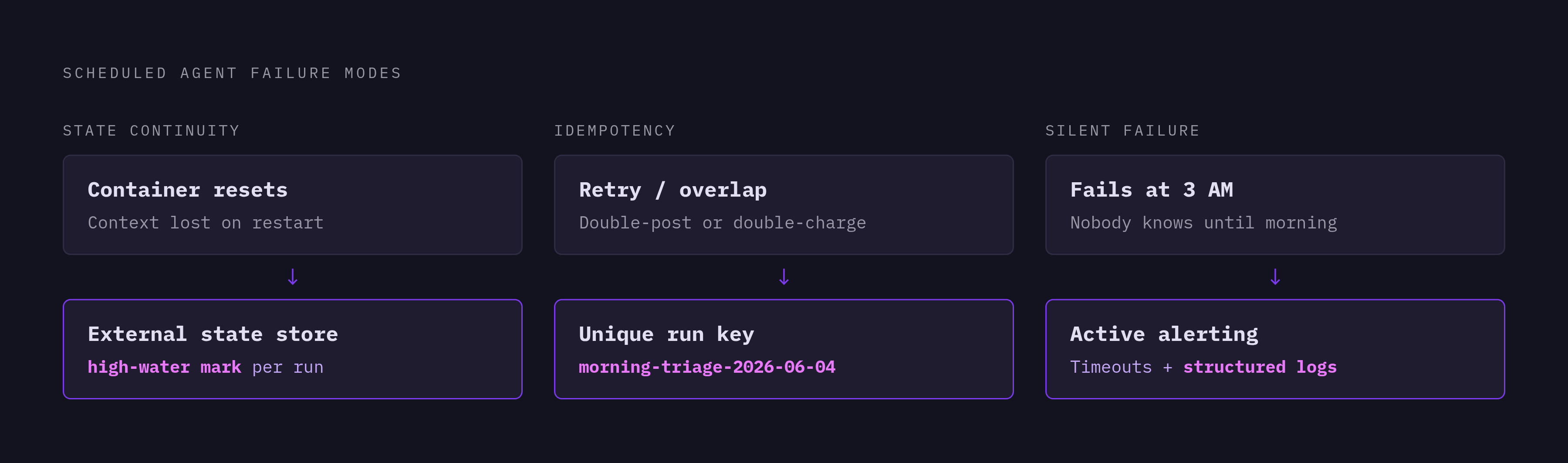
State continuity: if an agent runs in a container or serverless function that resets between runs, it loses everything it learned last time. Fix requires an external state store: the agent reads its persisted state on startup, writes updated state before it exits. In practice that's a JSON or Markdown file tracking the last processed ID, a high-water mark, a short summary of the previous run's actions. Some setups add a memory file that accumulates learnings over time, plus a date-stamped output folder for artifacts. Short-term context handles what the agent is doing right now; long-term memory holds user preferences and task history across weeks. Both have to survive the container boundary, or the agent is starting from zero every single run.
Picture a market-research agent that scrapes news and pricing data once a day. Without memory of yesterday's run, it re-scrapes the same sources and has no way to notice a trend building over several days. That's not a smarter version of the script; it's a broken one. Because episodic memory becomes a requirement, scheduling becomes part of the agent's actual thinking rather than an infrastructure detail.
Idempotency is the most common way cron-style agents break in production. The agent's logic is fine. It just ran twice, because of a network retry, a scheduler bug, or a deployment overlapping with the next scheduled run, and it double-posted, double-charged, or double-sent an email. With a script, that's annoying. With an agent that can send money or post trades, that's an incident report.
The fix is a unique idempotency key per scheduled run, something like morning-triage-2026-06-04, following a jobName_date format. Before the agent acts, it checks whether that key has already completed. Design for it from the start: an agent should always ask "did I already do this?" before doing it, so running the same job twice on the same day produces the same result, not two results.
A reactive agent that fails does so in front of someone, and gets noticed right away. A scheduled agent fails at 3 AM, and the failure stays invisible until the morning summary is absent from someone's inbox.
Guarding against that takes a few pieces working together. Mandatory timeouts matter most: LLMs can hang mid-call, so every scheduled job needs a strict timeout or it'll sit there burning credits on a stuck process. Structured logging should track execution count, success rate over the last 24 hours, 7 days, and 30 days, average run duration, and the timestamp and status of the last run. Alerting has to be active, not passive, sending a message when a job fails instead of waiting for someone to notice a gap in the output. Retry logic with backoff, plus tracking failure patterns over time, rounds it out.
Cost is part of this too. A job checking for updates every minute when every 5 minutes would do the job generates 34,560 extra API calls a month. Monitoring isn't just about catching downtime, it's about not paying for calls you didn't need to make.
What a production agent infrastructure stack requires
Production-grade scheduled agents need four layers working together, not bolted on after the fact.
Compute runs the inference and business logic, and has to survive a scheduled wakeup without losing where it left off. Persistent storage holds state, context, and artifacts across runs, ideally organized into structured, date-stamped folders with some kind of semantic index so other agents can find and use what's there. Orchestration handles multi-step workflows, retries, and dependencies between agents in a chain. Monitoring tells you what agents are doing, why they failed, and what they're costing, and it has to exist before the first silent failure, not after.
Any agent that executes generated code, runs shell commands, or touches user files needs an enforced execution boundary around it. Once agents have access to sensitive systems, security and governance stop being nice-to-haves: role-based access control, single sign-on, secrets management, audit logging, and scoped API access all become load-bearing.
Most open-source agent frameworks stop short of all this. They give you model calls, maybe some tool chaining, and leave state persistence, scheduling, isolation, and monitoring as separate problems for the developer to wire up. Hermes Agent is a useful reference point for what it looks like when a framework doesn't leave that gap: it ships skill sets, multi-layer persistent memory (multi-layer persistent memory across runs), and native cron-style scheduling as built-in features, not add-ons, along with native Stripe integration for agents doing commercial work.
How current scheduling platforms handle these problems differently
Every platform in this space makes different tradeoffs on persistence, retry handling, pricing, and how much the developer still has to build themselves.
AgentsRoom's Scheduled Tasks feature (as of September 17, 2026) bills itself as cron for AI coding agents, minus the cron expression. It works with Claude Code, Codex, and Antigravity sessions, plus custom agent roles, and lets you set frequency by minute interval, hourly, daily at one or more fixed times, weekly, monthly, or tied to an AI plan's quota window so the job runs when usage resets rather than on a fixed clock. It catches up missed runs the next time it launches and keeps a reopenable run history, so nothing gets lost switching between machines or sessions. Run history is kept reopenable so nothing gets lost between sessions. Listed use cases include a daily PR review at fixed times, an overnight crash-log scan, a weekly changelog, a recurring dependency check, and multi-agent workflows running in parallel on recurring schedules, all without writing cron syntax or manually relaunching anything.
LangSmith Deployment (the platform formerly known as LangGraph Cloud) is a managed deployment layer for LangGraph agents from LangChain. It saves state at every execution step by default, which directly solves the problem of maintaining continuity between runs. Pricing runs $0.001 per node executed, with standby costs from $0.0007 per minute in dev to $0.0036 per minute in production, and the Plus tier requires a LangSmith Plus subscription at $39 per user per month. It fits teams already building on LangChain who want managed persistence and debugging without building that layer themselves.
Trigger.dev is a background task platform built around retries, scheduling, and concurrency controls. It addresses the retry and failure-handling layer directly, and suits teams that want solid scheduling primitives without adopting a full agent platform around it.
Amazon Bedrock AgentCore is AWS's managed platform for building, deploying, and running agents, with enterprise governance, role-based access control, audit logging, and secrets management built in natively, which matters once agents are touching systems with real access requirements.
Google's Gemini Enterprise Agent Platform, rebranded from Vertex AI at Cloud Next 2026, runs its managed agent runtime through Vertex AI Agent Engine. Pricing is pay-as-you-go: $0.0864 per vCPU-hour and $0.0090 per GB-hour for memory, with a free tier covering 50 vCPU-hours and 100 GB-hours a month. It also ships visual, no-code tools for building and deploying agents.
None of these platforms solve one problem natively: provisioning an isolated, persistent agent for every individual end user, automatically, at the moment that user signs up. That's a different infrastructure question, and it's the one to dig into next.
Per-user agent sandboxing as the correct unit of scale for scheduled agents
Scheduling one agent is one problem. Scheduling one agent is one problem, but scheduling one agent per customer, for thousands of customers, poses different challenges. Each sandbox needs isolation at the per-user level, and it needs to hold state across turns so context survives between scheduled runs, not just between messages in one conversation.
Shared-state setups fall apart under this kind of multi-tenant load. One tenant's data can leak into another's context. A failed scheduled run for one customer can corrupt the working state of a completely different customer. And without a hard boundary between tenants, audit and compliance requirements become impossible to meet.
Production-grade per-user sandboxing needs several things at once: multi-tenant isolation enforced at the infrastructure level, not the application level; a persistent filesystem attached to each sandbox so state survives a scheduled wakeup; pause, resume, and snapshot capability so a sandbox can recover cleanly after a crash; scale-to-zero when idle so unscheduled sandboxes aren't burning compute around the clock; a pre-warmed pool so a scheduled run doesn't sit waiting on cold-start latency; and leader election plus per-sandbox events and metrics for observability.
The cloud API model built for this lets an operator make one API call to spin up an always-on sandbox for a given user. That sandbox accepts a cron schedule, runs unattended, and hands back results, without the operator manually provisioning infrastructure per customer. Agents supported through this model include Hermes, OpenClaw, Claude Code, Codex, or a custom harness, with files persisting between runs and billing metered per minute rather than per seat.
This opens up a white-label angle for B2B products: every customer gets a private, persistent, branded agent activated automatically at onboarding, instead of a founder manually spinning one up by hand for each new signup. Pricing for this model starts at $1.99 per month per agent instance. As of August 2026, managed hosting for OpenClaw and Hermes agents was serving more than 1,000 users on this kind of setup.
The security architecture matters specifically because these agents run unattended on a schedule, with nobody watching in real time, and that unattended operation is what makes the architecture consequential. Each sandbox runs under gVisor enforcement with its own filesystem and a hard disk quota. Hosts have no public hostname; every request comes in through Cloudflare's edge over TLS with API key authentication. Egress from each sandbox is firewalled to the public internet only, no access to the host machine, no access to private networks. Disk, backups, and metadata are encrypted at rest, and every connection is encrypted in transit. The infrastructure has SOC 2 Type II certification in progress, and prompts, files, and terminal sessions aren't collected or used to train any models.
Integrations that make scheduled agents useful in recurring workflows
A scheduled agent with nowhere to send its output is just a log file that updates itself on a timer.
Sources
- AI Agent Job Scheduling: Best Patterns for 2026
- Scheduled Tasks: schedule AI agents like a cron, without the cron
- What Is Hermes Agent? The Open-Source AI Agent Platform Explained
- Claude Managed Agents Add Cron Schedules and Credential Vaults:Anthropic Beta Puts Agents on Autopilot
- White Label Hermes Hosting (2026) | Agent 37
- Host any agent - Hermes, OpenClaw, Claude Code, Codex | Agent 37