Why Solo Founders Ship Faster When Agent Hosting Is Boring
Managed hosting keeps AI agents running without the founder.
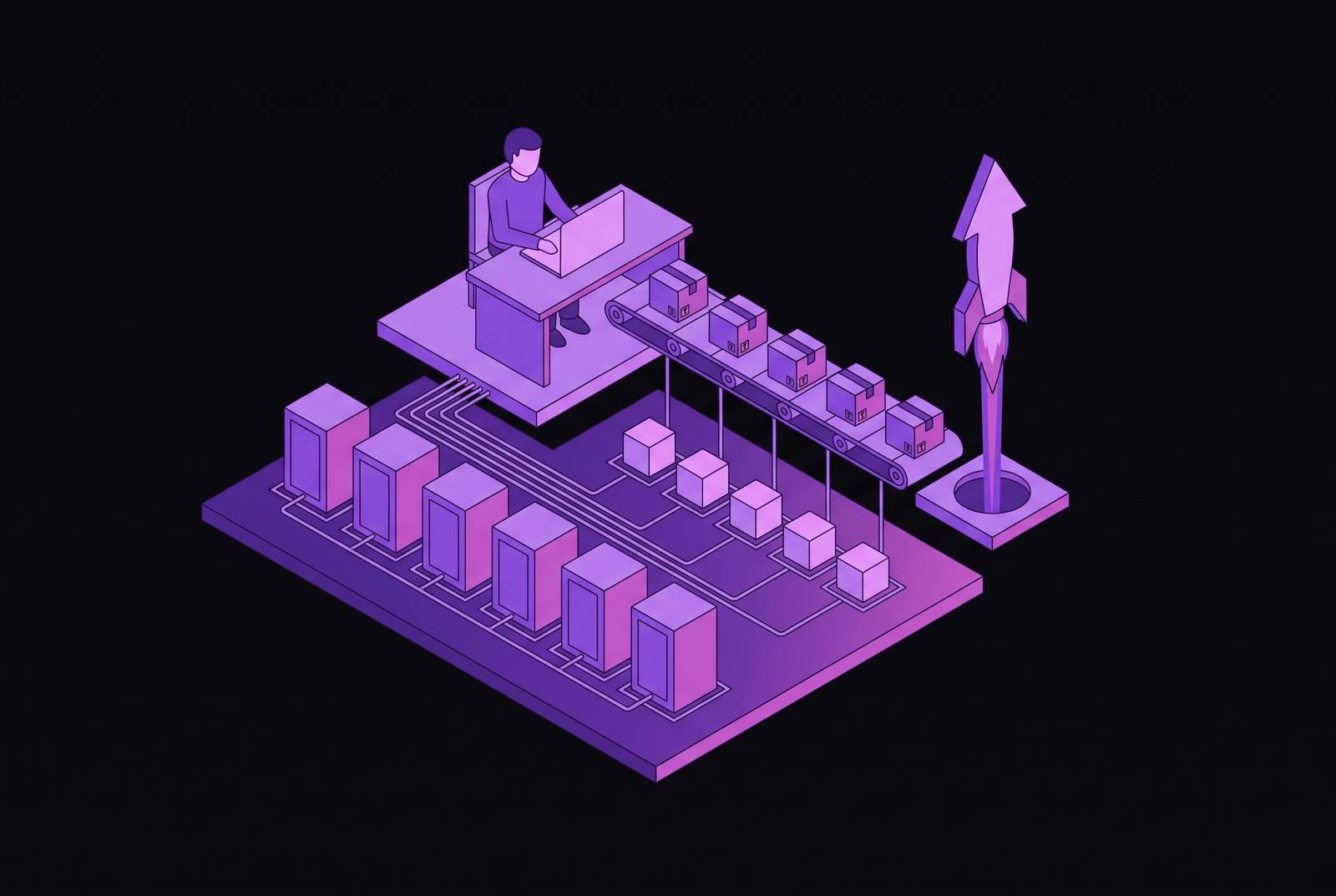
Solo founders can deploy AI agents without knowing how to handle software operations or infrastructure by using managed hosting that takes care of provisioning, uptime, recovery, and isolated customer environments. The agent is a separate choice from the platform that runs it. The fastest path to a paying customer is not a more elaborate setup, but one that stops demanding the founder’s attention.
The economics that made headcount optional for solo founders
A complete AI agent stack now costs a fraction of what a single junior hire costs annually. That changes the unit of scale for a solo-founded business. More execution no longer has to mean another employee. Sam Altman, Jensen Huang, and Satya Nadella have each publicly framed this as a structural change. The agent becomes a unit of leverage that a founder can add without building a team around it.
That shift turns agent hosting into a business decision. Getting work done cheaply is worth less if every new agent gives the founder another system to look after. The subscription is only part of the cost. Now that agents do the work, a founder’s handling of the infrastructure layer can compound or collapse that leverage.
How infrastructure babysitting eats the multiplier solo founders depend on
Having agents is not the same as having agents that run themselves. A self-hosted agent brings VPS setup, Docker configuration, TLS management, uptime monitoring, and manual recovery after crashes. None of that work produces revenue by itself. It also leaves the founder to get work moving again whenever the environment fails.
The hidden tax includes attention as well as maintenance time. An interruption breaks the focus a founder needs to decide what to do with a product, work through customer feedback, or finish a release. A short repair can therefore cost more than the time spent performing it. With dozens of agents, that dependence also makes the founder the stack’s single point of failure. The person responsible for the business is now responsible for keeping every worker available.
Infrastructure has to run an agent successfully and keep the founder off the critical path after launch, during recovery, and when another customer arrives. Otherwise, every increase in agent output comes with another claim on the founder’s attention. Boring infrastructure is a productivity prerequisite.
How can a solo founder deploy AI agents without managing infrastructure?
Stripe made it possible to take payments without becoming a payments company. Boring agent hosting applies the same division of labor. The founder delivers the product while the platform handles enough of the machinery underneath it to keep operations from becoming a second job.
The practical benchmark is one API call or one click to provision an agent. Uptime, recovery, and updates belong to the platform. A healthy dashboard should not conceal a daily maintenance routine. Predictable per-instance billing also gives the founder a cost that can be modeled per client, instead of an operational bill that becomes harder to understand whenever something breaks.
The same standard extends to security and customer separation. Encryption in transit and at rest, SOC 2 certification, and isolated customer environments remove work that would otherwise fall back on the founder. Isolation also contains a problem within one instance. These are criteria for choosing hosting that each managed service must be evaluated against. The useful comparison is how much responsibility remains with the founder after deployment.
The agents solo founders are actually deploying: Claude Code, Codex, OpenClaw, Hermes, and OpenCode
Claude Code and OpenAI Codex serve different coding workflows. Claude Code fits local implementation, focused refactor loops, and policy-heavy changes, while Codex fits parallel background delegation, multi-thread work planning, and broad research and execution batches. The choice need not be exclusive. A founder can split work between them. As of late 2026, their different architectures make workflow fit more useful than a blanket preference.
Codex also appears as an agent provider inside enterprise IDE workflows. In that setting, the decision extends beyond which interface a developer likes. Model constraints, approval hooks, and MCP servers can be configured per repository. The agent has to fit the rules surrounding the work. That is a different question from whether the founder wants to maintain the environment where it runs.
OpenClaw, Hermes, and OpenCode are also in active production use. OpenClaw and Hermes are general-purpose agent runtimes, rather than dedicated coding agents like Claude Code and Codex. Once an agent runs in an isolated, persistent hosted environment, its usefulness can be judged by its output.
How the integration layer — Gmail, Slack, WhatsApp, GitHub, and many other tools — changes what a solo founder can delegate
An agent that can reason but cannot act on business services leaves the founder doing the last step. Drafting is not delegation when someone still has to transfer the result into another system. Authenticated access to Gmail, Slack, GitHub, Notion, Jira, and Salesforce is a separate problem from hosting. The runtime keeps the agent available. The integration layer lets it perform work where the business actually operates.
Composio addresses that layer with pre-authenticated toolkits exposing tens of thousands of individual tools under an MIT licence. Its connected accounts isolate credentials per user, so each customer’s agent acts for the right person. Keeping OAuth token handling for every integration separate from the founder is especially important when the same product serves multiple customers. A working connection for the founder alone is not yet a repeatable customer workflow.
The production examples show what this removes from a day. A Gmail and Notion pipeline checks each morning for emails with specific keywords and creates tasks with email metadata, so the founder no longer has to sort those emails and enter those tasks by hand. A GitHub and Linear sync creates an issue when a pull request opens with a specific label, removing a coordination step. A Xero and Slack workflow checks overdue invoices daily and posts each client’s name, amount, and days overdue. The founder receives the financial alert without assembling it. Managing these integrations at the platform level makes delegation permanent.
Per-user agent isolation as the architecture that lets a solo founder scale without re-entering the loop
A shared runtime can turn one customer’s problem into a wider operational incident. Per-user isolation keeps that risk in check by giving each customer a separate environment. For a company of one, containment is essential. The founder cannot afford to check how each failure affects other customer instances. Isolation is therefore a minimum architecture for staying out of operations.
Each customer’s environment retains memory and context across sessions, rather than requiring the founder to reconstruct it when the customer returns. Managed isolated instances are also available at monthly prices that a founder can afford for each client.
AWS brought Bedrock AgentCore to general availability in October 2025. Its Bedrock Agents “Classic” entered maintenance mode and closed to new customers as of 30 July 2026, with AWS directing customers toward AgentCore. Microsoft Foundry Agent Service hosted agents became available for general use in July 2026. These moves confirm a market direction toward managed, isolated runtimes, rather than establish one vendor as the answer for every founder. The concrete expression of that direction is automatic onboarding through one API call that provisions one isolated, persistent customer agent without founder intervention.
Turning an agent stack into a customer-facing product: white-label infrastructure and the margin it creates
Once deployment is repeatable, an agent stack can become a customer-facing product. That requires an isolated runtime per client, the founder’s brand, and an API or dashboard for provisioning at scale. The customer need not see the underlying platform. With white-label infrastructure, the founder owns the visible relationship through branding, billing, and support. The hosting layer supplies the execution environment.
The margin depends on what happens after the sale. If every client adds monitoring, patching, and recovery work, the founder is selling a service that takes more and more work to maintain. Knowing what the infrastructure will cost does not, by itself, remove that work. Operational independence is what allows repeatable delivery without adding a matching amount of founder labor. Healthy agent instances that do a large share of the work each week can also show investors that the business uses its money well without spending its runway on early hires.
Branding terms affect those economics too. Chatbase charges a substantial annual fee to remove its branding, with full white-label access behind an enterprise contract. A platform that includes white-label capability by default removes that separate cost. However, commercial fit does not settle data sovereignty. For enterprise buyers with data-residency or zero-data-leave-the-VPC requirements, founders need to understand where a managed platform runs customer data before pitching it.
Security and compliance as the infrastructure layer that unlocks enterprise and regulated customers
Managed infrastructure does not have to trade safety for simplicity. Encryption in transit and at rest, role-based access controls, and audit logging are baseline requirements for a production agent. A founder needs more than their own word that a personal VPS setup is secure to give customers independent assurance. SOC 2 Type II is a de facto gate for enterprise SaaS contracts, even though it is not a legal requirement. A managed platform can supply infrastructure assurance that would otherwise be a substantial separate undertaking.
Healthcare and finance bring additional requirements, including HIPAA and PCI compliance. Ventus AI shows the operational value of handling them. Its SOC 2 Type II certification and full HIPAA compliance with BAA execution let agents carry out more than 3,000 claim status checks a day for Smilist without exposing PHI, work that would otherwise require multiple full-time coordinators.
Composio holds SOC 2 Type II attestation and ISO 27001:2022 certification, extending the available assurance beyond the agent runtime. One platform’s certification still leaves questions to answer about a customer-facing product. The opportunity is to build on managed controls and documented assurance, rather than have enterprise sales depend on a solo founder constructing the entire security foundation.
What solo founders actually do with the attention they recover
The gain is a workday with fewer forced changes of direction. When onboarding provisions an agent automatically, the founder can keep working on the product without stopping to set up another environment. When the invoice workflow posts its alerts, the founder can act on the information. When billing is predictable, pricing a customer does not require guessing how much maintenance that customer will create.
That leaves attention for decisions agents cannot take over from the founder, including strategy, taste, customer relationships, and which direction to build. These need more time to think than the gaps between alerts allow. Niche service agencies, micro-SaaS products, AI-powered consulting, and vertical-specific automation compete on the results they deliver and the relationships they build. Dario Amodei named proprietary trading, developer tools, and highly automated customer service as likely fields for the first billion-dollar solo-founder company. In each, the proposed advantage is knowledge and speed.
The practical rhythm is less dramatic than that prediction. Customers onboard, integrations run, and the day starts with a product decision. The founder can judge what the business should do next without first repairing its ability to work. The fastest-shipping solo founders are the ones whose hosting has stopped being a topic, leaving shipping as the only variable left.