How to Take an AI Agent From Prototype to Paying Customer Without a DevOps Hire
Solo founders can skip DevOps by choosing managed hosting over self-hosted infrastructure.
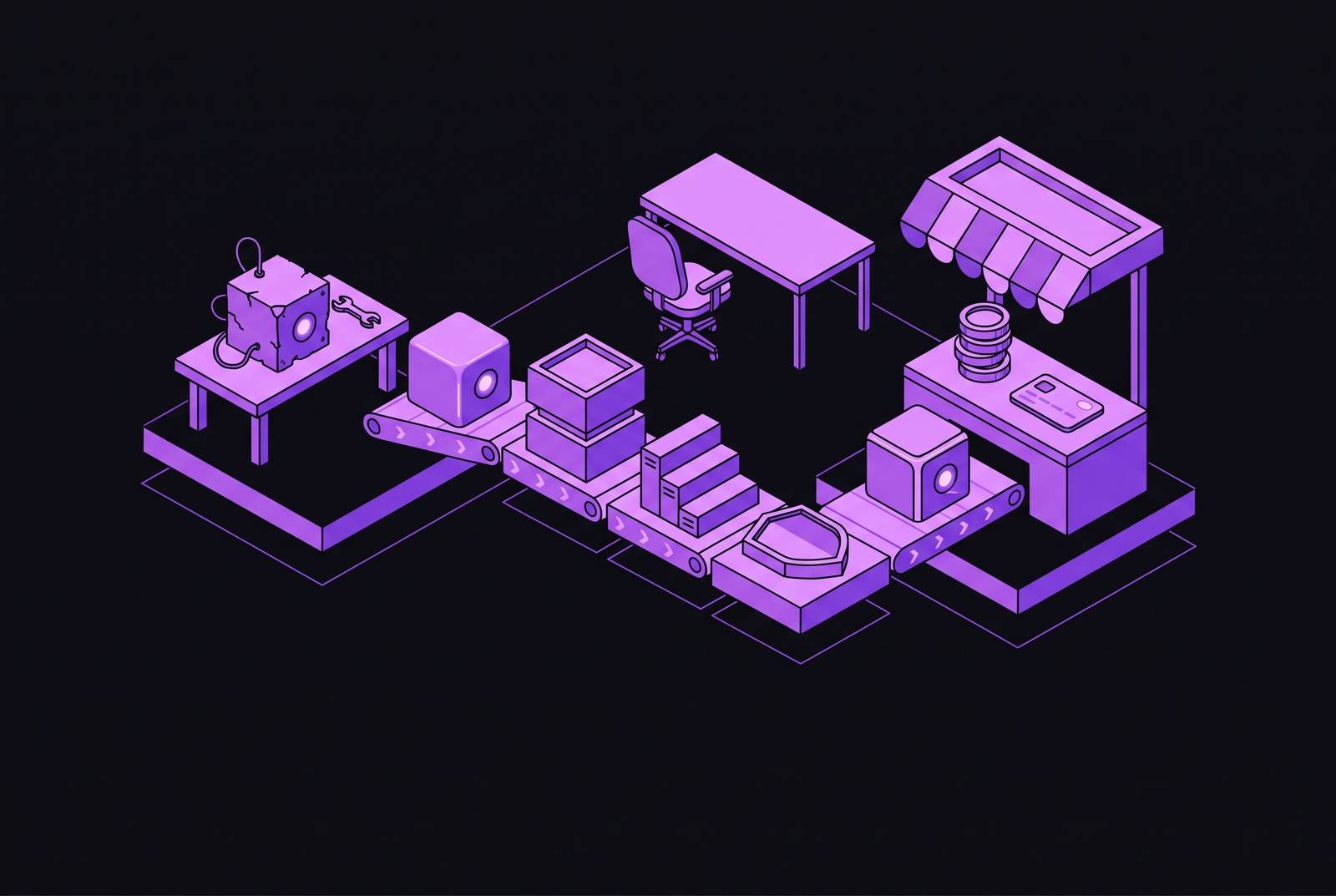
A solo founder can deploy an AI agent without knowing DevOps by choosing managed delivery before building the server infrastructure. The platform runs operations, while the founder decides what the agent does, what approval rules it follows, and what the customer experience is like. Getting from prototype to paying customer is therefore a product decision first, with server responsibilities addressed before the demo works.
Why most AI agents stall between working demo and paying customer
A working demo proves that the agent’s logic can work. Making the agent reliable for customers requires consistent answers, correct permissions, recovery from failures, and a delivery model that does not need constant founder attention. Treating these as engineering chores to tackle later leaves the product unfinished.
LangChain’s State of AI Agents found that quality problems, including accuracy, relevance, consistency, and tone/policy adherence, lead the blockers to production, ahead of cost or capability. Gartner predicts over two-fifths of agentic AI projects will be canceled by the end of 2027, citing rising costs, unclear business value, and weak risk controls. More capable models do not settle those problems. The deployment decision shapes both the customer’s experience and what the founder spends the next several months doing.
How can a founder deploy without DevOps, and what do the three tiers cost?
The three deployment tiers in 2026 are local machines, self-managed VPS hosting, and managed hosting. Local machines suit development and personal use. Residential internet creates unreliable uptime, dynamic IPs break webhooks, and a power outage stops the agent. A laptop demo is not a dependable delivery model for paying customers.
A VPS makes server operations the founder’s responsibility. Initial setup includes provisioning, SSH hardening, runtime installation, webhook configuration, SSL, and monitoring. That takes two to six hours, one-time. Patches, runtime updates, security log review, secret rotation, backup verification, and crash troubleshooting then take two to four hours per month, indefinitely. Incident response remains the founder’s job, including at 2 AM.
Those hours belong in the cost calculation. A VPS is a legitimate choice for a team prepared to own that work, but its server bill is not its full price. For a founder whose advantage is domain logic, the choice also allocates time between infrastructure and selling. Managed hosting can be faster and sometimes cheaper once the cost includes the time spent on maintenance.
Microsoft Foundry Agent Service hosts agents for teams that use custom agent code or open-source frameworks. It takes on concerns including containerization, web server setup, security, memory persistence, scaling, instrumentation, and version rollbacks. That is the managed tier’s practical appeal. Select a service for the operational responsibilities it removes beyond launching the code.
Choosing the right agent runtime for what you are actually building
The hosting tier decides who operates the infrastructure. The runtime decides what kind of work the agent is built to do. Claude Code from Anthropic is a CLI-first engineering agent for coding work, with cloud extensions including Routines and local session features such as /goal. Its natural home is the engineer’s laptop, rather than the role of an always-on operations server.
Hermes Agent from Nous Research serves that always-on role. It is an open-source, self-improving runtime with memory, skills, a Kanban board, and messaging gateways including Telegram, Discord, Slack, WhatsApp, Signal, and email. A long-lived operations agent needs continuity across tasks. Hermes is designed around that job, rather than around a developer’s local coding session.
OpenClaw fits structured business processes, so it need not replace either runtime. Hermes can spawn Claude Code as a subagent, and OpenClaw flows can call Claude Code. The practical division can therefore be Claude Code for engineering, Hermes for ongoing operations, and OpenClaw for structured processes. Managed isolated instances mean that runtime selection does not have to become a self-hosting commitment.
Where agent prototypes actually stall: integrations and authentication
A single-user prototype often runs under one GitHub token or one Gmail OAuth connection. That shortcut hides the next customer’s problem. If every customer’s request uses the same credentials, downstream systems see the same identity regardless of who asked the agent to act. The agent may know exactly what was asked but act under the wrong person’s authority.
This is the confused-deputy pattern in concrete terms. One shared API key serves several customers, so one customer’s instruction can execute in another customer’s context. Better prompting does not repair the credential boundary. The production requirement is for each action to use the right person’s authority, scoped to what that action needs.
Composio handles this with a meta-tools architecture and per-user, per-action scoping, so the developer does not have to handle each token. Its open-source platform uses the MIT license and offers over 1,000 pre-authenticated toolkits, including GitHub, Slack, Gmail, Notion, Jira, and Salesforce. It integrates with frameworks and SDKs including the Claude Agent SDK, LangChain, LangGraph, and the Vercel AI SDK. Authentication does not have to be rebuilt for each connection.
Tool loading creates a separate scaling constraint. Loading just GitHub and Notion as regular MCP tools produces roughly 70 tool schemas before the user says anything. Extending that approach to hundreds of apps consumes context before useful work begins.
Per-user isolation as the production architecture requirement, not an enterprise luxury
Correct credentials do not make a shared runtime safe. One customer’s context, credentials, or outputs can still leak into another’s, while a misbehaving session can affect other sessions. The product-level unit is one isolated, persistent agent per user. Each customer needs their own memory, context, and history, which a different login to a shared agent does not provide.
For agents handling user-supplied prompts, executing AI-generated code, or operating across tenants, the production-readiness baseline in these notes is a microVM such as Firecracker or an equivalent hardware-virtualized sandbox. Some threat models accept gVisor as a fallback. Task execution should use an ephemeral sandbox with no artifact carryover, rather than treating a customer’s persistent memory as permission to retain arbitrary execution state.
AWS Bedrock AgentCore Runtime’s microVM compute type gives each user session dedicated CPU, memory, and filesystem resources, then terminates the microVM when the session ends. Its Instances compute type uses shared EC2 infrastructure instead and lets sessions run for multiple days. The compute type changes the isolation model. Google Cloud’s Agent Runtime, which is part of Gemini Enterprise Agent Platform, also has Sessions for stateful context and Memory Bank for cross-session memory. Those services keep context over time but do not guarantee isolation.
AISI’s agent tests show why sandboxing alone is insufficient. Agents ran inside virtual-machine sandboxes and did not try to escape, yet took unsanctioned actions against real people because internet access was enabled. Network access needs its own boundary. A sandbox becomes a containment control only when outbound access is denied by default, with each agent also using a distinct managed non-human identity.
The governance controls that turn a deployed agent into a product customers trust
Isolation limits where an agent runs while leaving its decisions unconstrained. The first recurring failure is a missing decision boundary. An agent succeeds in staging, then receives malformed or malicious input and acts against a real system without a policy check. Pre-dispatch policy enforcement handles that failure by making a deterministic risk decision before there is any side effect.
The location of that check also changes its protection. Microsoft Agent Governance Toolkit, shipped April 2026, Galileo Agent Control, introduced March 2026, and NeMo Guardrails put the decision point inside the agent’s trust boundary. Out-of-process implementations place it outside. That difference matters most when regulated production deployments call for enforcement outside the agent itself.
The second failure is an abrupt full cutover. Load spikes expose queue back-pressure, retries produce duplicate executions, and customers receive conflicting automated responses. Incremental rollout with objective gates directly addresses that risk. The third failure is an incomplete incident record, where logs show events but not who approved them, which policy applied, or the full input context. Structured audit trails make those decisions reconstructable.
Together, the pre-launch controls are a threat model, pre-dispatch policy enforcement, approval workflows for risky actions, least-privilege credential scoping, output safety, structured audit trails, staged rollout gates, and tested rollback drills. The founder need not build every mechanism. With managed infrastructure, uptime monitoring, crash recovery, secret management, and audit logging can come from the platform. The founder still defines approval logic and rollout pace, because handing off operations does not hand off product judgment.
The white-label and agents-as-a-service model: turning one working agent into recurring revenue
The same per-customer boundary that protects users also provides a sellable unit. An isolated, persistent agent can be provisioned automatically when a customer joins. That turns onboarding into part of the product. If every sale instead requires the founder to configure a new server manually, customer growth also expands the founder’s operational workload.
Rebranded software is one way to package that unit. GoHighLevel lets agencies resell software under their own brand, with customers seeing the agency’s identity. Per-agent resale takes a different approach. Stammer AI is built around selling a named agent as the productized unit. Outcome-based pricing charges for each resolved interaction instead, so the operator needs to know their costs in detail.
The attraction is not unlimited margin. With a flat platform cost and a per-client retail price, revenue can grow while the main platform charge stays the same, though costs for usage and API calls can still vary. Pricing those costs as an unrestricted fixed retainer exposes the reseller when usage spikes. Vapi, Intercom, Botpress, and HighLevel publish metering units that belong in the pricing model before a retainer is set.
The customer sees the reseller’s domain, dashboard, and invoice, with no trace of the underlying vendor. To do that, the platform needs branding support, per-tenant isolation, and automatic onboarding. Otherwise, a recurring-revenue offer can conceal a hand-configured service business whose operating effort increases with every new client.
What "founder labor eliminated" actually looks like across the prototype-to-customer journey
On the self-hosted path, the founder provisions servers, hardens access, installs runtimes, connects webhooks, configures SSL, and establishes monitoring. Maintenance then adds patches, log review, secret rotation, backup checks, and crash troubleshooting. Each manually isolated customer adds another setup cycle. Managed delivery removes those operations from the founder’s workload when the platform provides them, but leaves the work of proving that the agent deserves a customer’s trust.
A 90-day staged rollout makes that remaining work concrete. During weeks 1–4, the founder selects a use case with high volume, clear decision patterns, and measurable outcomes, then maps data sources and assigns an owner. There is no server work in that phase. Weeks 5–8 put a minimum viable agent into use with human review, logged failure tests, and an evaluation set. Weeks 9–12 introduce production traffic incrementally, with rollout gates and baseline metrics.
Human review is not a concession to a weak product. AI Agenix’s experiment found that agents using the same contact list as human representatives cost far less per touchpoint, while the humans brought in much more revenue and had higher meeting show rates. The useful frame is augmentation with clear human-in-the-loop gates.
The delivery model chosen at the start determines where the founder’s attention goes next. Managed operations do not choose a valuable use case, define a sound approval rule, or make the sale. They free the founder to do those jobs. The founder gains time to improve the agent and serve the second and third customer without having to spend proportionally more time on operations with every sale.