Human-in-the-Loop Checkpoints in Autonomous Multi-Agent Workflows
Place human checkpoints before consequential agent actions, not routine reads.
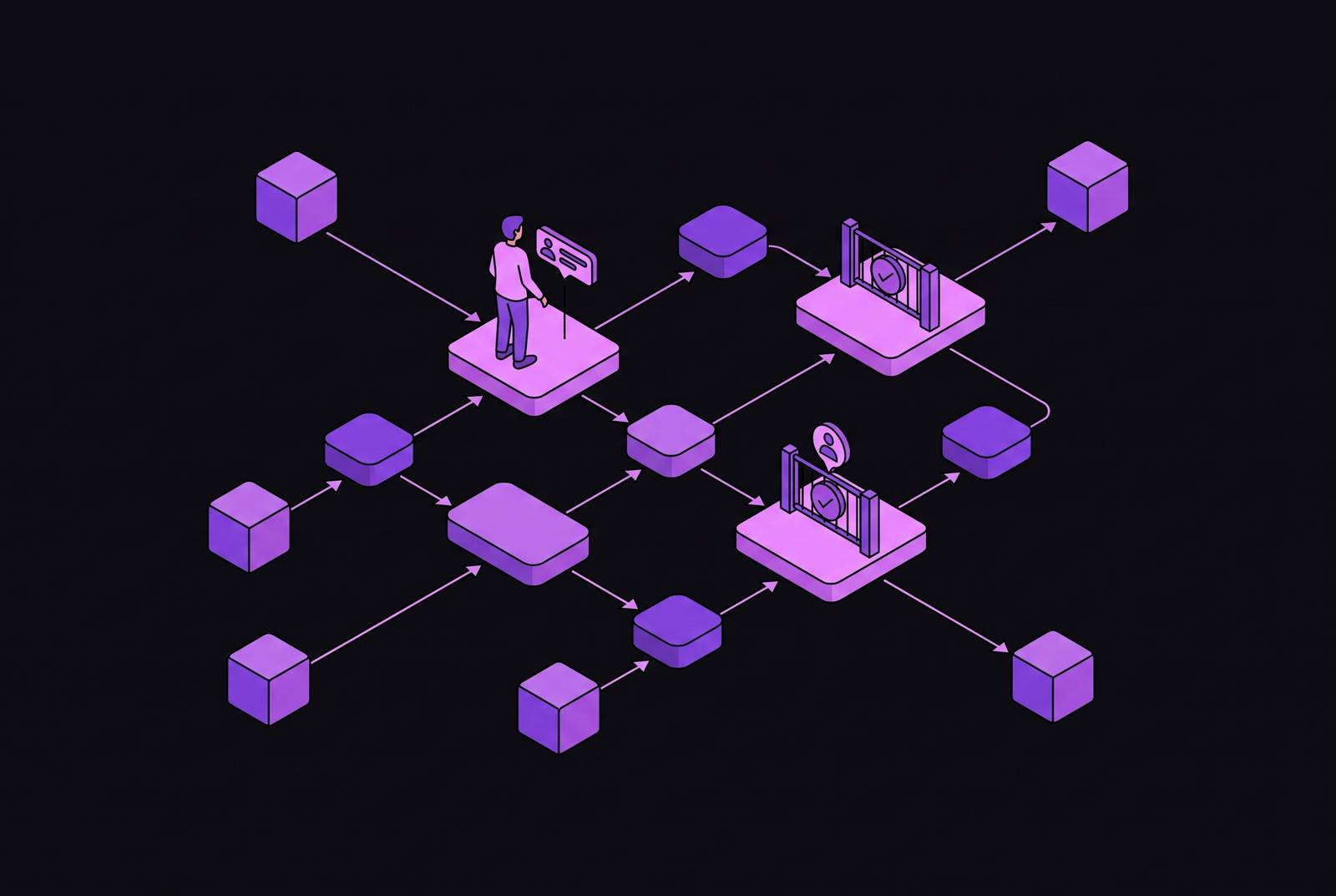
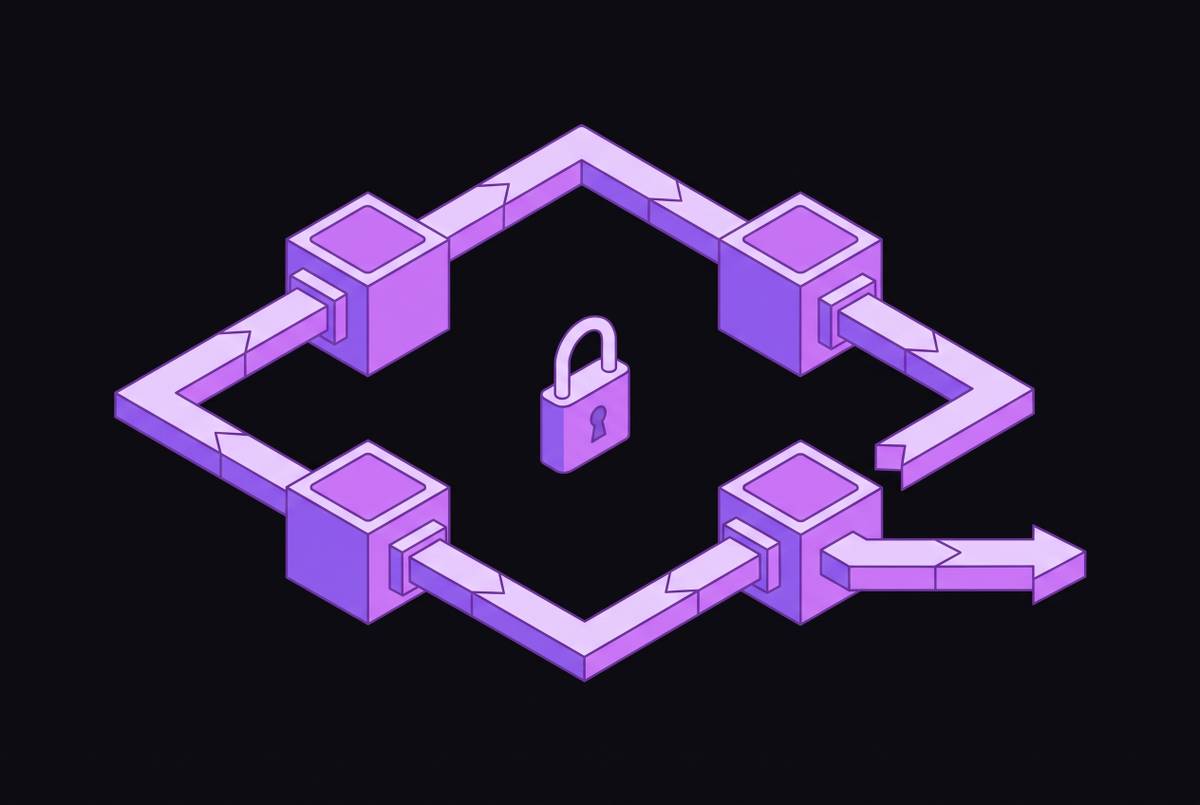
Human-in-the-loop checkpoints in autonomous multi-agent workflows work best at the boundary between preparing an action and carrying it out. The practical rule is to let agents read and investigate freely, then pause before consequential writes. Human attention belongs where an error would change the outside world.
Why autonomous agents fail at the write step, not the reasoning step
An agent works fine for weeks, then something goes sideways. It sends the wrong customer message, issues the wrong refund, or changes a record that takes hours to reconstruct. Nothing stood between a confident wrong answer and an action with consequences. Production safety depends on that missing boundary as well as on the quality of the model.
An agent can sound just as certain when guessing as when correct. Without a gate, a bad decision at step three changes the context for step four, which feeds incorrect information into step five. By the time a human notices, the root cause is buried upstream. A wrong summary is usually cheap to correct while it remains internal. The same mistake is harder to contain once it leads to a payment, deletion, or response to a customer.
The wrong response is to abandon automation or make a human approve everything. Neither fixes the structural problem, and the second can make automation slower than manual work. Containment also matters when agents serve separate customers. Agent37 handles provisioning, uptime, and per-customer sandboxing so teams can keep agent instances separate and spend their time on the gates themselves. Isolation limits the scope of a failure, but it does not replace approval before a consequential action.
The reads-vs-writes split as a principled checkpoint rule
The first design decision is to separate work that gathers or prepares information from work that changes state. Searching a knowledge base, checking an order status, retrieving account data, and drafting a recommendation belong on the read side. Issuing a refund, sending an email, updating a financial record, deleting data, and committing code belong on the write side. Let the former proceed autonomously in ordinary cases. Put a human gate before work on the write side when a wrong action has a real cost.
A refund workflow makes the boundary concrete. The agent retrieves order history and prepares a refund proposal without waiting for approval. A checkpoint can sit between that proposal and the step that issues the refund. This leaves the investigative work with the agent while giving the human control over the moment money moves. The distinction is not whether a step calls an API, but whether its result costs money, damages a relationship, or requires difficult repair.
That rule preserves speed because it does not treat every intermediate output as a decision requiring oversight. It also gives builders a clear place to start when a broad call to keep humans involved gives them little to work with. Pulling PII or reading regulated health data can itself carry consequences. The split is therefore a useful first pass that still requires judging the particular action.
Three tests for identifying which specific steps warrant a checkpoint
The irreversibility test asks how hard a wrong output would be to fix if nobody caught it immediately. In the refund workflow, retrieving order history does not itself issue money, while approving the proposed refund crosses into a consequential write. A customer email creates another boundary because a sent message is nearly irreversible. By contrast, an internal CRM tag is easy to undo. The harder the repair, the stronger the case for a checkpoint before execution.
The confidence threshold test then asks whether this kind of input reliably produces uncertain or variable answers. A refund agent can be told to flag low-confidence proposals for human review because some orders are less clear than others. That makes the checkpoint dynamic for cases where selective review is appropriate. Standard cases can stay out of the queue for cases that are unclear. But the irreversibility test still applies when confidence is high, so a consequential write may need approval even when the agent sounds certain.
The external visibility test asks whether someone outside the internal workflow will see or receive the result. Preparing a refund recommendation keeps the output inside the system, while issuing the refund or sending the customer a response exposes it externally. These tests work independently and can stack. An uncertain, irreversible, customer-visible action is a strong candidate for mandatory approval. A reversible, reliably accurate, internal step can instead run autonomously with periodic audit, avoiding a manual queue where review adds little.
Multi-agent handoffs as the highest-risk moment in a pipeline
A handoff changes the status of an agent’s output. What was a recommendation from agent A becomes the starting context for agent B. If B is responsible for a consequential next step, an upstream mistake can turn into action before a human sees either decision. The spread of the error makes the boundary between A’s output and B’s intake a natural place to consider review.
In a refund pipeline, passing along what an agent found differs from giving another agent grounds to issue money. Reviewing the handoff before execution can catch a flawed proposal before downstream work compounds it. This is different from inspecting each agent in isolation. The description of each agent’s task may leave out some of the risk that comes from linking them. Checkpoint placement must therefore follow the path from information to action.
Delegation assigns a sub-task to a specialized agent that works autonomously within its scope. Escalation transfers a step to a human because the agent has reached a limit. A sub-agent can absorb work, but handing work to it is not human oversight. As pipelines grow, even five agents can create many more handoff moments, so builders need to distinguish routine delegation from transfers that warrant a gate.
Four checkpoint patterns and how to combine them without building a bottleneck
Pre-execution approval gates give the most control because they stop an agent after it has investigated but before it acts. They also create the most friction, so they belong on irreversible or high-consequence writes. Review and correction loops serve a different need. The agent produces a complete draft or analysis, and a human edits it before approving its use. This pattern suits external communications because the reviewer is expected to improve the output.
Exception escalation, also called confidence-gated routing, lets standard cases go ahead while sending cases that are unusual or uncertain to a human. Review demand follows ambiguity. Periodic audits apply lighter oversight by letting the agent run and having a human inspect a sample on a schedule. They suit work with lower stakes, where mistakes can be fixed before they cause harm outside the workflow. Unlike pre-execution approval, an audit does not stop the particular action under review before it happens.
A workflow can combine these patterns without applying all of them to every step. It can gate the highest-consequence writes, escalate uncertain middle-ground cases, and audit routine reads. If every action requires approval, the agent has merely moved the manual process into a queue. As that queue grows, reviewers start approving without reading. More checkpoints then produce less meaningful oversight.
The approval screen must show the proposed action, why the agent chose it, the supporting information, and what approval will cause. Persistent per-customer environments, including those from Agent37, help teams track checkpoints and keep audit trails for each customer’s separate workflows. That infrastructure supports review, but cannot compensate for an empty approval prompt. A good checkpoint is one a reviewer can clear in seconds because everything needed is already on the screen.
How the HITL system should be architected separately from the agent application logic
Embedding approval logic inside each agent creates repeated work and inconsistent behavior. Every new workflow needs another implementation, and auditing requires examining each application separately. A separate HITL component gives those workflows a common interface. The agent signals that it needs a human decision, the component manages its delivery, and the response returns as structured input. The application remains responsible for its task rather than also owning the entire human interaction process.
Cheng and Cheng’s decoupled HITL architecture names four dimensions, namely intervention conditions, role resolution, interaction semantics, and communication channel. Intervention conditions define when a checkpoint fires. Role resolution determines which person or group receives it. Interaction semantics specify the information presented and the response expected. The communication channel determines how the request and decision travel between the system and the reviewer.
State must be kept while that exchange takes place. LangGraph’s interrupt() pauses the graph, stores state through a checkpointer, and waits for an external decision before execution resumes. Quinto et al.’s semantic persistence model proposes keeping workflow definitions, instances, inference records, context snapshots, and dependency relations as persistent, queryable knowledge objects. This creates an inspectable decision chain. Building that trail from the start makes oversight easier to audit and avoids reconstructing it after an incident.
How autonomy level and action consequence should move together as trust develops
A checkpoint policy should change as evidence accumulates, but not simply because an agent has been running for a while. Safin and Balta’s work on autonomy and agency treats freedom to act and the consequences of action as coupled design choices. As human correction becomes less available, the scope of autonomous action needs corresponding limits. A system that only reasons over supplied context is not taking the same risk as one that commits changes to authoritative records.
New routes, agents, and action types should start with pre-execution approval gates. When a happy path works, it still leaves other ways that a route could fail untested. Trust then accumulates for that route. Reliable refund decisions on one order type can justify less oversight there without justifying the same treatment for new order types or edge cases.
The operating mechanism is a shift from mandatory approval to confidence-gated routing and auto-approval with audit. Routes that consistently clear without correction can graduate, freeing reviewers to handle genuinely uncertain cases. But that change must be reversible. Errors, a new integration, a regulatory shift, or a new data source can justify tightening the gate again. Progressive autonomy is not a one-way ratchet, and its goal is not to eliminate human oversight but to concentrate it where it changes outcomes.
How do you give every customer an isolated agent environment as the product scales?
The checkpoint framework assumes there is infrastructure capable of running it. That assumption becomes harder to satisfy when a product moves from one agent and one workflow to a separate agent for each customer. Each instance needs persistent state across pauses, an audit trail, and a way to route decisions to the right reviewer. A founder can hand-configure a small workflow, but cannot give every growing queue the same personal attention. The number of action types, handoffs, and customer contexts grows faster than the time the founder can give them.
Per-user isolation therefore supports both security and meaningful oversight. Keeping each customer’s tools, files, and credentials in a separate sandbox helps contain the scope of a compromised credential. It also gives teams a separate environment for tracking that customer’s paused and completed work. The operational burden includes provisioning, uptime, recovery from mid-workflow failures, and updates that preserve in-progress checkpoint state. These are running costs of the approval system, even though they sit outside the approval screen.
For teams that do not want to build that deployment layer, Agent37 provides managed per-user agent sandboxes with isolated, persistent instances provisioned automatically at onboarding. Its platform handles uptime and state persistence across checkpoint pauses, with integrations including Gmail, Slack, WhatsApp, and GitHub via Composio. This supplies the infrastructure while leaving the team to decide which actions need approval. The Stripe analogy is useful in that limited sense, since managed infrastructure lets a team provide a capability without becoming the infrastructure business behind it. The product team’s job remains to define where gates fire, what reviewers see, and which routes have earned more autonomy.