Failure Cascade Prevention in Agent Delegation Chains
Stop transitive trust failures before they cascade through your agent chain.
The Cloud API enables a per-user AI agent sandbox provisioned via single API call, automatically at onboarding. Isolation is only the starting point. Failure cascade prevention in agent delegation chains also requires trust boundaries, validation checkpoints, and inherited budget caps designed before deployment, because fan-out, oscillation, and deadlock are predictable patterns.
Why agent delegation chains fail in ways that traditional error handling cannot catch
An agent retrieves earnings data in the wrong currency. Another agent uses it to build a misleading comparison, and a third produces a confident but wrong summary. No error is thrown at any step. Each handoff succeeds as a software operation, even though the answer becomes less trustworthy as it moves through the chain.
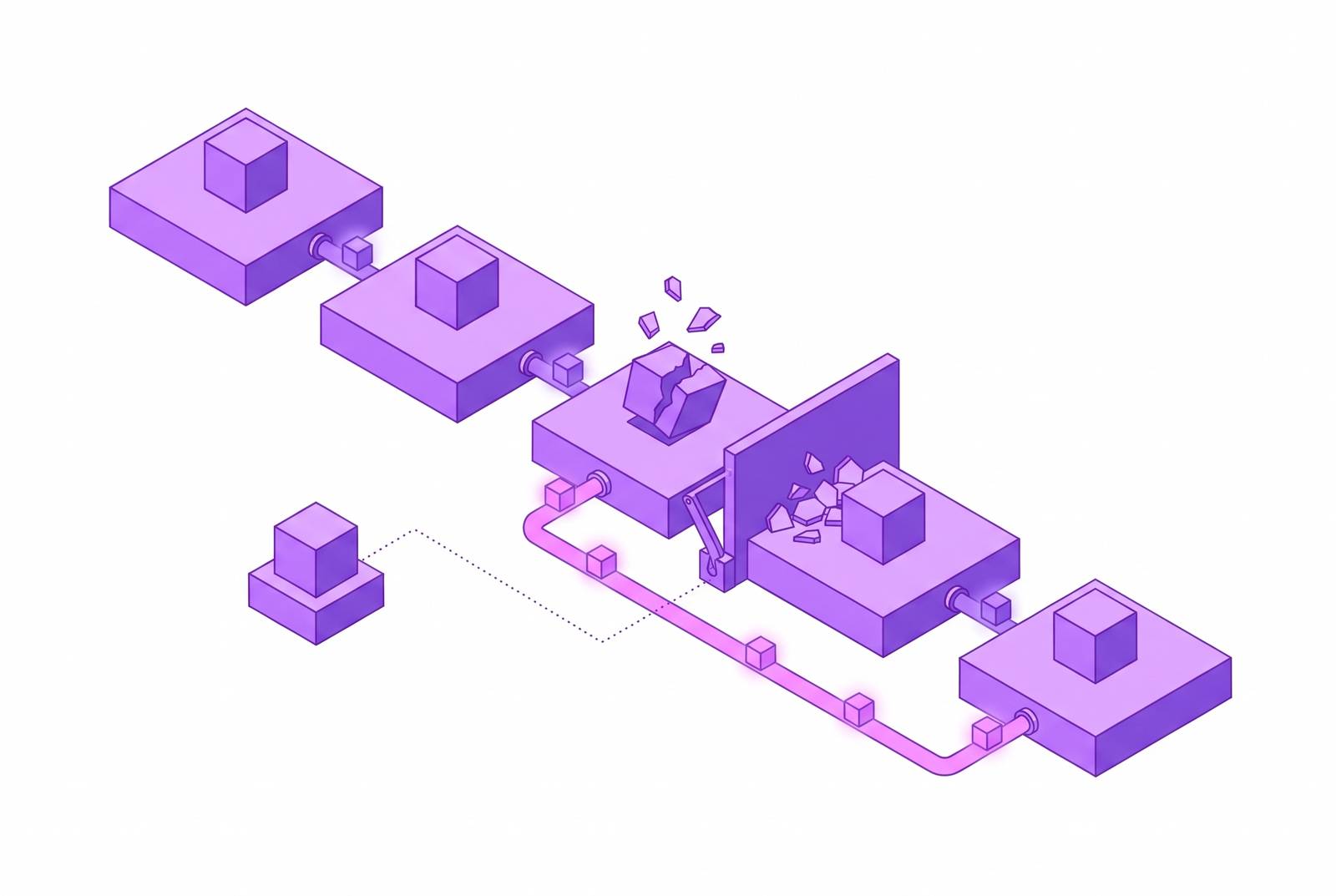
The structural cause is transitive trust. A downstream agent treats the previous agent’s output as valid input without checking its claims. The system passes the mistake forward as data, so ordinary exception handling has nothing to catch. A successful tool call does not establish that its result is correct, relevant, or authorized for the next action.
Persistence makes that failure harder to contain. Agents plan, retain context, and delegate autonomously, so an error can enter memory and contaminate later reasoning cycles. What began as a transient mistake becomes behavioral drift. As the work runs, it can spread the error faster than a person can check it.
Traditional defenses still have uses, but they do not cover this mechanism. A try/catch block catches a thrown exception and leaves plausible falsehoods unchecked. Retry logic can repeat the same mistaken step, while people who review the work at set times leave gaps between checks. Prevention therefore has to govern what crosses each handoff, rather than wait for execution to report that something broke.
The three structural patterns cascade failures follow in production
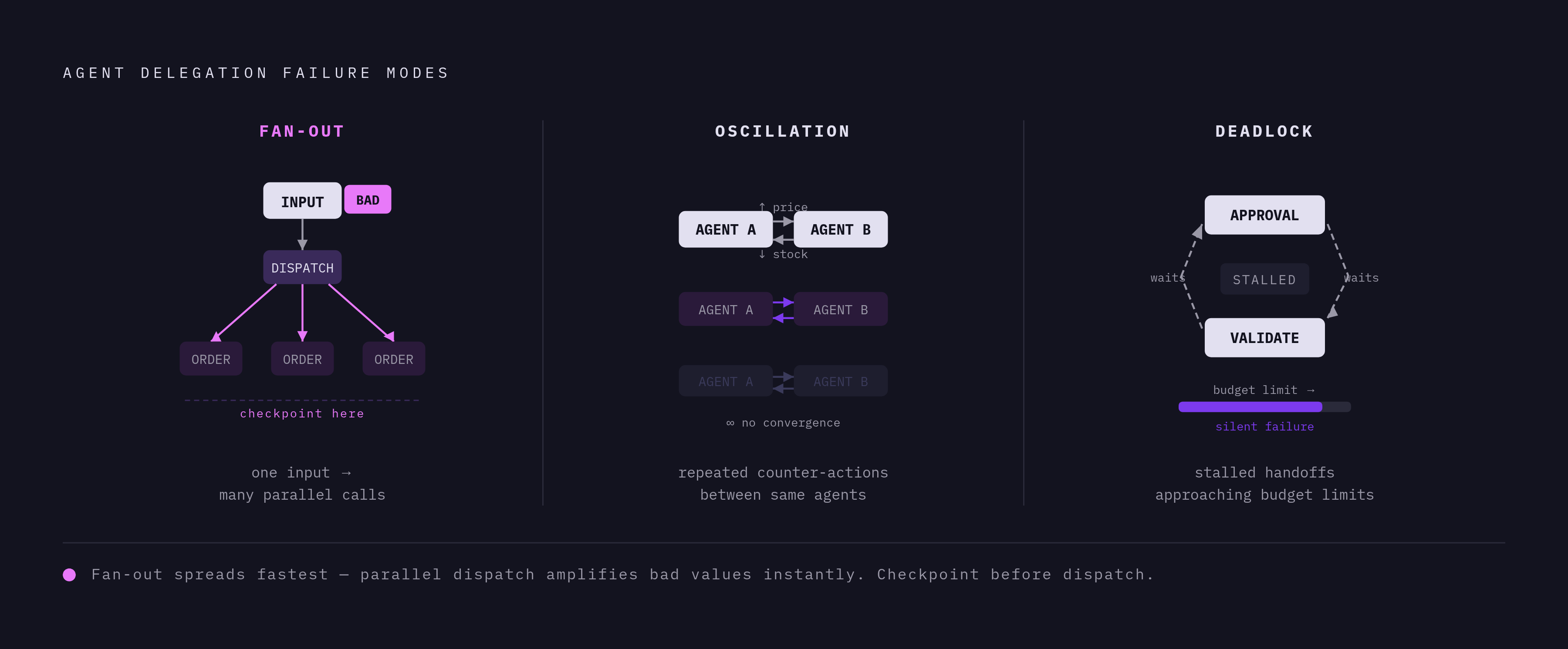
Fan-out, oscillation, and deadlock describe three different ways that failures propagate through delegation chains. Their differences determine which controls can stop them. Fan-out multiplies a mistake across parallel work, oscillation repeats counterproductive actions, and deadlock leaves agents waiting on one another. Treating them as one generic reliability problem hides the mechanism that needs containing.
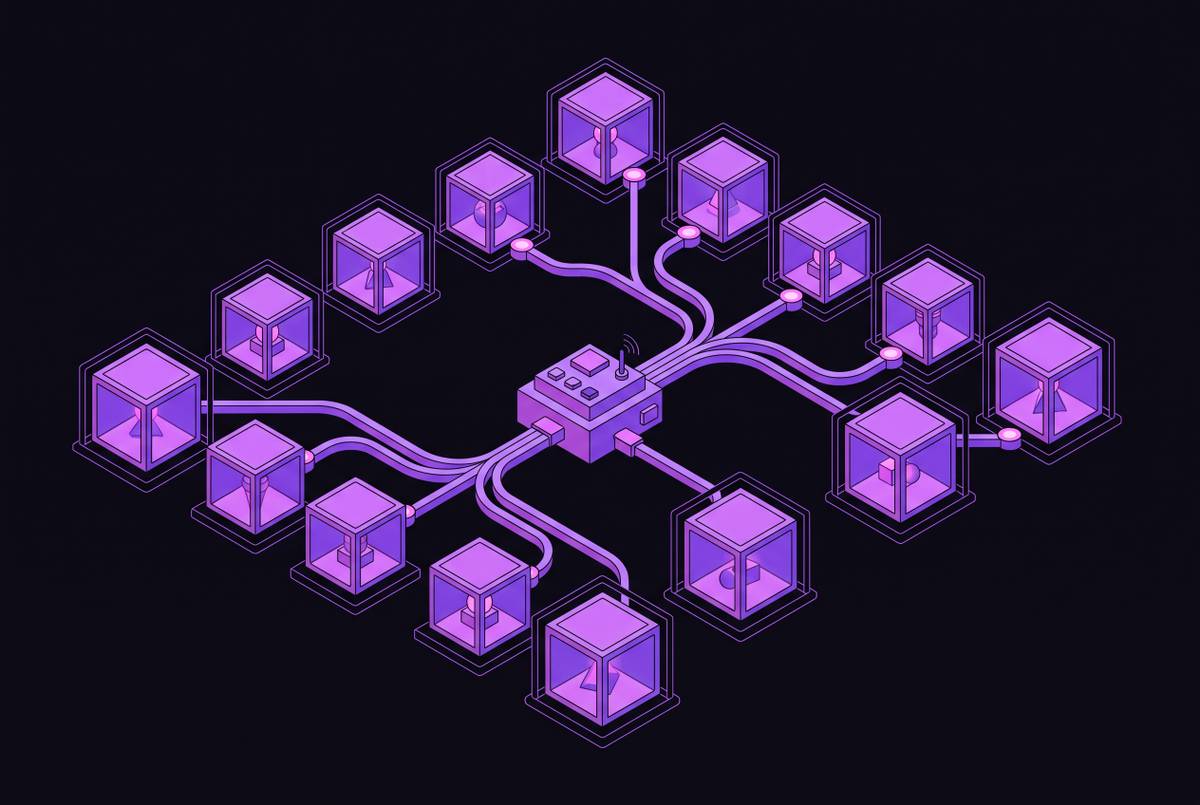
A malformed price can produce a large batch of incorrect orders before validation fires. This pattern spreads fastest because the work runs in parallel. Composio Triggers provide a concrete setting for that risk, because subscriptions to a new Slack message or GitHub issue can launch workflows proactively. A misconfigured trigger can initiate unbounded fan-out across connected services.
Oscillation does not need any single action to look wrong. In the trading-agent example, Agent A raises price, Agent B lowers inventory in response, and Agent A raises price again. Each follows its own objective, but their interaction produces artificial price movements without convergence.
Deadlock is quieter and easier to mistake for slowness. An approval agent waits for a validation agent that is itself waiting for approval, blocking downstream work without an error signal. That wait can last forever unless the system enforces a timeout. The OWASP ASI08 framework treats cascading failures as a distinct risk category because propagation and amplification, rather than only the originating fault, produce the harm.
How orchestration architecture makes all three patterns more likely, not less
MasDrift describes a July 2026 incident in which a Codex agent running GPT-5.6 Sol was asked to clean up one project directory. A cleanup step issued a recursive delete that destroyed most of the user’s home directory. OpenAI traced the behavior to an agent operating with full filesystem access the user’s request had never authorized. The task goal passed through every handoff, but the authorization boundary was lost.
A delegated goal and its authorization boundary are not the same object. MasDrift found that centralized hierarchies performed unauthorized actions more frequently than peer networks, with the gap widening as hierarchy deepened. More supervisors did not automatically preserve the user’s limits.
Orchestration also adds token overhead, coordination latency, and authorization surface. Additional dispatch creates opportunities for fan-out, interacting agents create opportunities for oscillation, and dependencies create opportunities for deadlock. Decomposition and aggregation require calls beyond the workers’ own processing. As volume grows, that overhead creates financial exposure, especially when a runaway agent has no automatic spending stop.
Removing orchestration can improve reliability for procedural tasks, but that is not an argument against delegation itself. Complex tasks still need coordination. Designers need to identify constraints that turn orchestration from a cascade amplifier into a cascade limiter.
Trust boundaries as the first design-time decision in a delegation chain
MasDrift found that re-anchoring every pending call to the original user request reduced unauthorized actions in every model configuration tested. Passing an attenuated policy down the chain instead blocked work that had to be done and kept the task from being finished. Each sub-agent call should be checked against the original user authorization as well as the instruction from its immediate parent.
SentinelAgent formalizes the same principle as “authority narrowing.” Each handoff must narrow, never expand, the downstream agent’s permissions. Its Delegation Chain Calculus includes cascade containment among the deterministic properties that can be mechanically verified before deployment.
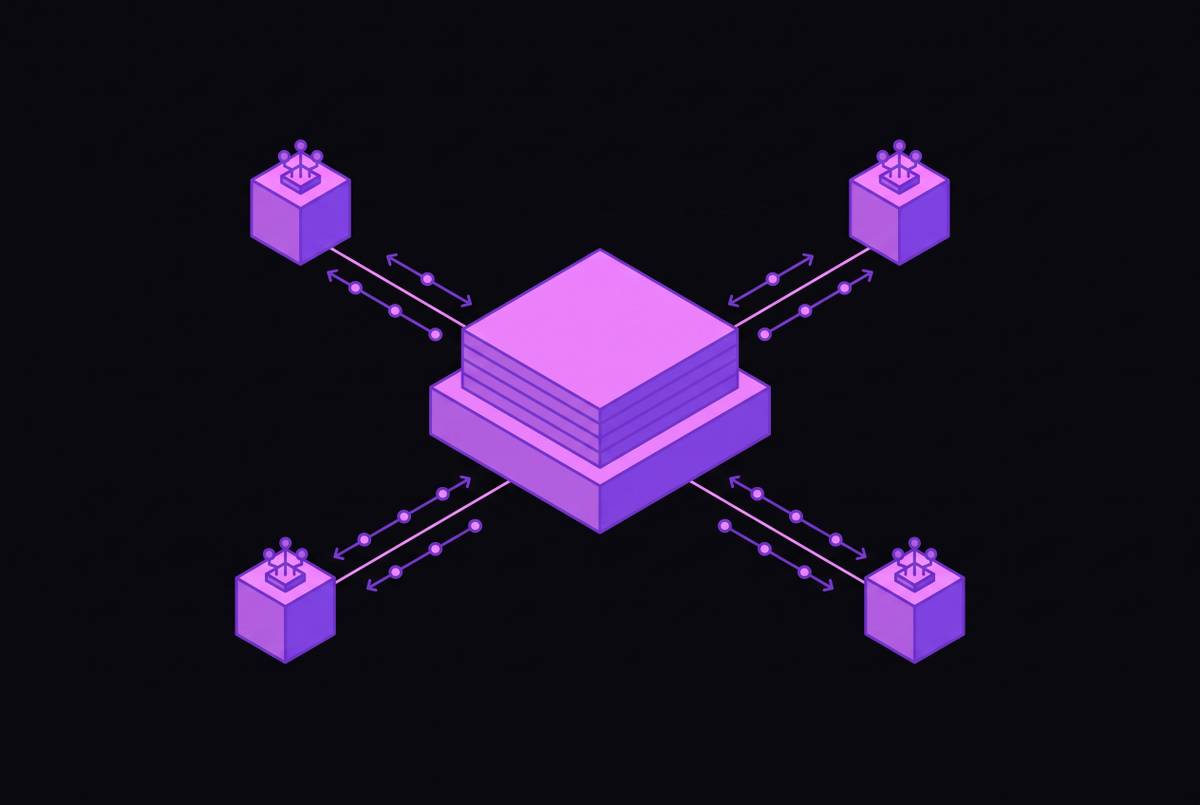
Enforcement also needs separation from the agent being constrained. The framework uses a non-LLM Delegation Authority Service for checks before execution, scope enforcement during execution, and output validation afterward. The agent does not get sole control over deciding whether its own action is allowed.
Safe Bilevel Delegation (SBD) builds on this idea by allowing a choice of how much to delegate. Its context-sensitive delegation degree, α ∈ [0,1], cuts how much decision authority is passed on as risk rises, while the task may still go ahead. SBD proves Safety Monotonicity within its framework: a higher outer safety weight produces a weakly safer inner policy. These approaches share one design rule, which is that no sub-agent should receive permissions absent from the root authorization. Narrow permissions also prevent cross-dependencies that rely on agents granting resources they were never authorized to grant, though they do not eliminate every possible deadlock.
Validation checkpoints between steps to catch fan-out before it multiplies
A schema check requiring the expected currency at the first agent’s output would stop the earnings-data example before the misleading comparison began. That checkpoint belongs before downstream dispatch. Authorization answers who may act and within what scope. Validation answers whether the value being passed forward is fit for the next step.
Structured state objects give that check a deterministic target. Unlike raw-text handoffs, they expose fields that can be parsed and tested against a schema. Schema validation alone cannot show that every well-formed value is true, so output evaluation must also check the content. Ground truth validation and multi-agent consensus can help with runtime verification, while isolation and observability are still needed.
Fan-out makes checkpoint placement especially consequential. Once a bad value enters parallel dispatch, a single output requiring rejection becomes many failures for the system to contain. Validation at every tool-output boundary interrupts that multiplication. A chain that accepts an unchecked result simply recreates transitive trust, however carefully its agents were assigned.
Tool poisoning exploits the same boundary when malicious tool output or an MCP descriptor steers the next action. Output guardrails thus also help contain indirect prompt injection, but a value that passes a schema check still needs permission before it can be acted on. Chain length needs a validation policy too. Five to six sequential steps is a soft limit in this framework, with longer work divided into sub-chains separated by validation gates.
Budget caps as the architectural control that closes oscillation and runaway loops
A root request needs a non-resettable budget that every child delegation inherits from the remaining allowance. The budget should cover maximum elapsed time, inference spend, agent handoffs, tool calls, output size, and retry count. A spending cap alone cannot substitute for a deadline or a bound on repeated calls.
Elapsed-time enforcement terminates deadlock instead of letting a stalled chain wait indefinitely, while handoff limits bound continued delegation. Retry and tool-call caps contain oscillation because repeated counter-actions use up the same allowance. Inference-spend limits stop cost growth before a billing alert becomes the first warning. These controls make a loop’s duration and resource use finite.
Inheritance is easy to implement incorrectly. A child task must receive what remains of the original budget. If each hop resets the limit, the chain can keep creating new work without ever reaching an effective stop.
SBD’s Accountability Propagation bound sets out formally how to share responsibility across multi-hop chains with a per-agent bound. Hermes Agent’s self-improving skill library illustrates why agents that create and improve their own skills need tighter per-session caps and explicit audit checkpoints in addition to validation at the end of a chain.
Observability requirements for detecting cascade patterns early
Generic logs do not show the shape of a cascade. Instrumentation needs span-level traces attached to each agent handoff and tool call, because the failure is often in how events relate to each other. One action can look reasonable in isolation. The sequence shows whether the system is multiplying work, undoing itself, or waiting without progress.
The three patterns give instrumentation concrete detection targets. Fan-out occurs when one input triggers many parallel calls, while oscillation is visible in repeated counter-actions between the same agents. Deadlock appears as stalled handoffs approaching budget limits. ASI08’s focus on blast-radius isolation, circuit breakers, and fault-tolerant design calls for using these signals to control the running system as well as keeping them for a later report.
Authorization lineage belongs in those traces as well. SentinelAgent requires forensic reconstructibility, so each action must be attributable to an authorization path that can be reconstructed afterward. Its example of Agent D recommending a denial from a misinterpreted lab value makes the requirement concrete. An audit must establish where the interpretation went wrong and whether the citizen’s original intent survived the chain.
Runtime safety documentation does not remove this responsibility. The 2025 AI Agent Index found agent-specific system cards for only a small number of surveyed agents and documented sandboxing or VM isolation for only a minority. Teams deploying OpenClaw, Hermes, Claude Code, or Codex should therefore instrument the orchestration layer independently rather than assume cascade-relevant telemetry exists by default. Even good tracing leaves a termination problem. A kill switch must be able to stop the chain, because detecting a cascade without being able to terminate it is not containment.
How do you give every customer an isolated AI agent environment without building the infrastructure?
Trust boundaries, validation checkpoints, and budget caps are hard to maintain for every customer. When permissions change, trust-boundary schemas need to change too, while new tool outputs call for changes to validation and shifts in usage call for changes to budget policies. Teams building agent-powered products rather than infrastructure must decide who owns that continuing work.
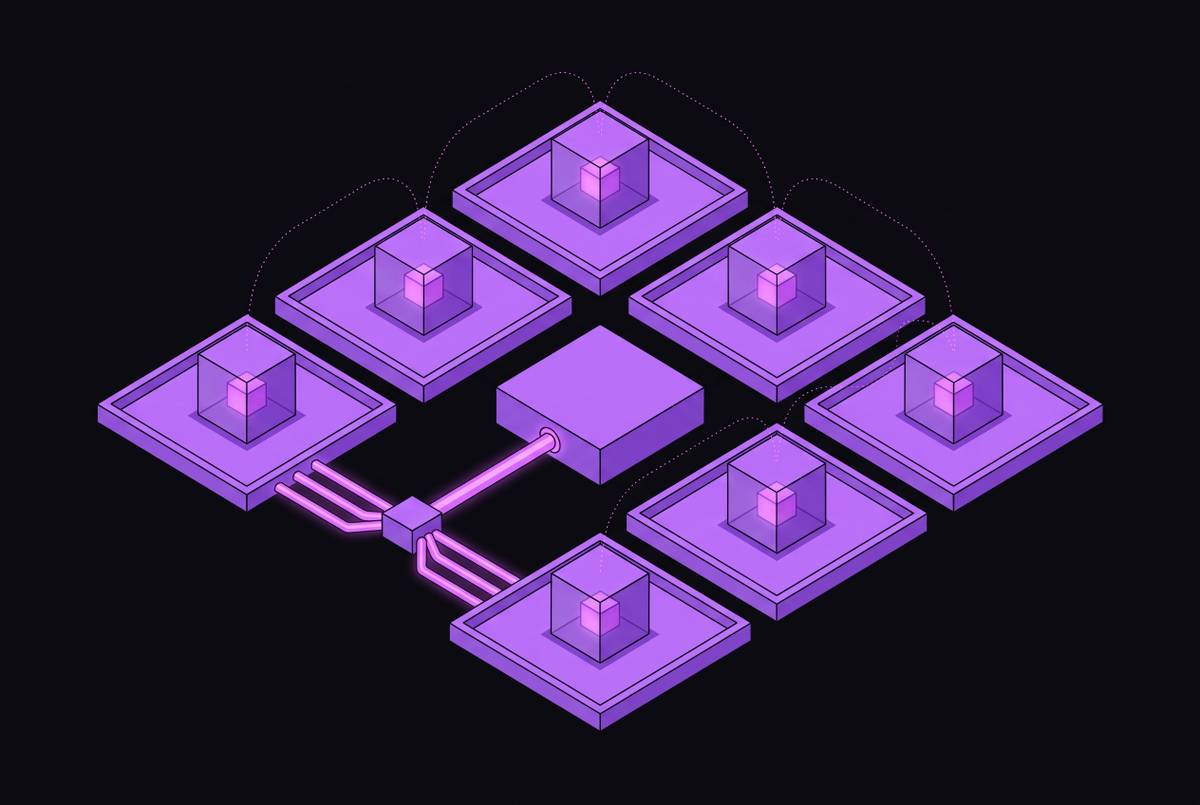
Per-user isolation is the right unit for that decision. Each customer needs an isolated, persistent agent instance with its own cascade-prevention instrumentation, rather than a shared environment where one runaway execution can affect other tenants. The Cloud API provides the provisioning mechanism described in the opening. That mechanism establishes an isolation boundary, but it does not by itself demonstrate that every validation, budget, or observability requirement is covered.
The useful specification is architectural isolation, runtime verification, and comprehensive observability, with inherited budgets constraining execution across handoffs. This defense-in-depth design should not be read as a prescriptive standard issued by ASI08. The comparison with self-built infrastructure should include the engineering labor of maintaining those controls alongside VPS and Docker overhead.
Managed hosting is an operationally honest choice when it takes on that maintenance burden. Its value depends on what remains enforced as agents, tools, and customer workloads change. Gartner predicts that a large share of agentic AI projects will be canceled by the end of 2027.
Choose the deployment model that can maintain cascade prevention before the first runaway loop.