Graceful Degradation Patterns When Primary LLM Endpoints Fail
LLM failures hide in silent quality degradation, not outages.
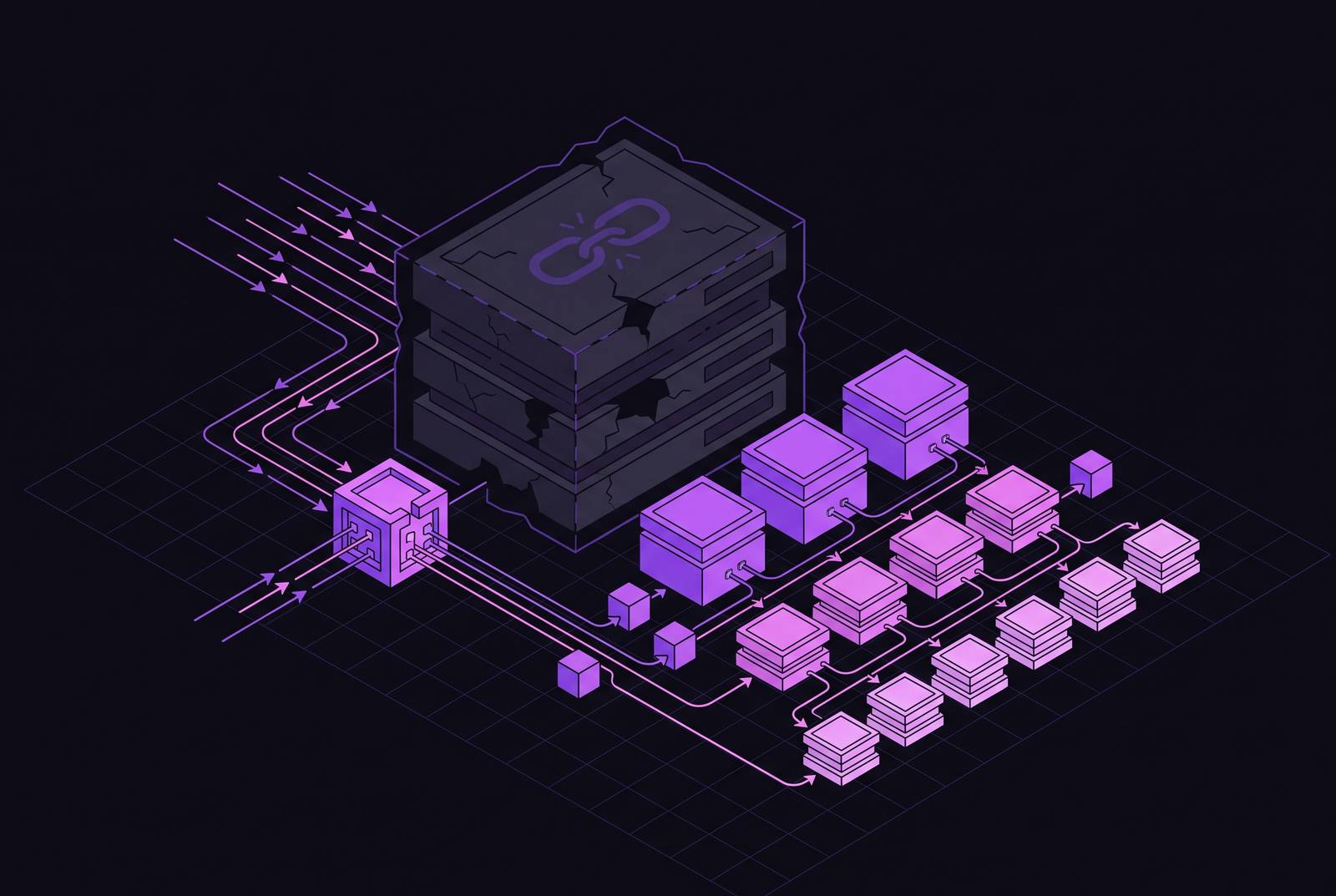
An agent calls the right tool, writes three duplicate records to the CRM, and returns an HTTP 200. The failure is in the content, not the connection, and that's what makes it dangerous.
Why LLM failures don't look like failures
Production AI agent systems don't fail the way a web server fails. An LLM can answer confidently, completely, and wrong, and nothing in the standard monitoring stack will tell you.
Four failure modes drive this problem. Fourth, tool calls themselves carry risk independent of the model's reasoning: an agent can call the correct tool with hallucinated parameters, have the call succeed, and write a corrupted record to a CRM before anything downstream notices.
Multi-step workflows make the fourth mode worse. Unless the system uses explicit saga patterns designed for exactly this, the retry itself becomes the cause of the damage.
This is why distributed-systems engineering built for conventional infrastructure, the kind that gives us CAP theorem, Paxos, Raft, doesn't transfer cleanly here. Zylos AI's 2026 research on graceful degradation frames the issue directly: LLM APIs violate that assumption systematically, because the failure isn't binary. A provider can be up, responding, and billing you, while producing output that's functionally broken.
Rate limits cause most of this. Analysis of LLM API traffic from February 2026 found that the majority of LLM API errors trace back to rate limits being exceeded. There's no clean moment where the lights go out. The system just gets worse, gradually, while every individual request still looks like it's being handled.
How silent these failures are in production
The dominant failure mode in production agent systems is an agent that stays online and gives wrong answers, a failure type that standard infrastructure monitoring was never built to catch.
Dashboards built around uptime and error rates show green across the board while users are quietly receiving bad output. The failure lives at the level of meaning, not at the level of status codes, and most monitoring stacks never look there.
The gap appears at the enterprise level too. Businesses building on top of that assumption are exposed in a way their existing SLA paperwork doesn't cover, and that exposure is starting to register as real cost.
Quality failures outnumber outages by a wide margin. The systems built on top of them were failing on their own terms, because agents misunderstood each other, not because the lights went out upstream.
The clearest demonstration of what happens when availability planning is treated as optional came in June 2026, when a US Commerce Department order forced a sudden change in model access. The two outcomes diverged because of architecture, not luck. It was architecture decided months earlier.
Why simple retry logic is the wrong starting point
Retry with exponential backoff is the obvious first fix, and it's a real one: for a transient rate-limit error, waiting progressively longer between attempts solves the problem it's designed to solve.
The correct shape of a retry is exponential backoff with jitter: wait an increasing interval between attempts, then randomize that wait by a meaningful margin. Zylos AI's graceful degradation research documents this pattern directly in multi-agent systems, where dozens of agents can share a rate limit boundary without realizing it.
Retry logic also needs to know when to give up. A system that can't tell transient and permanent failures apart will keep knocking on a locked door.
Even when retry works exactly as intended, it only solves for availability. Quality has to be checked separately from whether a call succeeded. Validation sits next to retry logic, not inside it.
There's a cost dimension too. Without a guardrail on spend, a retry storm hitting GPT-4o can multiply costs well before anyone on the team notices the bill.
Circuit breakers adapted for LLM systems
Retry logic decides what to do about a single failed call. Circuit breakers decide whether to keep sending calls to a provider. A circuit breaker that only watches for HTTP errors misses the failure mode that matters most here, a provider that's up, responding, and answering badly.
The standard pattern has three states. HALF-OPEN means the breaker sends a single test request to check whether the provider has recovered before opening the gates back up. That pattern was built for binary failure: a server error, a timeout, a dead connection. A circuit breaker protecting an LLM call has to trip on schema violations, hallucinated function signatures, and outputs that fail a held-out evaluator, not just on server errors.
A circuit breaker can key on a single model string, or it can key on the whole provider. Zylos AI's research describes this as per-provider request queues, each with its own overflow policy: drop, block, or error.
In a multi-agent system, circuit-breaker state has to be shared, not local to each agent. A router node checks a shared set of failed services before it delegates work to any agent or tool. A circuit breaker that only watches error rates, without a quality evaluator feeding into it, will let a fallback chain fire against a provider that's technically healthy and semantically broken at the same time.
Building a fallback chain that degrades quality gracefully rather than silently
A fallback chain without a quality check is silent substitution, which can do more damage than an error message ever would.
The core objection has to be dealt with up front: a prompt template tuned for one model can return garbage on a different one. A visible 503 tells the user something broke. A silent model swap that degrades quality tells the user nothing, which is strictly worse.
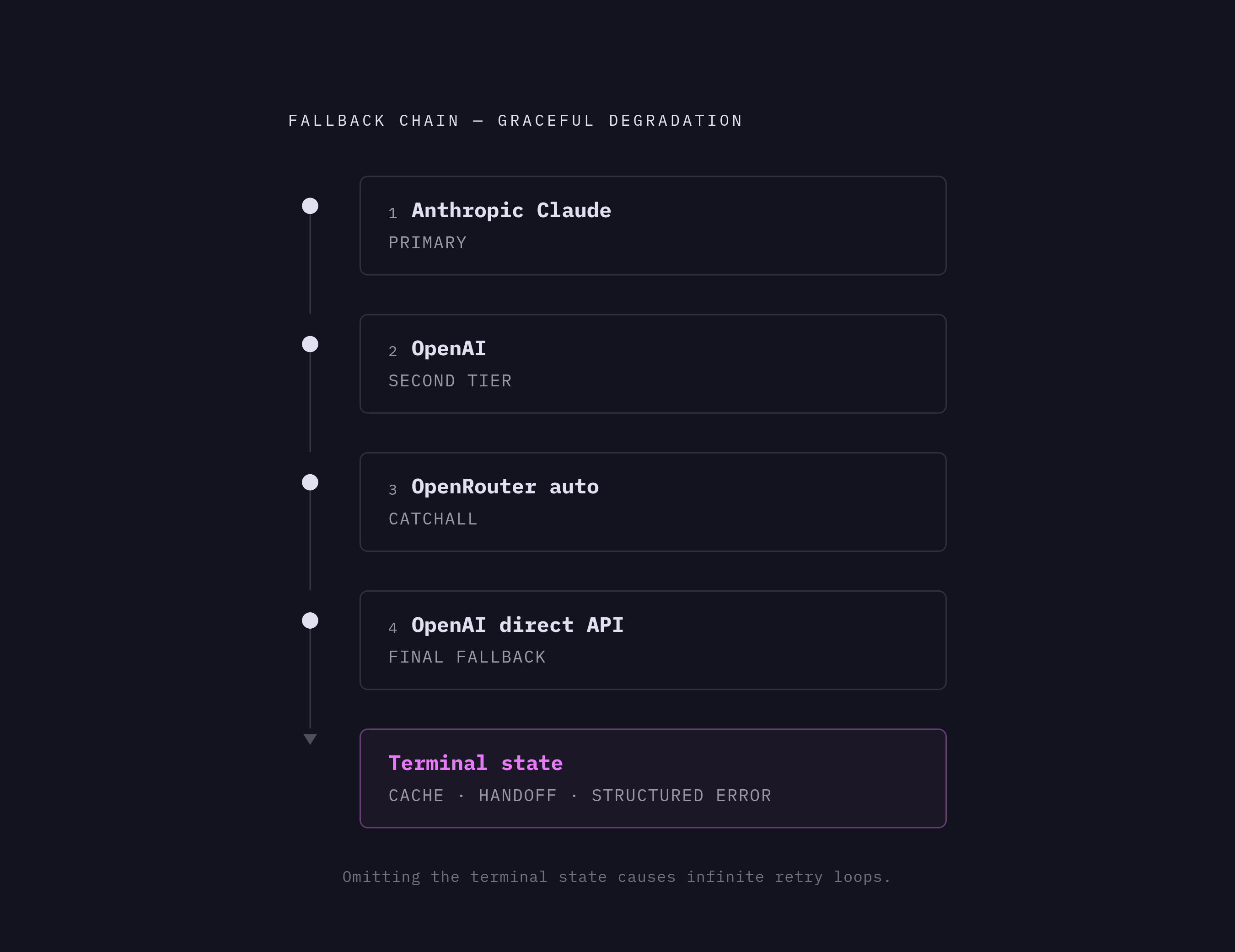
A well-built fallback chain is tiered, trading capability for availability one step at a time. One developer's production setup, shared publicly, lays this out cleanly: Anthropic Claude as primary, OpenAI as the second tier, OpenRouter's "auto" routing as a catchall, and the OpenAI direct API as the final fallback.
Cost has to shape the order of that chain, not just capability. Planning fallback order around economics, not just around which model is smartest, keeps an outage from turning into a budget event on top of an availability event.
Self-hosting a large open-weight model as a last-resort tier is an option worth considering, but it's not for everyone. A production-grade open-weight model takes substantial storage even after quantization, which makes this tier realistic mainly for teams that have already committed to the GPU spend elsewhere. For most teams, it's a genuine last resort, not something to build toward as a default.
The June 2026 Commerce Department order is the cleanest proof that this isn't a theoretical concern. And any fallback chain needs a true terminal state, not just a list of options to try. When every tier in the chain is unavailable, the system needs a defined endpoint: a cached response, a handoff to a human, or a structured error, rather than looping through the same exhausted options indefinitely.
Context compaction and session-state preservation across provider switches
Switching providers mid-session solves an availability problem and can create a data problem in the same breath, if the session's accumulated context doesn't travel with the switch. Without that, a graceful fallback turns into something closer to a full restart, wiping out whatever work the session had already done.
Context overflow is its own failure mode, and it has nothing to do with whether a provider is available. As an agent loop runs longer, the context it's carrying keeps growing, and once that context exceeds the model's window, reasoning quality degrades quietly, well before any API error ever fires. If it's skipped, a 20-step agent loop ends up reasoning on a corrupted, truncated version of its own history by the time it reaches the later steps. This is the same cascading-context-corruption failure named in the first section, and context compaction is the pattern built specifically to stop it from happening.
Provider switches add a second layer to the same problem. If that context was shaped for the original provider, tool schemas formatted for Claude's API, system prompt structure tuned for one specific model family, the new model may read it wrong even though nothing about the content itself has changed.
The fix is to keep session state outside the model call. The JW-ASTClaw solar telescope project, documented in its arXiv paper, shows this discipline applied in a real system: a four-level failover that moves from cloud LLM reasoning, to local inference, down to a rule-based fallback, with state carried across each level.
Zylos AI's research flags the multi-agent version of this same problem: agent-to-agent message passing breaks silently under load. A fallback tier needs a state-preservation contract, what gets serialized, in what format, and how it gets re-hydrated, decided before the first fallback ever fires in production, not improvised after it already has.
Bulkhead isolation so one agent's failure doesn't take down the rest
Circuit breakers and fallback chains operate at the level of a single call or a single provider relationship. Bulkhead isolation operates one level up, protecting the whole system from a failure that starts in just one part of it. Without it, one agent hanging on a 90-second timeout or hammering against a rate limit can exhaust a shared thread pool or connection limit and take down agents that have no relationship to the failing provider.
The bulkhead pattern partitions agents and workflows into separate resource pools, their own thread pools, their own connection limits, their own request queues, so saturation in one pool stays contained to that pool. When OpenAI starts rate-limiting, its queue fills and overflows according to that policy while Anthropic traffic keeps moving untouched.
In multi-agent orchestration, the same principle applies at the agent level, not just the provider level. Bulkheads are the mechanism that stops that corruption from crossing from one part of the system into another.
The overflow policy itself needs to match the stakes of the work sitting in the queue. This same isolation is what makes per-user agent sandboxing hold up structurally: one customer's agent hitting a provider limit or a broken tool call has no effect on any other customer's agent, because each sandbox runs inside its own resource pool.
Validation gates and human escalation as the last layer
Every degradation ladder needs a floor. Once every automated layer has been tried and none of them worked, the system has to hand the problem to a person instead of returning a wrong answer with confidence or looping through the same failed retry forever.
Validation gates do the job none of the earlier layers can: checking that an output is schema-compliant, grounded in the actual context, and internally coherent before it ever reaches a tool call. The side effect lands in production before any check afterward has a chance to catch it.
The idempotent saga pattern makes retrying a multi-step workflow safe. Without that pattern in place, retry logic at any layer of the stack risks duplicating charges, emails, or database writes exactly the way the five-step workflow example in the first section describes.
Human escalation belongs at the bottom of the ladder as a deliberate design choice, not as an admission that the system failed. Building it at three in the morning during an actual incident is how escalation paths turn into their own source of error.
The scale of what's at stake here is large. AgentStatus found that the vast majority of agents evaluated scored zero on quality checks. Only a validation gate sitting in front of tool execution can.
None of this should be invisible to the person using the system. Plain language about the degraded state lets the user decide whether to wait, try again, or escalate on their own end. For any agent-powered product serving outside customers, this ladder is the thing that actually enforces whatever quality the product promised. An SLA measured only by uptime is measuring the wrong thing, exactly as the AgentStatus numbers show.
Putting the layers together: what a complete resilience stack looks like in practice
Circuit breakers, fallback chains, context compaction, and bulkhead isolation each solve a different problem. A system running only one or two of them still has real gaps, because none of these four patterns substitutes for another.
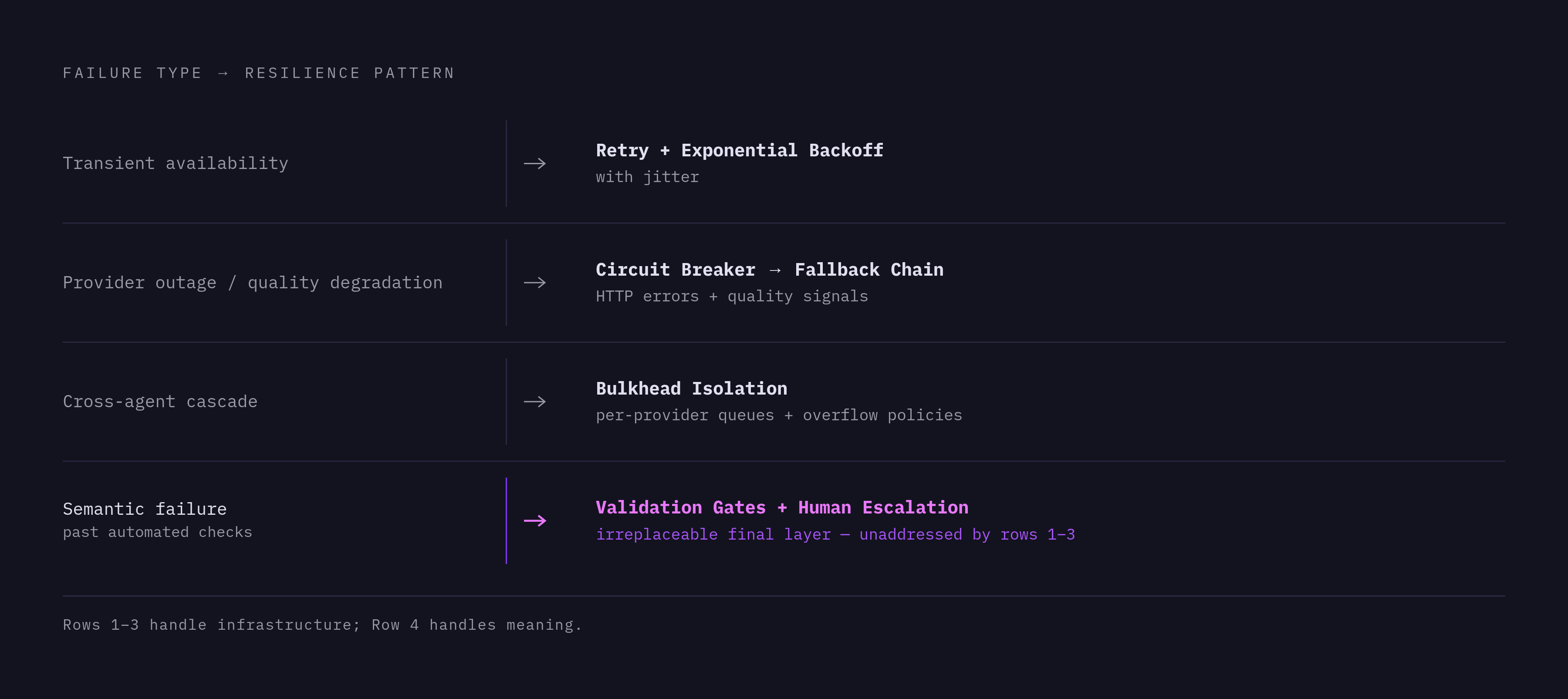
The mapping is direct. Transient availability failures call for retry with exponential backoff and jitter. Provider outages and quality degradation call for circuit breakers, watching both HTTP errors and quality signals, feeding into a fallback chain. Cross-agent cascade failures call for bulkhead isolation, built on per-provider queues with overflow policies defined in advance. And semantic failures that slip past every automated check call for validation gates ahead of tool execution, with human escalation as the defined floor.
The JW-ASTClaw solar telescope system is the clearest documented case of all of this working together at once. Without a quality evaluator and a circuit breaker layered on top of it, that chain handles availability well and leaves semantic degradation completely unaddressed.
The integrations an agent depends on to actually take action are a failure surface that's easy to overlook. Slack's token rotation limits each token to 12 hours. Managed authentication that handles token refresh centrally takes this entire failure surface out of the application layer.
A simple framework for deciding which layers a given system actually needs: any system that writes data or sends communications needs saga patterns and validation gates ahead of tool execution, full stop, no exceptions. Any multi-agent system needs bulkhead isolation and shared circuit-breaker state, not state kept separately per agent, to keep one failure from cascading into the rest.
Teams running agents on a platform that already handles uptime, monitoring, and recovery remove a meaningful share of this operational burden. The four patterns in this stack still have to be built. They just don't all have to be built by the same team solving the same problem from scratch.